
What If Every Line of Hanuman Chalisa Is Protected by Sita and Rama?
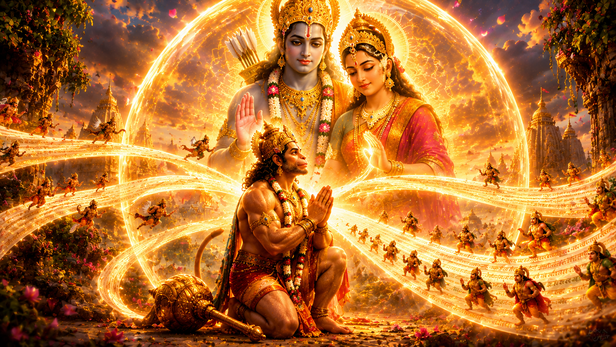
Millions of people recite the Hanuman Chalisa every day. Some do it out of devotion, some for peace, and others simply because it has become a daily ritual. But very few stop to notice something extraordinary hidden in plain sight. What if the real power of the Hanuman Chalisa is not only in its verses but in the way it begins and ends? Once you see this beautiful pattern, you may never read the Hanuman Chalisa the same way again.
The Journey Begins with Grace, Not Strength
The very first word of the Hanuman Chalisa is "Shri." At first glance, it may seem like a respectful way to begin a sacred composition. But "Shri" carries a much deeper meaning. It represents grace, prosperity, purity, and divine blessings. It is also closely associated with Goddess Lakshmi, whose earthly form is believed to be Mother Sita. Before Hanuman's strength, wisdom, or courage is ever mentioned, the Chalisa starts with grace. It quietly reminds us that every meaningful journey should begin with humility and blessings rather than power alone.
The Last Word Quietly Points Back to Lord Rama
The final word of the Hanuman Chalisa is "Bhup," meaning the protector or king of the earth. For Hanuman, there has only ever been one true king Lord Rama. Ending the Chalisa with this word is deeply symbolic. After describing Hanuman's incredible strength, courage, intelligence, and service, the composition gently brings every achievement back to Rama. It reminds readers that no matter how great one's abilities become, true fulfillment lies in surrendering them to a higher purpose.
A Hidden Frame That Most Readers Never Notice
Imagine the Hanuman Chalisa as a pair of brackets. The opening bracket is "Shri," representing Mother Sita's grace. The closing bracket is "Bhup," representing Lord Rama's divine kingship. Between these two symbols lies Hanuman's entire story his courage, wisdom, victories, and unwavering devotion. It is as if Goswami Tulsidas carefully placed Hanuman's entire life safely between Sita and Rama, showing that every accomplishment gains meaning only when protected by divine grace and guided by devotion.
Hanuman's Greatest Strength Was Never Physical Power
Hanuman could lift mountains, cross oceans, and defeat mighty demons. Yet none of these qualities defined him completely. His greatest strength was his complete surrender to Lord Rama. Every miracle he performed came from devotion rather than ego. The hidden structure of the Hanuman Chalisa reflects the same truth. Hanuman's greatness is not standing alone it is always connected to Sita's blessings and Rama's purpose. That is what transforms extraordinary power into sacred service.
The Hanuman Chalisa Mirrors Our Own Life
Perhaps this hidden symbolism is also meant for us. Every morning begins with hope, gratitude, and fresh blessings our own version of "Shri." Then comes the struggle of daily life: responsibilities, deadlines, challenges, and endless effort. Finally, every person longs to return home to peace, comfort, and loved ones. The Hanuman Chalisa quietly reflects this human journey. It teaches that life's struggles become lighter when they begin with gratitude and end with inner peace.
Why Devotees Rarely Leave the Hanuman Chalisa Incomplete
Most devotees naturally prefer completing the Hanuman Chalisa instead of stopping halfway. Beyond tradition, there may be a deeper emotional reason. The prayer begins with divine blessings and concludes by returning to Lord Rama. Leaving it unfinished can feel like leaving a meaningful journey incomplete. Reading every verse creates a sense of spiritual completion, allowing the mind to move from hope through effort and finally toward peace, making the experience deeply satisfying.
The Secret Is Not Hidden in the Words But in the Journey
Perhaps the most beautiful lesson is not about language but about life itself. The Hanuman Chalisa silently teaches that every meaningful journey starts with grace, continues through courage, and ends in surrender. Hanuman's story becomes a reflection of our own lives. When we begin with gratitude, face our struggles with faith, and end each day with peace in our hearts, we unknowingly walk the same path that Hanuman followed. That may be the hidden message many recite daily but only a few truly notice
Unlock insightful tips and inspiration on personal growth, productivity, and well-being. Stay motivated and updated with the latest at My Life XP.
Frequently Asked Questions (FAQs)
1. What is the hidden meaning behind the first and last words of the Hanuman Chalisa?
A symbolic interpretation suggests that the Hanuman Chalisa begins with "Shri," representing the grace of Mother Sita, and ends with "Bhup," referring to Lord Rama as the divine king. Together, they beautifully frame Hanuman's entire life of devotion, strength, and service.
2. What does the word "Shri" mean in the Hanuman Chalisa?
"Shri" signifies auspiciousness, grace, prosperity, and divine blessings. It is traditionally associated with Goddess Lakshmi and, in the context of the Ramayana, also symbolizes Mother Sita, reminding devotees to begin every journey with humility and grace.
3. What is the meaning of "Bhup" in the Hanuman Chalisa?
"Bhup" means the protector or king of the earth. Spiritually, it is understood as a reference to Lord Rama, the eternal king whom Hanuman served with complete devotion throughout his life.
4. Is the "bracket theory" of the Hanuman Chalisa mentioned in any scripture?
No. The idea of Hanuman's story being symbolically placed between "Shri" and "Bhup" is a modern devotional interpretation. It is not explicitly mentioned in traditional scriptures but offers a meaningful way to reflect on Hanuman's unwavering devotion to Sita and Rama.