
What If Every Mahabharata Hero Was an Element of Nature?
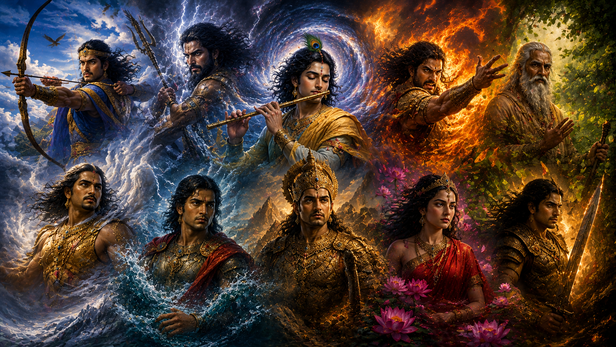
Was Bhishma really defeated by arrows, or by something much deeper? Why did the mighty Dronacharya lose despite being unmatched in knowledge? And why did every great warrior in the Mahabharata seem to fall only when a completely different force appeared? Many believe these were simply battle strategies. But when you look closely, an extraordinary pattern begins to emerge. Every powerful warrior represented a unique energy, and each one could only be overcome by its opposite or by a greater force. This hidden symbolism makes the Mahabharata far more than a story of war. It becomes a timeless lesson about balance, nature, and the laws that govern life itself.
Bhishma Represented the Sky
Bhishma was known for his unbreakable vows and unwavering determination. Symbolically, many spiritual interpretations compare his nature to the vast sky, limitless, calm, and impossible to control. Just as no one can touch the sky, almost no warrior could defeat Bhishma for ten days. His strength was not only physical but also rooted in his unwavering principles. This makes him one of the greatest examples of stability and discipline in the Mahabharata.
Why Shikhandi Changed Everything
The battle changed only when Shikhandi entered the battlefield. Shikhandi's unique life journey represented transformation rather than rigidity. Unlike Bhishma's fixed nature, Shikhandi symbolised change and fluidity. Bhishma chose not to raise weapons against Shikhandi, allowing Arjuna to strike. Spiritually, many interpret this as a reminder that even the strongest force can be temporarily overshadowed by an entirely different kind of energy. Sometimes flexibility succeeds where raw strength cannot.
Dronacharya Was the Power of Wisdom
Dronacharya was not remembered only for his military skills but also for his unmatched knowledge. He represented wisdom, discipline, and strategic thinking. As long as his mind remained focused, he was nearly impossible to defeat. However, when he became emotionally attached to the fate of his son Ashwatthama, his judgment weakened. This powerful moment reminds us that even the greatest intelligence can lose its strength when emotions overpower clarity.
Dhrishtadyumna Was Born From Fire
Dhrishtadyumna did not take birth in an ordinary way. He emerged from the sacred yajna fire with a single purpose: to defeat Dronacharya. Fire represents energy, transformation, courage, and destruction. Just as flames continue to rise unless controlled, Dhrishtadyumna carried an unstoppable mission. In symbolic interpretations of the Mahabharata, he represents the energy of fire that cannot simply be extinguished by force. His destiny reminds us that every powerful element in nature follows its own divine purpose and timing.
Ashwatthama Became Rudra's Fierce Energy
After the Kurukshetra war, Ashwatthama's anger reached its highest point. Several traditions describe him invoking the fierce energy of Lord Rudra before attacking the Pandava camp. Symbolically, Rudra represents an even greater force than ordinary fire. This explains why Dhrishtadyumna, who symbolised fire, was ultimately defeated. The Mahabharata repeatedly shows that every powerful force eventually encounters another force that is stronger, reminding us that no worldly power remains supreme forever.
Every Warrior Followed a Hidden Cosmic Law
One fascinating way to interpret the Mahabharata is through the balance of energies rather than simply weapons and warriors. Bhishma reflected the vast sky, Shikhandi symbolised transformation, Dronacharya represented wisdom, Dhrishtadyumna embodied fire, and Ashwatthama carried Rudra's fierce force. Whether taken literally or symbolically, these interpretations reveal a remarkable pattern. Every great warrior met an opponent whose nature balanced or surpassed their own. This deeper perspective transforms the epic into a timeless lesson about harmony, destiny, and the laws of nature.
The Mahabharata Is More Than a Story of War
The Mahabharata continues to inspire millions because every character teaches more than history alone. Beyond the battles lies a profound message about balance, ego, wisdom, duty, and the natural order of the universe. Whether you see these warriors as historical figures, spiritual symbols, or both, their stories encourage deeper reflection. The greatest victory was never simply defeating an enemy. It was understanding the forces that shape human life and learning how wisdom can overcome even the strongest power.
Disclaimer This article is based on traditional beliefs and is intended for informational purposes only.
Unlock insightful tips and inspiration on personal growth, productivity, and well-being. Stay motivated and updated with the latest at My Life XP.