
What If Hanuman Had Fought in the Mahabharata War?
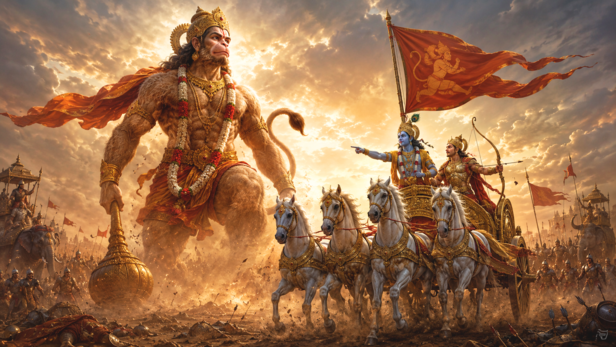
The Mahabharata war at Kurukshetra is already described as one of the most intense and destructive battles in Hindu tradition. It is a war where divine strategy, human emotion, and cosmic purpose all collide under the guidance of Lord Krishna. Now imagine if one of the most powerful and immortal beings in Hindu mythology, Lord Hanuman, had not just been present in a symbolic way, but had actively fought in the war itself. This “what if” is not part of the core Mahabharata narrative, but it becomes an intriguing thought because Hanuman already has a subtle presence in the epic. He is believed in many traditions to reside on Arjuna’s chariot flag, symbolizing protection, courage, and divine strength during the war.
So the question becomes even more fascinating: what if that presence had turned into direct participation?
Hanuman in the Mahabharata: A Subtle but Powerful Presence
Before imagining an active role, it is important to understand that Hanuman is not completely absent from the Mahabharata tradition. In one of the most well-known episodes, he meets Bhima during the Pandavas’ exile and teaches him humility by revealing that true strength is not arrogance but control and awareness. He is also deeply connected to the Pandavas through his divine lineage as the son of Vayu, making Bhima his spiritual brother. And during the Kurukshetra war itself, many traditions describe Hanuman as a protective force on Arjuna’s chariot flag, symbolizing divine support in battle. But importantly, in all known traditional narratives, Hanuman does not take an active combat role. That is where the “what if” becomes powerful.
If Hanuman Entered the Battlefield as a Warrior
If Hanuman had physically entered the war as a fighter rather than a symbol, the balance of power would have shifted in a way that is almost impossible to measure within human logic. Hanuman is not just a warrior. He is described across traditions as a being of immense strength, speed, and divine power, often associated with feats that defy normal physical limits. His presence alone is often portrayed as overwhelming even to powerful beings. In a battlefield like Kurukshetra, which already included great warriors such as Arjuna, Bhima, Karna, and Dronacharya, Hanuman’s active participation would likely have introduced an entirely different level of force. However, traditional interpretations of Hindu epics consistently emphasize that divine beings do not intervene to override destiny but instead guide it. This is a key philosophical boundary within the Mahabharata narrative itself.
The Deeper Question: Would Dharma Still Function?
The Mahabharata war is not just a physical conflict. It is a structured unfolding of karma, dharma, and consequence. Even Lord Krishna does not fight directly with weapons; instead, he guides Arjuna and shapes events through strategy and wisdom. If Hanuman had fought directly, it raises a deeper philosophical contradiction: would that have disrupted the karmic balance of the war? Many interpretations suggest that the war’s purpose was not just victory for the Pandavas, but the large-scale restoration of dharma through consequence. The presence of overwhelming divine intervention on one side could have removed the moral complexity that defines the Mahabharata. This is why even powerful divine figures are usually placed in supportive or symbolic roles rather than direct combat within the epic framework.
The Bhima Factor: A Different Kind of Reaction
There is already a symbolic encounter between Hanuman and Bhima, where Bhima’s pride is gently broken when he realizes Hanuman’s true strength. If Hanuman had entered the battlefield, Bhima would likely have experienced not just humility but complete transformation in his understanding of strength. Instead of relying purely on physical power, warriors might have been forced to confront the limits of human capability when faced with divine force. This could have reshaped battlefield psychology more than battlefield mechanics.
Krishna and Hanuman: Two Different Styles of Divine Action
One of the most important aspects of this thought experiment is understanding the contrast between Krishna and Hanuman. Krishna operates through strategy, dialogue, and moral guidance. Hanuman represents absolute devotion, raw strength, and unwavering loyalty. If both had actively influenced the battlefield at the same physical level, the Mahabharata might have shifted from a morally complex war into a decisive divine intervention narrative. That would fundamentally change its philosophical message. Instead of exploring human struggle under divine guidance, it would become a story of direct divine domination over human conflict.
The Bigger Meaning Behind Why It Never Happened
In traditional interpretation, the absence of Hanuman as an active fighter is not an omission. It is intentional design. The Mahabharata is structured to explore what happens when humans are placed in morally complex situations where even divine guidance does not remove responsibility. Hanuman’s role remains supportive because his purpose in the epic framework is to strengthen dharma without replacing human choice. His presence on Arjuna’s chariot flag already symbolizes protection without intervention, power without dominance, and faith without interference.
Conclusion
If Hanuman had fought in the Mahabharata war, the scale and outcome of the conflict might have been dramatically different on a physical level. However, it would also have changed the very nature of the epic itself. The Mahabharata is not designed as a story of unstoppable divine warriors eliminating conflict. It is a narrative of human beings navigating duty, emotion, and consequence under divine guidance. Hanuman’s real power in this context is not in changing the outcome of war, but in preserving its philosophical meaning. And that is why, even without raising a weapon in Kurukshetra, his presence remains one of the most powerful symbols of strength, devotion, and unseen protection in the entire epic tradition.
Explore the latest trends and tips in Health & Fitness, Spiritual, Travel, Life Hacks, Trending, Fashion & Beauty, and Relationships at Times Life!