
Who Created God? The Question That Breaks Logic
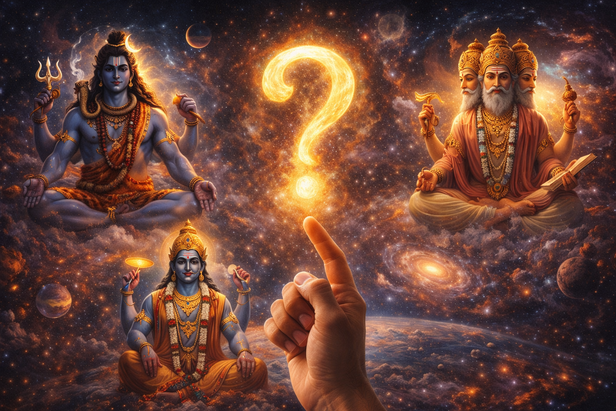
There is one question that doesn’t just challenge beliefs it stops your mind completely. If God created everything… then who created God?” At first, it sounds simple. Almost logical. But the moment you think deeper, something unusual happens. Your thoughts slow down. Answers disappear. Because this question doesn’t just question religion it questions logic itself. We are taught that everything must have a cause. But what if that rule is incomplete? What if existence itself doesn’t follow the rules we believe in?
Where Science Stops
Science has explained evolution, atoms, galaxies, and even the Big Bang. But when we ask what existed before the Big Bang, there is no clear answer. We have data only up to a certain point, like cosmic background radiation, but beyond that, there is silence. Science depends on observation and proof, and without it, it cannot continue. This is not a weakness it is a boundary. It shows that even the most powerful system of knowledge has limits, and beyond those limits lies a reality that cannot yet be measured or explained.
The Infinite Question Loop
If everything has a creator, then logically, God must also have a creator. But if God has a creator, then who created that? This question continues endlessly, forming a loop with no conclusion. This is known as a causality loop, where logic keeps moving but never reaches a final answer. It challenges our basic belief that everything must have a cause. The deeper you think about it, the more confusing it becomes. Your mind searches for an answer, but every answer creates another question, trapping you in an infinite cycle.
A Twist from Quantum Reality
Quantum physics introduces an idea that challenges everything we believe about cause and effect. At the smallest level, particles can appear and disappear randomly, without any clear reason or cause. This suggests that not everything follows the rules of logic we understand. If small particles can exist without explanation, then it is possible that the universe itself may not need one either. This idea feels uncomfortable because it removes certainty, but it also opens a new way of thinking that existence may simply be, without needing a reason.
Science vs Meaning
Science and religion are often seen as opposites, but they focus on different questions. Science tries to explain how things happen, while religion tries to explain why they happen. Science deals with physical reality matter, energy, and space. Religion and philosophy deal with meaning, purpose, and consciousness. The confusion happens when we expect one to answer everything. Trying to find God through equations or explain emotions through science creates conflict. Both perspectives are valuable, but they operate in different areas of understanding.
The Real Question
The real question is not “Who created God?” The real question is whether we are ready to accept that some things may never be fully explained. This is where most people feel uncomfortable, because we seek certainty and clear answers. But not every truth can be proven or defined. Some truths exist beyond logic and explanation. When you stop forcing answers and accept uncertainty, something changes. You move from confusion to awareness. And in that awareness, you begin to understand that not everything needs to be solved to be real.
Silent Realization
Some questions are not meant to be answered they are meant to awaken you. Who created God?” is one of those questions. It breaks logic, challenges belief, and pushes your mind beyond comfort. Maybe the universe doesn’t need a final explanation. Maybe existence simply is. And maybe the goal is not to find answers but to become comfortable with the mystery. Because sometimes, the deepest truth is not something you understand it’s something you experience.
Unlock insightful tips and inspiration on personal growth, productivity, and well-being. Stay motivated and updated with the latest at My Life XP.
Frequently Asked Questions (FAQs)
1. Why does the question “Who created God?” confuse people?
Because it challenges a basic belief that everything must have a cause. When this idea is applied to God, it creates an endless loop with no clear answer, making the mind uncomfortable and confused.
2. Does science have an answer to what existed before the Big Bang?
No. Science has evidence only up to a certain point, like cosmic background radiation. Beyond that, there is no clear data, so it cannot confidently explain what came before the beginning of the universe.
3. What is a causality loop?
A causality loop is a situation where every cause leads to another cause, with no final starting point. It creates an infinite chain of questions that logic cannot fully resolve.
4. Can something exist without a cause?
According to quantum physics, some particles appear and disappear without a clear cause. This suggests that not everything in the universe may require a reason to exist.
5. Are science and religion in conflict?
Not necessarily. Science focuses on “how” things happen, while religion focuses on “why” they happen. Both explore different aspects of reality and can coexist without fully overlapping.