
Why Bhishma Told This Shocking Story to Yudhishthira
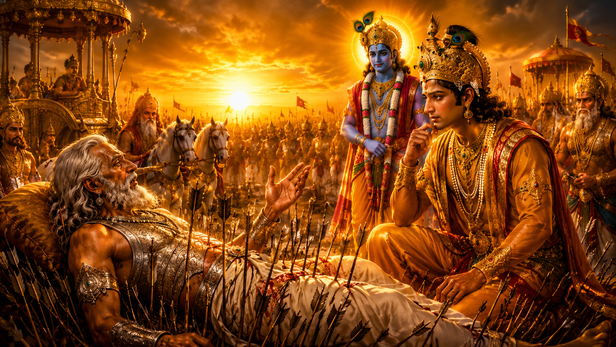
When something terrible happens, our first instinct is to find someone to blame. A person. A situation. A mistake. Someone must be responsible. But what if the truth is far more complicated? What if the person standing in front of us is only a small part of a much larger chain of events? After the devastating war of Mahabharata, Yudhishthira was drowning in guilt. He believed he was responsible for the deaths of countless people. Seeing his pain, Bhishma Pitamah told him a remarkable story about a grieving mother, a snake, Death itself, and the mysterious law of karma. The lesson hidden within this story remains as powerful today as it was thousands of years ago.
A Mother's Greatest Loss
An elderly woman named Gautami lived for one purpose alone her son. He was her support, her hope, and the reason she continued living. One day, she returned home and found him lying lifeless on the ground. A snake bite had taken his life. Her cries echoed through the village, attracting the attention of a hunter named Arjunaka. Filled with anger, he tracked down the snake and captured it. Certain that he had found the guilty party, he brought the snake before Gautami and demanded justice.
The Snake's Unexpected Defense
As Arjunaka prepared to punish the snake, something extraordinary happened. The snake spoke. Calmly, it explained that it held no hatred toward the boy. It had no desire to kill him and no personal reason to cause harm. The snake claimed it was merely an instrument carrying out a larger force. According to the snake, Death itself had directed the event. The hunter was stunned. How could the creature responsible deny its own guilt? Yet the snake's words opened a question far deeper than anyone expected.
When Death Appeared
At that very moment, Death appeared before them. The hunter immediately accused Death of being responsible for the boy's fate. But Death offered an unexpected answer. Death explained that even it was not completely independent. It simply carried out the commands of a higher force known as Time, or Kala. Just as the snake had acted as an instrument, Death itself was also serving a larger cosmic order. The mystery deepened. If Death was not ultimately responsible, then who truly was?
The Final Revelation
As the debate continued, Kala revealed the deepest truth. Neither the snake nor Death alone had caused the boy's fate. The true cause lay within the boy's own karma. The consequences of past actions had matured, and the snake merely became the instrument through which those results manifested. This was not a lesson about punishment. It was a lesson about cause and effect. Every action creates consequences, and sometimes those consequences unfold through people and events that appear responsible but are only part of the larger chain.
Why Yudhishthira Needed This Story
Bhishma did not tell this story randomly. He told it because Yudhishthira believed he was personally responsible for every death in the Mahabharata war. The king carried immense guilt despite repeatedly trying to prevent conflict. Bhishma wanted him to understand that he was not the sole cause of the tragedy. Duryodhana had made his own choices. Countless warnings had been ignored. The war emerged from many actions and decisions. Yudhishthira was an instrument within a much larger unfolding of destiny and karma.
The Mistake We Still Make Today
Even today, people often search for a single person to blame whenever something goes wrong. Relationships fail, careers collapse, and opportunities disappear. We immediately point fingers. Yet reality is rarely that simple. Most outcomes result from multiple causes acting together over time. The Mahabharata story reminds us to look beyond surface appearances. Sometimes the person we blame is only one link in a much larger chain. Understanding this does not remove responsibility, but it creates wisdom and compassion.
Learning to Let Go
Gautami ultimately accepted the wisdom she had heard. She released her anger and allowed the snake to go free. More importantly, she released the burden of endless questioning. Bhishma hoped Yudhishthira would do the same. Some events in life cannot be changed. Carrying guilt for things beyond our control only deepens suffering. The lesson is not to avoid responsibility but to understand its limits. Once we have done our best, we must learn to trust the larger flow of life.
Unlock insightful tips and inspiration on personal growth, productivity, and well-being. Stay motivated and updated with the latest at My Life XP.
Frequently Asked Questions (FAQs)
1. Why did Bhishma tell this story to Yudhishthira?
Bhishma wanted to help Yudhishthira overcome the guilt he felt after the Mahabharata war and understand the deeper role of karma and destiny.
2. Who was Gautami in the story?
Gautami was an elderly woman whose only son died from a snake bite, leading to a profound discussion about responsibility and fate.
3. Was the snake responsible for the boy's death?
According to the story, the snake was merely an instrument. The ultimate cause was linked to the boy's karma.
4. What role did Death play in the story?
Death explained that it was acting under the authority of Kala (Time), suggesting that even Death follows a larger cosmic order.
5. What is the main lesson of this Mahabharata story?
The story teaches that events often result from many interconnected causes, and blaming a single person may not reveal the whole truth