
Why Did Krishna Remain Silent When Abhimanyu Was Trapped in Chakravyuh?
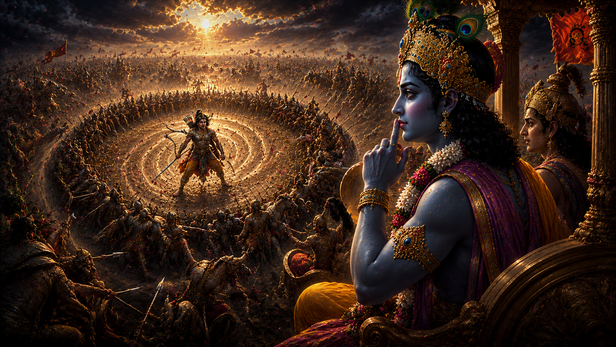
Few scenes in the Mahabharata are as heartbreaking as Abhimanyu's final battle. A fearless young warrior entered the deadly Chakravyuh knowing only half its secret. Surrounded by some of the greatest warriors of his time, he fought like a lion until his last breath. Yet one question still echoes through history. Where was Krishna? Why did the Lord, who protected countless devotees, remain silent when Abhimanyu was trapped? The answer is not about helplessness. It is about destiny, dharma, and a truth so profound that it continues to challenge our understanding of divine justice even today.
Love Was Never the Problem
Many people assume Krishna left because his love changed. Ancient traditions suggest exactly the opposite. Krishna's affection for Radha was never questioned. Their relationship symbolized the highest form of devotion, where love exists without possession or expectation. The separation was not caused by a lack of affection but by a greater responsibility waiting beyond Vrindavan. Their bond remained untouched because true spiritual love is not measured by physical presence. It is measured by connection of the soul, which remains eternal regardless of distance.
A Call Greater Than Personal Happiness
Vrindavan was a place of joy, music, and divine play. Yet Krishna's earthly mission extended far beyond its borders. Evil rulers threatened society, and dharma needed protection. Krishna knew that remaining in Vrindavan would mean choosing personal happiness over a larger purpose. His departure reminds us that great responsibilities often require difficult sacrifices. Sometimes the path of duty leads away from comfort and toward challenges. Krishna's choice teaches that true leadership means serving a higher cause, even when the decision brings personal pain.
The Separation That Deepened Love
Most relationships weaken with separation. Radha and Krishna's connection became stronger. Spiritual traditions describe their separation as a divine lesson. Radha's remembrance of Krishna became constant and unwavering. Every moment of longing transformed into devotion. Instead of reducing love, the distance revealed its depth. Their story suggests that genuine love is not dependent on physical closeness. Sometimes absence intensifies appreciation, turning ordinary affection into something sacred. This is one reason their relationship continues to inspire devotees around the world.
The Hidden Meaning of Vrindavan
Many saints explain that Vrindavan is more than a geographical location. It symbolizes a spiritual state where the soul experiences divine love. Krishna may have physically left the village, but spiritually he never left the hearts of those who loved him. Radha carried Vrindavan within her consciousness because Krishna remained there. This deeper interpretation transforms the story. The departure was physical, not spiritual. It reminds devotees that divine presence is not limited by place, distance, or time.
A Lesson Hidden in Every Relationship
Life often presents moments when personal desires conflict with responsibilities. Many people struggle between following their heart and fulfilling their duties. Krishna's departure reflects this universal challenge. He did not choose duty because love was unimportant. He chose duty because his love included responsibility toward the world. The story teaches that mature love supports growth, purpose, and service. It does not hold someone back from fulfilling their destiny. This wisdom remains relevant even in modern relationships.
Radha's Greatest Strength
Radha's greatness lies not only in her love but also in her response to separation. She did not allow sorrow to turn into bitterness. Instead, she transformed longing into devotion. Her remembrance of Krishna became so complete that she experienced his presence constantly. This spiritual strength is one of the reasons devotees revere her so deeply. Radha teaches that love reaches its highest form when it becomes selfless, unconditional, and centered on the beloved's well-being rather than personal gain.
Why Their Story Still Moves Millions
Centuries have passed, yet the story of Radha and Krishna continues to touch people of every age. It speaks to universal emotions—love, longing, sacrifice, faith, and hope. More importantly, it offers a vision of love that transcends physical limitations. Their relationship shows that the deepest connections are not broken by distance, time, or circumstance. This timeless message is why their names remain inseparable in the hearts of devotees around the world.
Unlock insightful tips and inspiration on personal growth, productivity, and well-being. Stay motivated and updated with the latest at My Life XP.
Frequently Asked Questions (FAQs)
1. Why did Krishna not stop Abhimanyu's death?
According to traditional interpretations of the Mahabharata, Krishna had chosen the role of a guide rather than a warrior. His non-intervention is often seen as part of the larger divine plan that allowed dharma and human choices to unfold naturally.
2. Did Krishna know what would happen to Abhimanyu?
Many devotional traditions believe that Krishna, being divine, was aware of future events. However, he allowed events to unfold according to destiny and the laws of karma and dharma.
3. What was the Chakravyuh?
The Chakravyuh was a complex military formation designed to trap and isolate enemies. It was considered one of the most difficult battle formations to penetrate and escape.
4. Why could only Abhimanyu enter the Chakravyuh?
Abhimanyu had learned the technique to enter the Chakravyuh while in his mother's womb. However, according to tradition, he did not hear the explanation of how to exit the formation.
5. Why wasn't Arjuna present to help Abhimanyu?
The Kauravas deliberately created a strategy to draw Arjuna away from the main battlefield, leaving Abhimanyu as the only warrior capable of breaking the formation.