
Why Did Shiva Grant Boons Even to Those Who Would Misuse Them?
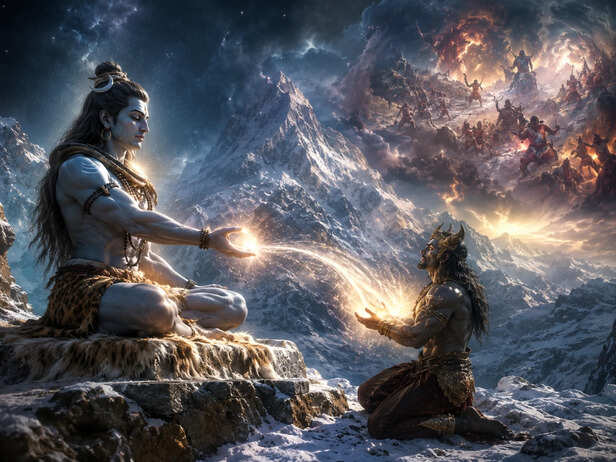
Lord Shiva, the destroyer in the Hindu trinity, is paradoxically also the most compassionate. He is known as Ashutosh, the one who is easily pleased. Legends repeatedly show him granting powerful boons to sages, devas, and asuras alike, often without judging their future intentions. This creates an enduring mythological puzzle. Why would a deity associated with wisdom and cosmic order empower beings who might later harm the world? The answer is layered. Shiva does not operate within human moral binaries. His boons are not endorsements of behavior but responses to sincerity in penance. In Shiva’s worldview, the intensity of tapasya itself carries truth, even if the seeker’s intentions are flawed.
The Law of Tapasya and Cosmic Neutrality
In Hindu thought, tapasya, or deep spiritual austerity, generates immense inner energy. This energy is considered powerful enough to influence cosmic order itself. Shiva, as Yogeshwar, recognizes tapasya as a neutral force. It is not inherently good or evil. When someone performs severe penance, Shiva responds to the discipline and transformation involved, not the moral alignment of the seeker. This reflects a cosmic neutrality. Power gained through tapasya is not “given” in a moral sense but “activated” as a consequence of spiritual effort.
Shiva’s Compassion Beyond Judgment
Shiva is often described as beyond ego and judgment. Unlike deities who reward based strictly on virtue, Shiva acknowledges sincerity wherever it appears. Even asuras, despite their destructive tendencies, are capable of intense devotion and discipline. Shiva does not deny that effort. Instead, he responds to it with boons that reflect cosmic fairness. However, this compassion is not naive. It operates under the principle that true growth must come through consequences. Shiva does not prevent misuse of boons because preventing consequences would interrupt karmic evolution.
When Boons Become Instruments of Ego
Mythology is filled with examples of boons granted by Shiva that later lead to destruction due to ego-driven misuse. Ravana, after intense penance, receives near invincibility. Yet his ego leads to downfall. Bhasmasura is granted the power to turn anyone into ashes, only to use it carelessly until it threatens even Shiva himself. Mahishasura gains strength that eventually disrupts cosmic balance. In each case, the boon is not the problem. The transformation of power into ego is. Shiva’s role is not to prevent misuse but to allow the universe to reveal the consequences of unchecked ambition. The destruction that follows is not punishment alone but correction of imbalance.
The Principle of Balance and Cosmic Correction
Shiva represents destruction, but not in a negative sense. His destruction is restoration of balance. When a boon is misused, it creates an imbalance in dharma. That imbalance eventually triggers correction, often through the emergence of divine forces or avatars who restore order. This is why Shiva’s boons always fit within a larger cycle. Power rises, ego expands, imbalance grows, and eventually cosmic correction occurs. Rather than preventing this cycle, Shiva enables it. The universe, in this framework, learns through unfolding consequences rather than imposed restrictions.
Free Will, Ego, and the Lesson of Responsibility
A deeper interpretation of Shiva’s actions lies in free will. If divine beings prevented every misuse of power, free will itself would become meaningless. Shiva’s boons serve as mirrors. They reflect the inner state of the receiver. A disciplined seeker uses power wisely. An ego-driven seeker destroys themselves through it. The mythological message is not about Shiva enabling harm, but about the inevitability of ego when power is not grounded in awareness. Shiva’s silence after granting boons is itself a teaching. It forces beings to confront their choices and their consequences. In this way, Shiva becomes not just a giver of boons but a silent guide of karmic truth.
The Wisdom Hidden in Shiva’s Silence
Shiva granting boons to those who misuse them is not a contradiction but a reflection of cosmic law. His actions are rooted in neutrality, compassion, and the understanding that true evolution requires experience, even painful ones. He does not interfere with the unfolding of ego because ego itself is a stage of learning. Every misuse of power becomes a step toward eventual correction and realization. Shiva’s silence after granting boons is perhaps his greatest teaching. It reminds us that power is never the problem, only the consciousness that wields it. In that silence lies the deepest form of divine wisdom, where the universe is allowed to balance itself through time, consequence, and awakening.
Unlock insightful tips and inspiration on personal growth, productivity, and well-being. Stay motivated and updated with the latest at My Life XP.