
Why Ganesha Wrote Mahabharata, Not Other Gods
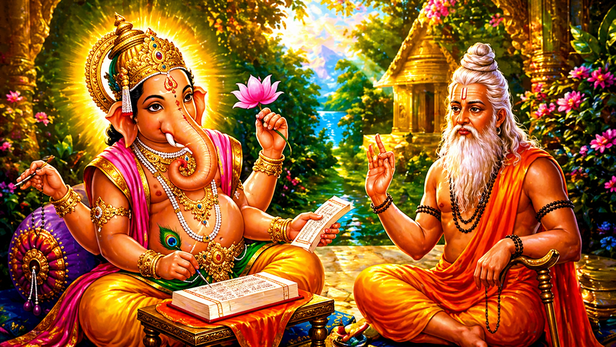
What if one of the greatest epics ever written was created under a strict, unbreakable condition? Not just written but dictated, memorized, and preserved with intense focus. The story of the Mahabharata is not only about war and dharma; it is also about how knowledge survived through time. Behind this vast epic was a powerful partnership between Ved Vyasa, who spoke without pause, and Ganesha, who wrote without stopping. And the condition they agreed on was not simple. It demanded perfection and changed how we understand this timeless story forever.
THE CREATOR AND THE WRITER
The true creator of the Mahabharata is Ved Vyasa. He composed the entire story its characters, events, and philosophy. But writing such a vast epic alone was not possible. That is where Ganesha came in. He took on the role of the scribe, carefully writing every verse as Vyasa dictated. This partnership shows that knowledge creation and preservation are two different but equally important roles.
THE CONDITION THAT CHANGED EVERYTHING
Before beginning, Ganesha set a condition he would write continuously, but Ved Vyasa must not stop speaking. If Vyasa paused, Ganesha would stop writing. In response, Vyasa added his own condition Ganesha must understand every verse before writing it. This created a balance. It ensured speed without losing meaning. It also gave Vyasa time to think deeply, making the epic rich in wisdom and detail.
THE SACRIFICE BEHIND “EKADANTA”
During the intense writing process, Ganesha’s writing tool broke. But he did not stop. To keep his promise, he broke his own tusk and continued writing. This act gave him the name “Ekadanta.” It symbolizes dedication beyond comfort. The message is clear true commitment requires sacrifice. This moment transforms the story from a simple task into an example of unwavering focus and devotion.
WHY GANESHA WAS THE ONLY CHOICE
Among all deities, Ganesha is known as the god of wisdom, intellect, and beginnings. Writing the Mahabharata required not just speed, but understanding and precision. Other gods had different roles, but Ganesha’s qualities made him perfect for this task. His ability to process complex ideas quickly ensured that the epic remained accurate and meaningful. This choice reflects the importance of intellect in preserving knowledge.
THE HIDDEN LESSON IN THIS STORY
The story of Mahabharata’s writing is more than mythology. It teaches a powerful lesson. Wisdom alone is not enough you need discipline to express it. And action without understanding lacks depth. The partnership between Ved Vyasa and Ganesha represents this balance. When thought and execution come together, something timeless is created.
Wisdom and Action Together
The story of the Mahabharata is not just about its content. It is about how it came into existence. A sage who never stopped speaking.
A deity who never stopped writing. And a condition that demanded perfection. It reminds us that greatness is never accidental.
It is built through focus, discipline, and sacrifice. Because sometimes, the most powerful stories are not just told they are earned.
Unlock insightful tips and inspiration on personal growth, productivity, and well-being. Stay motivated and updated with the latest at My Life XP.
Frequently Asked Questions (FAQs)
1. Who actually wrote the Mahabharata?
The Mahabharata was composed by Ved Vyasa. He is considered the original creator who structured the entire narrative, philosophy, and events of the epic.
2. What was the role of Lord Ganesha?
Ganesha acted as the scribe. He wrote down the verses as Vyasa dictated them, ensuring the epic was preserved accurately and without interruption.
3. What was the condition between Vyasa and Ganesha?
Ganesha agreed to write only if Vyasa spoke continuously without pause. In return, Vyasa set a condition that Ganesha must understand each verse before writing it, ensuring depth and accuracy.
4. Why is Ganesha called Ekadanta?
During the writing process, Ganesha’s pen broke. To continue without stopping, he broke his own tusk and used it to write, earning the name “Ekadanta,” meaning “one-tusked.”
5. Why was Ganesha chosen for this task?
Ganesha is known as the god of wisdom, intellect, and beginnings. His sharp understanding and dedication made him the ideal choice for writing such a complex and vast epic.
6. Is this story symbolic or literal?
Many consider it symbolic, representing the balance between wisdom (Vyasa) and action (Ganesha). It highlights how great knowledge requires both deep thinking and disciplined execution.