
Why Is Hinduism Asked to ‘Modernize’ While Other Religions Are Left Untouched?
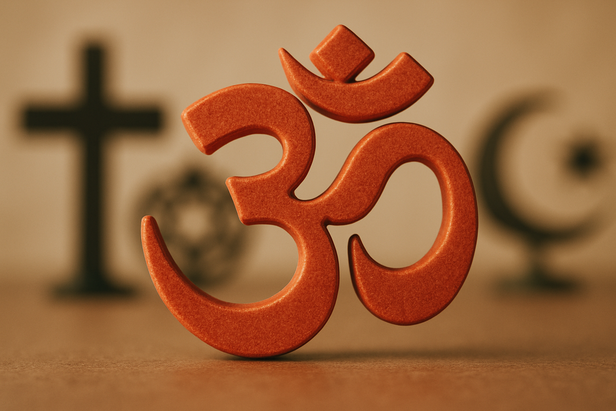
Every few months, the debate keeps cropping up again: “Hinduism needs to modernize.” This is being reiterated by columnists, activists, academicians, and social media personalities often without any clarity on what this “modernization” is supposed to mean. What is pertinent, however, is not this proposed reform per se, but rather whom this proposed reform excludes. Why this select exclusion to this end, and why this particular religion that is Hinduism? This is not a defensive answer, it is an analytical one.
A Civilization, Not a Conversion Religion
One of the reasons why Hinduism is under constant observation is because of the fact that it is not a missionary religion. Unlike other religions, where there is a prophet, a holy book, and a common doctrine, Hinduism is a civilization framework or a set of philosophies, practices, and paths. “From Advaita to Bhakti, Tantra to Yoga, from idol worship to formless meditation” this is Hinduism, and it sustains contradictions without contradictions leading to collapse. Irony, and that is If the religion lacks defined boundaries, then people who are “outside” can more easily point out flaws in the religion. “Protected belief systems” apply to other faiths, and Hinduism is a social experiment ready to be corrected constantly.
The evolution of Hinduism has occurred over the years and has been unnoticeably evolving from the beginning of Hinduism. Contrary to what many people believe, Hinduism is not static or resistant to change. Thousands of years ago, the Upanishads began questioning ritualism. Through the Bhakti Movement, the caste system; and the dominance of elite Sanskrit, were all challenged by providing access to worship and spirituality in local languages.
Colonial Lenses Still Shape Modern Criticism
The major criticisms of Hinduism in recent times are reminiscent of the colonial era, in which Indian practices are governed by terms such as superstitious, reactionary, and irrational, thereby justifying colonial rule. The British colonial rulers tended to misconstrue, or in some cases, purposefully misunderstand, the tenets of Hindu practices in the context of their philosophical underpinnings. The kinds of frameworks used to describe Hindu practices are, sadly, still operative in contemporary narratives in academia and media. The customs of Hindus are thereby measured by Western morality and principles.
Selective Reform: A Global Pattern
Here’s the uncomfortable truth: In any religion, contradictions, societal issues, and baggage are always there. However, in other religions, practices are termed “faith-based” or “sensitive.” But in Hinduism, similar practices are dubbed “regressive” or “requiring reform.” This doesn’t mean Hindus can’t do any self-analysis. It means reform should happen in a non-disparaging manner.
The Price of Pluralism
Hinduism does not threaten excommunication if there is dissent. Hinduism does not follow ideologies with a threat of eternal punishment. Hinduism permits questioning, questioning that extends to God itself. Ironically, liberating freedom goes further. Since Hinduism does not counterattack, it is perceived as much too pliable. Since it tolerates criticism, it is automatically considered to be faulty. The openness factor, however, cannot be considered a vulnerability.
Modern Myths of the Past
What does “modernity” mean, anyway? Technology? Hindu philosophy is effortlessly compatible with science and cosmology. Gender politics? Hinduism is saturated with the worship of feminine deity in various autonomous manifestations. Individual liberty? Hinduism incorporates atheism, agnosticism, and multiple paths to truth. Modernity is not an abandonment of roots; it is an interpretation of roots with wisdom. Hinduism has been doing this over the centuries repeatedly. .
Contemplating Reform & Reconstruction
The distinction between reforming Hindu society from inside out and constructing it from outside in is drastically different. Hindu society has its share of societal problems such as caste discrimination, gender injustice and social inequality, but to limit Hinduism to these issues ignores the philosophical depth of Hinduism and its history of reform. Too often, the request for Hinduism to "modernize" becomes a request for the culture of Hinduism to be sacrificed in order to accommodate the global perspective. This is not merely the reform of an existing culture. This is the erasure of it.
Hinduism Is a Living Tradition
Hinduism does not need the approval of modernity. The tradition has outlasted invasions, colonials, globalism and digital upheaval not through rigidity but through adaptability. Perhaps the more appropriate question is not "why does Hinduism need to modernize," but rather: "why do modern discussions have difficulty in comprehending a faith that does not fit neatly into the classification systems of modernity?"
Hinduism is not resisting change; rather, it is resisting oversimplification. It is not resisting reform; it is resisting interpreting the faith through a double standard when compared to other faiths. A truly enlightened society would not demand that one faith keep proving its relevance while the same society sees no need for the continuance or relevance of the other faiths. It would seek understanding prior to judgment, and be able to place itself in the contexts of others prior to publicly criticizing, and to have decency prior to forming violent reactions towards others' traditions. The goal of Hinduism is not to catch up with modernity; rather, modernity should take time to understand Hinduism.