
Why Kali Won’t Truly End Even After Kalki
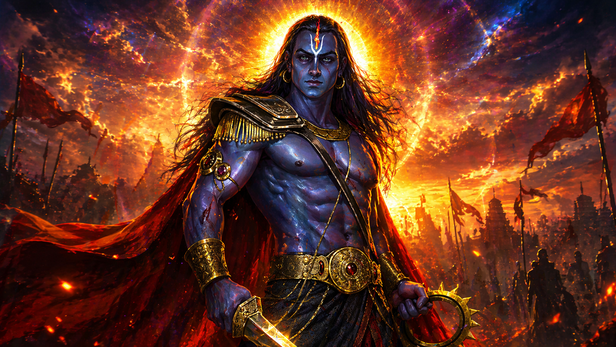
We all have heard about the end of Kalyug The arrival of Kalki. The destruction of evil. The beginning of a new era. But what if the story isn’t as simple as it sounds? What if the darkness we think will end never truly disappears? There is a hidden layer in this ancient story that most people never notice. A truth that changes how you see Kalyug, Kalki, and even time itself. Because this isn’t just a story of destruction It’s a story of something that keeps coming back.
The Mysterious Birth of Kali
According to ancient texts, Kali’s origin is deeply symbolic. He is said to be born from Adharma, which itself emerged from imbalance in creation. This lineage connects him to qualities like anger, violence, and illusion. In another story, Kali is linked to the leftover poison from Samudra Manthan, representing negativity that even divine events could not fully erase. These origins are not just mythological they reflect how darkness is born when balance is lost. Kali is not just a being, but a reflection of human tendencies that grow when dharma weakens.
The Marriage That Strengthened Darkness
Kali’s story becomes darker with his relationships. It is believed he married his own sister and also Alakshmi, the opposite of prosperity. These unions symbolize the expansion of negative forces confusion, greed, and misfortune. Instead of balance, his life reflects distortion of natural order. This is not just about mythology; it represents how negativity multiplies when left unchecked. The more it grows, the harder it becomes to control. Kali’s rise shows that darkness doesn’t stay small it expands quietly until it dominates everything around it.
The Battle With Kalki
The arrival of Kalki is seen as the ultimate turning point. He represents restoration of dharma and the end of chaos. When Kalki confronts Kali, it is not just a physical battle it’s a clash between order and disorder. Scriptures suggest that Kali cannot face Kalki’s power directly and retreats. This moment is often seen as victory of good over evil. But here’s the twist—it’s not complete destruction. Kali doesn’t fully vanish. Instead, he escapes, waiting for another time. And that changes how we understand this victory.
The Secret Escape of Kali
After the battle, Kali is believed to move into another cycle of time. This idea reveals a powerful truth—evil is not destroyed forever. It simply withdraws. Waiting. Observing. Preparing to return when the conditions are right again. This explains why history often repeats patterns of rise and fall. It’s not coincidence it’s a cycle. Kali’s escape symbolizes that darkness is never fully gone. It exists in potential form, ready to emerge whenever balance weakens again in the world.
The Endless Cycle of Yugas
The concept of Yugas reveals the deepest truth of all. Time is not linear it is cyclical. After Kalyug ends, Satya Yuga begins again, followed by Treta and Dwapar, eventually returning to Kalyug. This means Kali’s influence is not a one-time event. It is part of a repeating pattern. Every cycle carries the possibility of imbalance again. This doesn’t make the story hopeless it makes it meaningful. Because it shows that every era depends on human actions. Dharma must be maintained, or the cycle continues.
Unlock insightful tips and inspiration on personal growth, productivity, and well-being. Stay motivated and updated with the latest at My Life XP.
Frequently Asked Questions (FAQs)
1. Who is Kali in Kalyug?
Kali is considered the symbolic force of adharma (unrighteousness), representing negativity, greed, anger, and imbalance in the world during Kalyug.
2. What is the role of Kalki Avatar?
Kalki, the future incarnation of Lord Vishnu, is believed to restore dharma by ending Kalyug and defeating the forces of evil, including Kali
3. Will Kali be completely destroyed by Kalki?
Some interpretations suggest Kali is defeated but not entirely destroyed, symbolizing that negativity can return in future cycles of time.
4. What are Yugas and why are they important?
Yugas are cyclical time periods—Satya, Treta, Dwapar, and Kali—that repeat continuously, showing the rise and fall of dharma in the universe.
5. How is Kali connected to Adharma?
Kali is said to originate from Adharma’s lineage, symbolizing how negative traits evolve when righteousness declines.
6. Can we reduce the effects of Kalyug in our life?
Yes, by following dharma—truth, discipline, compassion, and right actions—individuals can reduce the influence of negativity in their lives.