
Why Krishna Didn’t Stop the War: 4 Uncomfortable Truths
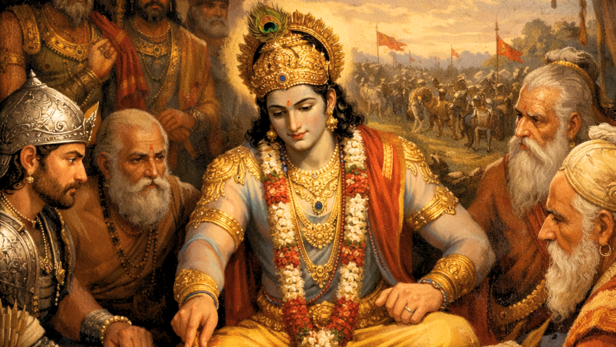
There is something deeply unsettling about the Bhagavad Gita when you truly sit with it, not as a religious text, not as a cultural inheritance, but as a raw moment of human crisis unfolding on the edge of a battlefield where brothers are about to kill brothers, teachers are about to fall to their students, and an entire civilisation stands on the brink of irreversible destruction. The question that quietly disturbs many minds, even today, is not just why the war happened, but why Krishna- God himself, standing right there- did not stop it.
At first glance, it feels almost cruel. Arjuna collapses in despair, his body trembling, his bow slipping from his hands, his mind overwhelmed by grief and moral confusion as he looks at the faces of those he must fight- his own family, his beloved Guru Dronacharya, the grandsire Bhishma- and in that moment, what he seeks is not victory, not power, but escape. He does not want to fight. He does not want blood. He wants the war to end before it begins.
And yet, Krishna does not stop the war. Instead, he speaks.
The First Truth: The Real Battle Was Within
This is where the discomfort begins, because Krishna’s response is not what we expect from a divine saviour who could, with a single act of will, dissolve the conflict, restore harmony, and prevent unimaginable suffering. Instead of stopping the war, Krishna dismantles Arjuna’s hesitation. He does not validate his retreat; he challenges it. He does not offer peace; he offers clarity. And that clarity is terrifying.
Krishna tells Arjuna that the war is not the real problem. What appears as compassion is deeply entangled with attachment, identity, fear, and confusion about one’s role in the cosmic order. Arjuna’s paralysis is not just emotional- it is a loss of clarity. The Gita shifts the entire perspective inward, forcing us to confront the uncomfortable reality that our greatest battles are often within ourselves.
The Second Truth: The War Had Already Begun
Krishna introduces the concept of dharma- not as a comforting moral guideline, but as an uncompromising alignment with truth and responsibility. Arjuna is not just a man; he is a warrior placed in a moment where the preservation of justice demands action. The war is not random violence; it is the culmination of years of deceit, humiliation, and adharma inflicted by the Kauravas.
And this is where the second uncomfortable truth emerges: the war did not begin on the battlefield- it had already begun long before. From the dice game to Draupadi’s humiliation, from repeated betrayals to the denial of even minimal peace, every event pushed the world toward an unavoidable confrontation. Krishna himself attempted peace, even asking for just five villages, but human arrogance refused compromise.
At that point, the question was no longer whether the war should happen, but whether it could still be stopped at all.
The Third Truth: Action Is Inevitable- So Is Its Consequence
Krishna’s silence on stopping the war is not indifference; it is recognition. Recognition that certain consequences, once set into motion by human choices, cannot simply be erased. The Gita presents a universe governed by responsibility, where actions carry inevitable outcomes, even when they are painful.
In one of the most profound teachings, Krishna reveals that life and death are not absolute opposites but transitions. The soul remains untouched, eternal, beyond destruction. What Arjuna fears losing is, in a deeper sense, never truly lost. This does not justify violence in a simplistic way- it reframes it within a larger cosmic understanding.
Perhaps the most disturbing realisation is this: refusing to act, when action is required, is also a choice- with consequences just as real as action itself.
The Final Truth: Krishna Did Not Remove the Battle- He Transformed the Warrior
Krishna does not offer Arjuna an escape from suffering; he offers him a way to act within it. Detachment, as he explains, is not withdrawal from life but freedom from the need to control outcomes. Arjuna is asked to fight without hatred, without ego, without attachment to victory or defeat.
This teaching challenges the very idea of divine intervention. We often imagine God as someone who removes our problems, but the Gita presents a different vision- one where the divine does not always eliminate the battlefield but stands beside us within it, offering clarity and strength.
Krishna did not stop the war because stopping it would not have resolved the deeper crisis. The real battle was always the human mind- its confusion, its fear, its attachment, and its resistance to responsibility.
In the end, the Gita does not promise a life free from conflict. It offers something far more demanding- a way to stand in the middle of chaos without losing oneself.
And that is the uncomfortable truth.
Unlock insightful tips and inspiration on personal growth, productivity, and well-being. Stay motivated and updated with the latest at My Life XP.