
Why Krishna Let Adharma Happen to Defeat Adharma
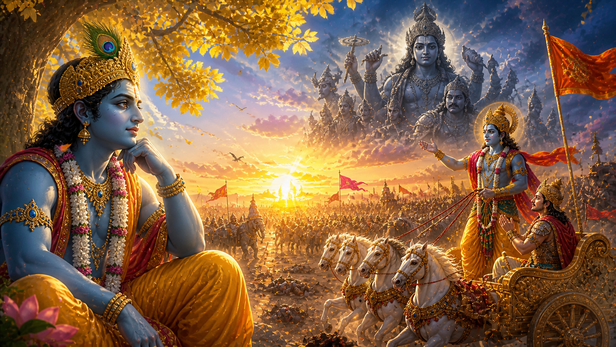
Few questions in Hindu philosophy provoke as much debate and curiosity as this one: why did Krishna, the very embodiment of divine wisdom, allow adharma to unfold before ultimately defeating it. At first glance, it appears contradictory, almost unsettling, because the expectation from a divine figure is immediate justice and clear righteousness. Yet, the Mahabharata does not present a simple moral world. Instead, it presents a deeply complex reality where right and wrong are often entangled, forcing even the divine to act within the constraints of time, human nature, and cosmic balance.
The story of Krishna in the Mahabharata is not about preventing conflict at all costs, but about ensuring that when conflict becomes inevitable, it leads to the restoration of dharma.
Krishna Tried to Stop Adharma Before Allowing It to Unfold
One of the most overlooked truths in the Mahabharata is that Krishna did not encourage war from the beginning. In fact, he made repeated efforts to prevent it. Acting as a diplomat, he approached the Kaurava court with a remarkably humble proposal, asking for just five villages for the Pandavas in order to avoid bloodshed. This was not a strategic delay but a genuine attempt to uphold peace and prevent destruction. However, the refusal of Duryodhana made it clear that adharma had already taken deep root. At that point, Krishna’s role shifted from a peacekeeper to a guide who would ensure that the inevitable conflict served a higher purpose. This transition is critical, because it shows that adharma was not created by Krishna, but allowed to reveal itself fully before being destroyed.
The Complex Truth: Dharma Is Not Always Simple or Pure
The Mahabharata repeatedly emphasizes that dharma is not always obvious or absolute. In fact, it often exists in shades of grey, where decisions must be made in morally complex situations. Scholarly interpretations of the epic highlight that dharma and adharma do not clearly announce themselves, and what appears right in one context may not be right in another. This is where Krishna’s actions become deeply philosophical rather than merely strategic. By allowing adharma to unfold, he exposed its true nature to the world, making its destruction not just necessary but justified. If adharma had been suppressed prematurely, its roots would have remained hidden, potentially resurfacing in more dangerous forms.
Why Krishna Used Strategy That Looked Like Adharma
Perhaps the most debated aspect of Krishna’s role is his use of unconventional and sometimes morally ambiguous strategies during the Kurukshetra war. From guiding Arjuna to strike when advantage presented itself, to orchestrating situations that led to the fall of powerful warriors like Bhishma, Drona, and Karna, Krishna’s actions often appeared to violate traditional codes of warfare. Yet, these actions were not arbitrary. The epic itself suggests that strict adherence to rules would have allowed adharma to prevail, because the opposing side was already violating those very principles. Krishna’s approach reflects a deeper understanding that when the system itself is corrupted, restoring balance may require stepping outside conventional boundaries.
This is not an endorsement of wrongdoing, but a recognition that dharma, in its highest sense, is about preserving justice and order, even when the path to achieving it is complex.
The Cosmic Perspective: Destruction as a Path to Restoration
At its core, Krishna’s role in the Mahabharata is aligned with a larger cosmic principle. Hindu philosophy holds that whenever adharma rises beyond a certain point, it must be allowed to manifest fully before it can be completely destroyed. This idea is echoed in the teachings of the Bhagavad Gita, where Krishna emphasizes action aligned with duty, without attachment to immediate outcomes. The Kurukshetra war itself is not merely a battle between two families, but a symbolic confrontation between dharma and adharma, where the destruction of the old order becomes necessary for the establishment of a new one. In this sense, Krishna did not “support” adharma, but allowed it to reach its peak so that its fall would be complete and irreversible.
A Lesson That Still Resonates Today
The story of why Krishna allowed adharma to unfold is not just a theological explanation but a reflection of real life, where injustice is often not immediately corrected, and where the path to truth can be complicated and uncomfortable. Krishna’s actions suggest that true righteousness is not always about immediate intervention, but about timing, understanding, and the courage to act decisively when the moment demands it. His role reminds us that dharma is not a rigid rulebook but a living principle, one that requires wisdom to interpret and strength to uphold.
In the end, the Mahabharata does not give easy answers, and perhaps that is its greatest strength. It invites us to question, to reflect, and to understand that even the divine operates within a universe where truth must sometimes pass through complexity before it can shine clearly.
Unlock insightful tips and inspiration on personal growth, productivity, and well-being. Stay motivated and updated with the latest at My Life XP.