
Why Lord Brahma Lost Worship: Lord Shiva's Curse Explained
In the vast and layered universe of Hindu mythology, few questions spark as much curiosity- and quiet disbelief- as this: how did Brahma, the very creator of existence, become the least worshipped among the divine trinity that includes Vishnu and Shiva? It is a paradox that has fascinated believers, scholars and seekers for centuries- a creator forgotten in his own creation. The answer lies not in a single story, but in a powerful convergence of mythology, symbolism, cosmic roles and divine consequences that reshaped spiritual traditions.
The Cosmic Lie That Changed Everything
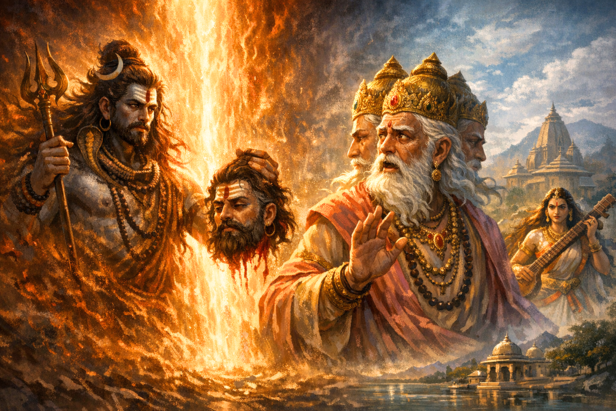
At the heart of this mystery lies one of the most dramatic episodes in Hindu lore- the confrontation between Brahma and Shiva. According to ancient Puranic narratives, Brahma and Vishnu once found themselves locked in a debate over supremacy. To resolve this, Shiva manifested as an infinite pillar of light, a cosmic force beyond comprehension, challenging both deities to find its beginning or end.
While Vishnu accepted defeat after failing to locate the base, Brahma, driven by pride, falsely claimed that he had reached the top. That single moment of dishonesty would alter divine destiny forever. Shiva, embodying truth and cosmic justice, saw through the deception and pronounced a powerful curse: Brahma would no longer be widely worshipped on Earth. This was not merely punishment, but a profound spiritual lesson- that truth stands above ego, even for Gods.
The Curse of Ego: Symbolism Behind Shiva’s Wrath
In some variations of the story, Shiva’s reaction goes even further. He severs one of Brahma’s five heads- an act often interpreted not as violence, but as the symbolic destruction of ego and arrogance. This moment reflects a deeper philosophical truth embedded in Hindu thought: that creation without humility becomes incomplete, and that even divine beings are bound by the universal laws of dharma.
From that point onward, Brahma’s role remained essential in the cosmic cycle, yet his connection with everyday human devotion began to weaken. He was still revered as the creator, but no longer worshipped with the same fervour.
Saraswati’s Anger and the Pushkar Curse
Another powerful narrative adds emotional depth to this mystery. It is said that Brahma, while performing a sacred yajna in Pushkar, faced a delay from his consort Saraswati. Bound by ritual timing and urgency, Brahma married another woman, Gayatri, to complete the ceremony.
When Saraswati finally arrived and witnessed what had happened, her anger was fierce and immediate. In a moment of divine fury, she cursed Brahma that he would be worshipped only in Pushkar- and nowhere else. Even today, the rare temple dedicated to Brahma in Pushkar stands as a living reminder of that curse, a sacred exception in a land filled with countless temples.
The Shift in Devotion: Why Vishnu a Shiva Took Center Stage
Beyond mythology, the evolution of Hindu worship practices also played a crucial role. Over centuries, devotional movements such as Vaishnavism and Shaivism brought Vishnu and Shiva into the center of spiritual life. These deities were seen as actively engaged with the world- preserving, protecting, and transforming it.
Brahma, by contrast, was perceived as having fulfilled his role after creation. Unlike the preserver who sustains or the destroyer who liberates, Brahma became a more distant figure in the devotional imagination. Worship, deeply tied to relevance and emotional connection, gradually shifted away from him.
The Eternal Lesson Behind the Forgotten Creator
What makes this story truly powerful is not just the curse itself, but what it represents. Across different versions- whether it is Shiva’s wrath, Saraswati’s anger, or the symbolic loss of Brahma’s head- the message remains consistent: power without humility leads to decline, and truth remains the highest principle in the universe.
Today, Brahma is not forgotten- he is remembered in scriptures, invoked in rituals, and acknowledged as the source of existence. But his temples are few, his worship rare, and his story a quiet yet profound reminder that in the grand design of the cosmos, integrity matters more than creation itself.
And perhaps that is why the creator, despite shaping the universe, stepped back into silence- leaving behind not dominance, but a timeless lesson.
Unlock insightful tips and inspiration on personal growth, productivity, and well-being. Stay motivated and updated with the latest at My Life XP.