
Why Ravana Could Never Cross That One Simple Line
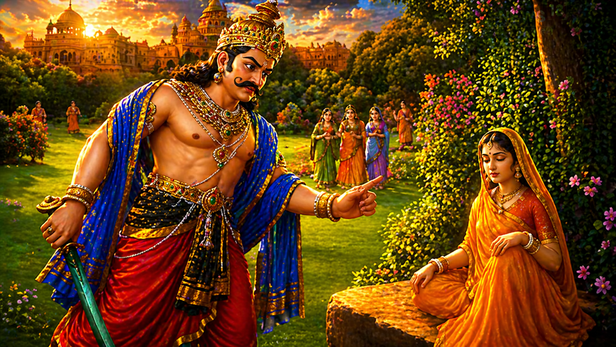
What if the most powerful moment in the Ramayana was not a battle but a silence? A silence so strong that even Ravana, the king of Lanka, could not break it. When Sita was taken to Ashok Vatika, Ravana did not just approach her as a captor he approached with power, pride, and persuasion. But what he faced was something unexpected. Not fear. Not pleading. But a simple blade of grass placed between them. That small “tinka” was not just an object. It became a boundary of dignity, devotion, and divine separation one that even the strongest force of ego could not cross.
THE SILENT LINE OF DHARMA
When Ravana tried to persuade Sita, she did not respond with anger or fear. Instead, she placed a small blade of grass between them. This act was not weakness it was clarity. It meant that dialogue itself had limits when faced with adharma. Sita’s silence was louder than Ravana’s words. She made it clear: she was not available for negotiation, temptation, or manipulation. That straw became a sacred line one that defined dharma in its purest form. It told Ravana that power without righteousness cannot enter the space of truth.
DISRESPECT TO ADHARMA, NOT THE PERSON
When Sita turned away from Ravana, it was not emotional reaction it was spiritual rejection. She did not validate his ego by direct confrontation. Instead, she denied him the dignity of equal conversation. In dharmic symbolism, this is not insult but protection of inner purity. The gesture showed that not every force deserves engagement. Some energies weaken simply by being ignored. Ravana’s strength lost meaning the moment Sita refused to recognize it as worthy.
THE MEMORY OF RAMA’S DHARMA
Sita’s strength was not isolated. It was rooted in her connection with Lord Rama. Every action reflected that bond. The straw was not just separation from Ravana it was alignment with Rama. In her mind, no force in the world could replace or break that connection. Even in isolation, she stood within that invisible protection. That is why Ravana’s persuasion failed not because Sita lacked power, but because her strength was already anchored in something beyond physical reach.
WHEN A SMALL OBJECT BECOMES AN UNBREAKABLE WALL
The straw represents a timeless truth: size does not define power. Ravana had armies, wealth, and illusion of invincibility. Sita had none of these. Yet a simple blade of grass became a psychological and spiritual wall he could not cross. This shows that real strength is not force it is conviction. When conviction is absolute, even the smallest symbol becomes unbreakable.
THE LESSON BEYOND MYTH
This moment is not just mythology it is life philosophy. It teaches that boundaries are sacred. That respect for oneself is non-negotiable. And that not every situation deserves engagement some deserve silence, distance, and clarity. Sita’s straw is a reminder that dignity does not always shout. Sometimes, it quietly separates truth from illusion. Even today, the lesson remains powerful: protect your values, even if all you have is a simple “tinka” of conviction.
Unlock insightful tips and inspiration on personal growth, productivity, and well-being. Stay motivated and updated with the latest at My Life XP.
Frequently Asked Questions (FAQs)
1. Why did Sita place a blade of grass between her and Ravana?
Sita placed the blade of grass as a symbolic boundary. It represented her refusal to engage with Ravana on equal terms and her commitment to dharma and Lord Rama. It was a silent but powerful form of rejection.
2. Was the “tinka” (straw) a real object or symbolic?
In most interpretations, it is understood as a symbolic gesture. The straw represents a spiritual and psychological boundary rather than just a physical object.
3. What does this moment teach about Sita’s character?
It highlights Sita’s inner strength, clarity, and unwavering devotion. She did not respond with aggression or fear but with calm dignity and firm boundaries.
4. Why didn’t Sita directly argue with Ravana?
Because engaging deeply with adharma is seen as giving it unnecessary validation. Instead, she chose silence and symbolic refusal, which reflects strength through restraint.
5. What is the deeper meaning of Ravana being unable to cross the line?
It symbolizes that ego, desire, and power cannot cross the boundary of truth and devotion. When someone stands firm in their values, external force loses influence.