
Why Revenge Failed And Forgiveness Won Everything
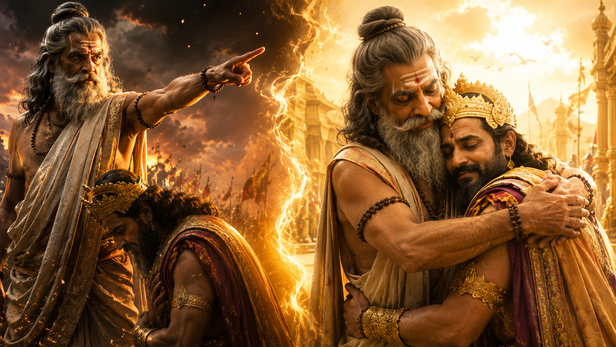
What is stronger a weapon that wins a battle or forgiveness that ends a war? The Mahabharata answers this question through one of its most emotional stories. It is not about arrows, divine weapons, or mighty warriors. It is about a single decision that broke a chain of hatred passed from one generation to another. The rivalry between Dronacharya and Drupada became a legacy of revenge, but in the end, it was Draupadi's unexpected choice that changed everything. This forgotten lesson remains as powerful today as it was thousands of years ago.
The Friendship That Turned Into a Lifelong War
Dronacharya and Drupada were childhood friends who dreamed together. But time changed everything. Drupada became a king, while Dronacharya lived in poverty. When Dronacharya asked his old friend for help, Drupada rejected him, saying friendship exists only between equals. That single insult shattered their bond. From that moment, revenge replaced friendship, planting the seed of a conflict that would consume not just two men but their entire families.
One Revenge Created Another
Determined to reclaim his honor, Dronacharya trained the Pandavas and Kauravas into unmatched warriors. As guru dakshina, he asked them to defeat King Drupada. They succeeded, and Dronacharya took half of Drupada's kingdom. Yet instead of celebrating victory, he offered peace. Drupada, however, could not forget the humiliation. His wounded pride demanded revenge, proving that revenge rarely ends with one victory it only prepares the next battle.
A Son Born for Revenge
Unable to forgive, Drupada performed a sacred yajna seeking a son who would kill Dronacharya. From the holy fire emerged Dhrishtadyumna, destined to fulfill that prophecy, and Draupadi, whose destiny would later shape the Mahabharata itself. The children inherited a conflict they never created. Before they could choose their own path, they had already become part of an unfinished battle between two fathers.
The Fifteenth Day Changed Everything
The fifteenth day of the Kurukshetra war became one of its most tragic moments. Dronacharya killed King Drupada during the fierce battle. But before the day ended, Drupada's son Dhrishtadyumna fulfilled the prophecy and killed Dronacharya. Both fathers died on the same day, yet nothing truly ended. Their deaths only transferred the burden of revenge to the next generation, leaving Ashwatthama and Draupadi to decide what came next.
Ashwatthama's Darkest Choice
Heartbroken by his father's death, Ashwatthama allowed anger to control him. During the final night of the war, he attacked the sleeping camp and killed Dhrishtadyumna along with the five sons of Draupadi. It was not a battle between warriors but a massacre driven by hatred. His revenge destroyed innocent lives, proving that anger often hurts those who had no role in the original conflict.
The Moment Forgiveness Became the Greatest Victory
Draupadi had every reason to seek revenge after losing her children. Instead, she chose forgiveness. She spared Ashwatthama's life, refusing to continue the endless cycle of bloodshed. However, justice was still served. Ashwatthama's divine jewel, which protected him from hunger, disease, and suffering, was taken away. He was left to live with the consequences of his actions. Draupadi proved that mercy can be stronger than any weapon when guided by wisdom.
The Mahabharata's Lesson for Every Generation
The Mahabharata reminds us that hatred never truly wins. Revenge may offer temporary satisfaction, but it often creates new pain for future generations. Forgiveness does not erase injustice it prevents injustice from multiplying. Draupadi's decision became the true ending of a war that had lasted for decades. Her courage teaches that the strongest person is not the one who takes revenge but the one who chooses to end it forever.
Unlock insightful tips and inspiration on personal growth, productivity, and well-being. Stay motivated and updated with the latest at My Life XP.
Frequently Asked Questions (FAQs)
1. What is the central lesson of the story of Dronacharya, Drupada, and Draupadi?
The story teaches that revenge can continue across generations, while forgiveness has the power to end even the deepest cycle of hatred. Draupadi's decision to spare Ashwatthama is considered one of the Mahabharata's greatest moral lessons.
2. Why did Dronacharya and King Drupada become enemies?
Although they were childhood friends, their relationship broke after Drupada refused to help Dronacharya in his time of need and claimed that friendship exists only between equals. The insult led to years of revenge between their families.
3. Why did Ashwatthama attack the Pandava camp?
After Dronacharya's death in the Kurukshetra war, Ashwatthama was consumed by grief and anger. Seeking revenge, he attacked the Pandava camp at night and killed Dhrishtadyumna along with the five sons of Draupadi.
4. Why did Draupadi forgive Ashwatthama?
Despite losing her sons, Draupadi chose forgiveness because she did not want another mother to suffer the same pain. Her decision ended the cycle of revenge, while Ashwatthama was still punished by losing his divine jewel and its protection.
5. What does 'Shakti or Kshama' symbolize in the Mahabharata?
'Shakti' (power or vengeance) represents the urge to defeat an enemy through force, while 'Kshama' (forgiveness) represents the courage to end hatred. The Mahabharata ultimately shows that forgiveness is the greater strength because it brings lasting peace where revenge cannot.