
Why Shiva Blessed Ravana But Still Chose Rama
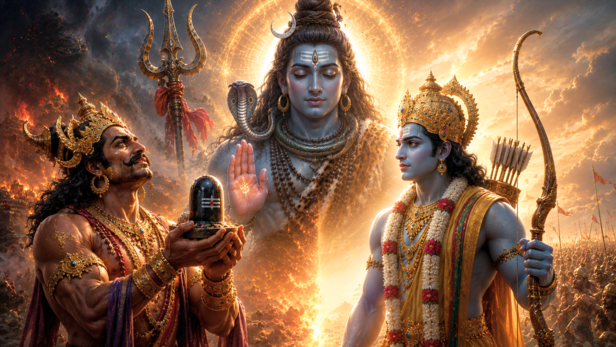
One of the most fascinating truths in the Ramayana is that Ravana was not just a villain, but a deeply devoted follower of Shiva, whose intense tapasya and unwavering focus earned him divine attention. Ancient texts describe Ravana as a brilliant scholar, a master musician, and above all, a powerful devotee who performed severe penance for years, compelling the gods to grant him extraordinary boons. Ravana’s devotion to Shiva is central to understanding why he was blessed. In Hindu philosophy, divine grace is not given based on moral judgment alone but on the intensity and sincerity of devotion. Shiva, known for his compassion toward devotees regardless of their nature, responded to Ravana’s tapasya by granting him strength, protection, and spiritual favor. This was not an endorsement of Ravana’s future actions, but a recognition of his devotion in that moment.
When Devotion Turned Into Ego
However, the story does not end with devotion. Ravana’s greatest strength slowly became his greatest weakness. The same power and blessings he received began to fuel an overwhelming sense of pride and invincibility. He started violating dharma, the fundamental law of righteousness, most notably by abducting Sita, the wife of Rama, an act that set the stage for his downfall. This transformation reveals a crucial aspect of Hindu thought. Divine blessings do not remove free will. Ravana was given power, but how he used it remained his choice. His descent into arrogance shows that devotion alone is not enough if it is not accompanied by humility and adherence to dharma.
Why Shiva Did Not Protect Ravana in the End
A question that naturally arises is why Shiva, who blessed Ravana, did not ultimately protect him. The answer lies in the very nature of Shiva himself. Shiva is not bound by personal loyalty in the way humans understand it. He represents the ultimate truth and cosmic balance, which must remain intact above all else. When Ravana crossed the limits of dha rma, his fate was no longer about personal devotion but about restoring universal order. Shiva’s role was never to shield wrongdoing, even if the wrongdoer was his devotee. In this sense, Shiva did not abandon Ravana. He simply did not interfere with the consequences of Ravana’s own actions.
Why Rama Became the Chosen Force of Dharma
Rama, as an incarnation of Vishnu, represents the embodiment of dharma, discipline, and moral order. His battle against Ravana was not just a personal conflict but a cosmic necessity to restore balance in the universe. Ravana’s boon made him nearly invincible against gods, but he had dismissed humans as insignificant, which is why Vishnu incarnated as Rama to defeat him. This is a profound moment in the epic because it shows that divinity can manifest in the simplest forms to overcome even the greatest power when dharma is at stake.
In supporting Rama, Shiva was not choosing sides in a rivalry. He was aligning with the principle that sustains the universe. Rama’s victory was not just about defeating Ravana, but about reestablishing righteousness.
The Deeper Truth Behind Shiva’s Decision
The apparent contradiction of Shiva blessing Ravana yet allowing his defeat reveals a deeper spiritual truth that goes beyond good and evil. Hindu philosophy does not present the divine as biased toward individuals but as aligned with principles. Ravana was rewarded for his devotion, but he was also held accountable for his actions. Rama was supported not because he was opposed to Ravana, but because he upheld dharma. This duality shows that the divine does not operate on favoritism but on balance.
In the end, the story is not about Shiva choosing one over the other. It is about the universe correcting itself. Ravana’s devotion earned him greatness, but his ego led to his fall. Rama’s righteousness ensured his victory. And Shiva, beyond both, remained the silent force that upheld the cosmic order, reminding us that true divinity always stands with dharma, not with power alone.
Unlock insightful tips and inspiration on personal growth, productivity, and well-being. Stay motivated and updated with the latest at My Life XP.