
Why Some Hanuman Idols Have Five Faces (Panchamukhi Hanuman)
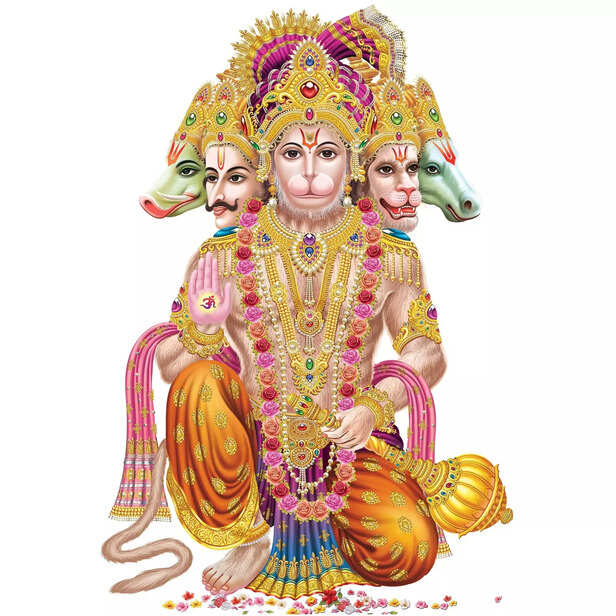
Among the countless depictions of Lord Hanuman — from the mighty warrior carrying a mountain to the humble servant bowing before Lord Rama — one unique image often draws attention and curiosity: Hanuman with five faces.
Known as Panchamukhi Hanuman, this rare and powerful form holds deep mythological meaning and spiritual symbolism. But why does Hanuman have five faces in some idols? Where did this form come from, and what do the five faces represent?
1. The Legend Behind the Five Faces
The tale of Panchamukhi Hanuman comes from ancient Hindu texts beyond the main events of the Ramayana. After Ravana’s death, a new challenge arose in the netherworld. A sorcerer-demon named Ahiravana, a master of dark magic and Ravana’s brother, kidnapped Lord Rama and Lakshmana. He took them to Patala loka, the realm beneath the earth, with the intention of offering them as sacrifices to Goddess Kali.
To rescue them, Hanuman had to enter this mysterious world. But Ahiravana had a unique protection — his life was stored in five oil lamps placed in five directions, and all five had to be extinguished at the same moment for him to be killed.
To defeat Ahiravana, Hanuman transformed into Panchamukhi Hanuman, gaining five heads and immense power. Each face looked in a different direction. With this divine form, Hanuman simultaneously blew out the lamps and destroyed the demon, rescuing Lord Rama and Lakshmana.
This divine transformation marked the origin of the Panchamukhi form — a symbol of ultimate protection and divine energy.
2. What Do the Five Faces Represent?
Panchamukhi Hanuman isn’t just a visual marvel — it is a deeply symbolic image in Hindu spiritual practice. Each face is associated with a different deity and direction, and together they form a shield of divine energy.
1. Hanuman (East-facing)
- This is Hanuman’s original face.
- Symbolizes: Strength, courage, devotion, and loyalty.
- Direction: East, associated with new beginnings and enlightenment.
2. Narasimha (South-facing)
- Lion-headed avatar of Vishnu.
- Symbolizes: Destruction of evil, protection from fear.
- Direction: South, the direction of death and transformation.
3. Garuda (West-facing)
- The eagle mount of Vishnu.
- Symbolizes: Protection from poisons, snakebites, and black magic.
- Direction: West, symbolizing defense and removal of darkness.
4. Varaha (North-facing)
- The boar incarnation of Vishnu.
- Symbolizes: Earthly strength, lifting one from curses and negativity.
- Direction: North, which represents growth and stability.
5. Hayagriva (Skyward-facing)
- Horse-headed avatar of Vishnu known for wisdom.
- Symbolizes: Knowledge, intelligence, clarity.
- Direction: Upwards, indicating spiritual awakening.
Together, these faces protect devotees from all directions — and also represent mastery over the five senses and five elements (earth, water, fire, air, and ether)
3. Devotional Meaning and Worship
Panchamukhi Hanuman is not simply an artistic version of the deity — he is seen as a powerful protector and spiritual guardian. Many devotees turn to this form when facing challenges like:
- Black magic or evil energies
- Unexplainable fears or nightmares
- Serious health concerns or mental distress
- Financial instability or loss of direction in life
Worshippers believe that Panchamukhi Hanuman watches over them from all sides and wards off unseen forces. His idols or pictures are often placed at the entrance of homes, in vehicles, and even in workplaces, as a spiritual shield.
4. Mantras and Practices
Special prayers and chants are dedicated to this form of Hanuman. Among the most popular is the Panchamukhi Hanuman Kavach, which offers protection through the invocation of each face. Some also chant the following mantra for strength and safety:
These mantras are typically recited on Tuesdays and Saturdays, which are considered sacred to Hanuman.
5. Temples and Cultural Importance
Panchamukhi Hanuman is especially venerated in South India, where several temples are dedicated solely to this form. One of the most well-known is in Rameswaram, Tamil Nadu, believed to be the place where Hanuman first appeared in his five-faced form.
In Karnataka, the Panchamukhi Hanuman Temple near Mantralayam is another pilgrimage site, attracting thousands of devotees every year.
The image of Panchamukhi Hanuman has also become popular among spiritual seekers and tantric practitioners, as it is believed to help overcome internal enemies like ego, fear, and confusion.
Final Thoughts
The image of Lord Hanuman with five faces is far more than a visual or artistic variation — it is a symbol of divine mastery, multidimensional strength, and ultimate protection. Panchamukhi Hanuman teaches us that to face life’s challenges, one must be alert in all directions — physically, emotionally, mentally, and spiritually.
He is not just the brave monkey-god of Ramayana, but a cosmic protector, guiding those who seek courage, clarity, and peace.
Frequently Asked Questions [FAQ's]
- Why does Hanuman always face east in most temples and images?
East symbolizes sunrise, new beginnings, and spiritual awakening. Hanuman's east-facing form signifies victory of light over darkness and aligns with his role as a protector and remover of obstacles. - Is Panchamukhi Hanuman worshipped for different purposes than regular Hanuman?
Red or orange is the color of tapasya (penance), sacrifice, and energy (shakti). It also reflects his eternal celibacy and burning devotion toward Lord Rama. Saffron is also symbolic of spiritual power and detachment. - Why does Hanuman wear a crown and royal ornaments if he was a humble devotee?
While Hanuman is known for humility, he is also worshipped as a divine king and warrior. The crown and ornaments honor his supreme strength, divine birth, and status among gods as a protector of Dharma. - Can chanting Hanuman Chalisa daily affect mental health?
Yes. Devotees and spiritual practitioners believe it reduces anxiety, strengthens focus, and enhances confidence, especially because it activates the solar plexus (manipura chakra), associated with personal power.