
Why This Ganesha Idol Has 3 Trunks
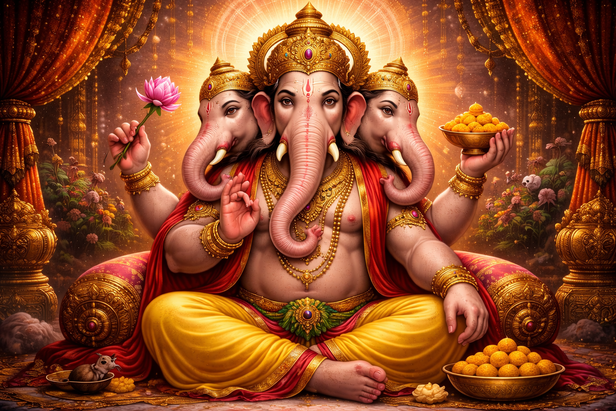
What if a single statue could hold centuries of mystery, symbolism, and spiritual depth? Hidden in the heart of Pune stands a rare form of Ganesha that immediately captures attention with its unusual appearance. Three trunks, six arms, and a powerful divine presence make it unlike any other representation. But beyond its striking form lies a deeper story one woven with philosophy, devotion, and ancient belief. It is not just stone carved into shape, but meaning carved into time. Every detail invites curiosity, hinting that what you see is only the surface of something far more profound and timeless.
A Temple Born From History
The Trishund Ganpati Temple was built in the 18th century under the guidance of Mahant Morya Gosavi tradition. Interestingly, historical records suggest it was originally planned as a Shiva temple. However, over time, it evolved into a sacred space dedicated to Ganesha. This shift itself adds mystery to its origin, making it more than just a structure it becomes a story of transformation.
The Rare Three-Trunk Form
The most striking feature of this idol is its three trunks. According to traditional interpretation, they represent Sattva, Rajas, and Tamas the three fundamental qualities of nature. This rare depiction is not commonly found in Ganesha temples. It symbolizes balance between action, stability, and awareness. It is not just artistic creativity it is deep philosophical expression carved in stone.
More Than Just Sculpture
The idol also features six arms and intricate carvings, reflecting extraordinary craftsmanship of its time. Every detail in the sculpture reflects precision and devotion. This is not just religious art it is a fusion of architecture, symbolism, and spiritual philosophy. Ancient artisans didn’t just build idols; they encoded meaning into every curve and shape.
A Place of Meditation and Silence
Over centuries, saints and seekers have meditated here. The temple is believed to hold a calm energy that supports deep contemplation. This is why it became more than a place of worship it turned into a center of spiritual practice. People come not just to pray, but to experience stillness within themselves.
Why This Temple Still Matters Today
In today’s fast-moving world, places like this remind us of something deeper balance. The Trishund Ganesh form of Ganesha teaches that life is never one-dimensional. It is a continuous blend of thoughts, emotions, actions, and inner energy working together. When we understand this symbolism, we begin to see life more clearly and calmly. Instead of being pulled in different directions, we learn to stay centered. This awareness helps us reconnect with inner stability, patience, and focus. Ultimately, such teachings are not just about belief they are about finding harmony within ourselves in a world full of constant noise and distraction.
Frequently Asked Questions (FAQs)
Q1. What is Trishund Ganesh?
It is a rare depiction of Ganesha shown with three trunks and multiple arms, symbolizing deeper spiritual meanings and cosmic balance.
Q2. Where is the Trishund Ganesh temple located?
It is located in Pune, Maharashtra, and is known for its unique architecture and spiritual significance.
Q3. What do the three trunks represent?
They are commonly interpreted as the balance of three energies—creation, preservation, and transformation.
Q4. Why is this form considered special?
Because it is rare in iconography and represents complex philosophical ideas in a single form.
Q5. Is it only a religious symbol?
No, it is also seen as a symbol of art, heritage, and inner awareness.
Q6. Can visitors experience anything unique there?
Many visitors report a sense of calm, focus, and reflection when they spend time at the temple.