
Why Vijay’s First Day as CM Sparked a Tamil Identity Row
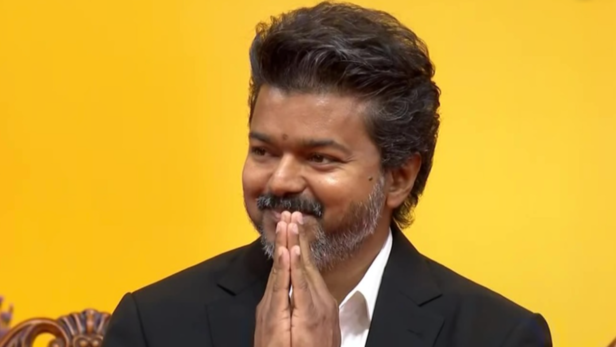
For C. Joseph Vijay, May 10 was meant to be the symbolic beginning of a new political chapter. The actor-turned-politician, whose rise has already altered Tamil Nadu’s political landscape, took oath as Chief Minister amid enormous public attention, ending decades of uninterrupted dominance by the state’s traditional Dravidian power centres. But within hours, what should have been remembered purely as a historic transfer of power became the center of a sharp political and cultural controversy.
The dispute did not arise from Vijay’s speech, cabinet choices, or his first administrative decisions. It emerged from the order in which songs were played during the swearing-in ceremony. That seemingly procedural decision quickly opened a deeper debate touching on Tamil identity, constitutional symbolism, federal culture, and the emotional weight of public ritual in a state where language and cultural dignity have long shaped politics.
The moment that triggered the row
At the swearing-in ceremony, “Vande Mataram” was played first, followed by the national anthem “Jana Gana Mana,” while “Tamil Thaai Vaazhthu,” the Tamil invocation song traditionally accorded prominence at official state functions, was played third. That sequence immediately drew criticism because many in Tamil Nadu viewed it as a break from long-observed state convention.
The issue may appear technical from a distance. Yet in Tamil Nadu, ceremonial order carries political meaning. Public events are not merely formal occasions but symbolic declarations of cultural hierarchy and constitutional sensibility. When a state’s official invocation is displaced from its expected place, many do not see it as administrative detail. They see it as a statement about what is being prioritized and what is being pushed to the margins.
Why Tamil Thaai Vaazhthu carries unusual emotional force
To understand the intensity of the reaction, one has to understand what “Tamil Thaai Vaazhthu” represents. In Tamil public life, it is not simply a song used to begin official functions. It has deep emotional resonance tied to linguistic identity, cultural pride, and the historic assertion of Tamil distinctiveness within the Indian Union.
Tamil Nadu’s political history has been shaped by powerful movements centered on language, self-respect, and resistance to cultural homogenization. Across decades, public symbolism has often mattered almost as much as legislation. In that context, the placement of “Tamil Thaai Vaazhthu” was interpreted by critics not as a trivial ceremonial variation but as a sensitive cultural signal.
Why Vande Mataram became part of the debate
“Vande Mataram” is India’s national song and carries immense historical significance in the freedom movement. The controversy was not about the legitimacy of the song itself. The sharper debate was over sequence, precedence, and the setting in which it was played. Recent reporting also noted that the inclusion was linked to a Union government directive concerning official ceremonial practice. That shifted the conversation beyond a state-level political argument and into a wider discussion about how national symbolism and regional identity are negotiated in a federal democracy.
That distinction matters. Much of the criticism did not argue that national symbols should be excluded. Instead, it questioned whether Tamil Nadu’s own established ceremonial culture should have been altered at such a politically charged moment.
Why the controversy grew so quickly
The timing made the issue unusually combustible. Vijay was not merely taking oath as a new Chief Minister. He was assuming office after one of the most consequential political transitions in recent Tamil Nadu history.
His party, Tamilaga Vettri Kazhagam, emerged as the single largest force in the Assembly, and his swearing-in was widely viewed as the arrival of a new generation in Tamil politics. Because expectations were already unusually high, even symbolic choices came under immediate and intense scrutiny. What might have been a passing protocol debate in ordinary circumstances became, on his very first day, a test of political judgment. In politics, first impressions often acquire disproportionate significance. A ceremonial controversy on day one can become a lens through which supporters and opponents begin interpreting an entire administration.
The opposition response
Political criticism followed swiftly. Leaders from rival camps argued that “Tamil Thaai Vaazhthu” should have retained precedence at a state function. For them, the issue became part of a broader argument about preserving Tamil political culture and respecting long-standing public convention. The criticism was sharpened because symbolic questions often travel faster than policy debates. Economic decisions require explanation. Administrative reforms take time. But a moment from a public ceremony can circulate instantly, especially when it touches identity. That explains why the conversation moved rapidly beyond the hall where the oath was administered and into the wider political arena.
TVK’s response and attempt at damage control
As the controversy intensified, Tamilaga Vettri Kazhagam sought to contain the fallout. Party general secretary Aadhav Arjuna said that going forward, “Tamil Thaai Vaazhthu” would be played first at official functions, followed by the national anthem at the end. He also indicated that the sequence at the swearing-in had been connected to arrangements made by the Governor’s office.
That response was politically important for two reasons. First, it signaled that the party recognized the emotional depth of the issue. Second, it suggested that the government was unwilling to allow an avoidable symbolic dispute to define the opening days of Vijay’s tenure. Whether that fully resolves the matter remains uncertain, but it clearly represented an attempt to restore equilibrium.
The deeper political meaning
At its core, this controversy is about more than the order of songs. It reveals the continuing force of Tamil political consciousness in a period of transition. Even as Tamil Nadu enters a new phase under Vijay, the old political grammar of language, dignity, cultural precedence, and federal identity remains deeply alive. The episode also demonstrates something important about modern leadership. Electoral victory does not automatically settle symbolic expectations. In fact, once a leader acquires power, symbolic choices often become even more consequential because they are interpreted as expressions of governing philosophy. For Vijay, that is perhaps the most significant lesson of his first day in office.
A balanced reading
A balanced assessment also requires caution against overstating the episode. There is no evidence that the ceremony was designed as an attack on Tamil identity. Nor is there evidence that national symbols were invoked with hostile intent. Available reporting suggests the controversy arose from ceremonial protocol, interpretation, and political sensitivity rather than from explicit confrontation. That distinction matters because democracies often become vulnerable when symbolic disagreements are immediately converted into accusations of deliberate cultural hostility.
At the same time, dismissing the reaction as mere political theatrics would miss the historical depth of Tamil Nadu’s public culture. In this state, symbols have memory. They carry accumulated meanings built over generations.
Conclusion
Vijay’s first day as Chief Minister was supposed to mark a triumphant political beginning. It still did. But it also became an early reminder that governing Tamil Nadu requires more than electoral momentum, public popularity, or administrative ambition. It requires sensitivity to a political culture in which language, symbolism, and ceremonial order are inseparable from democratic legitimacy. That is why the row over “Vande Mataram” and “Tamil Thaai Vaazhthu” became much larger than a matter of protocol. It became the first real test of how Tamil Nadu’s new Chief Minister will navigate the delicate space between national symbolism and regional identity. And in a state where political meaning often lives inside public ritual, that test began almost the moment he took oath.
Unlock insightful tips and inspiration on personal growth, productivity, and well-being. Stay motivated and updated with the latest at My Life XP.