
Why Vishnu Took 24 Avatars, Not Just 10
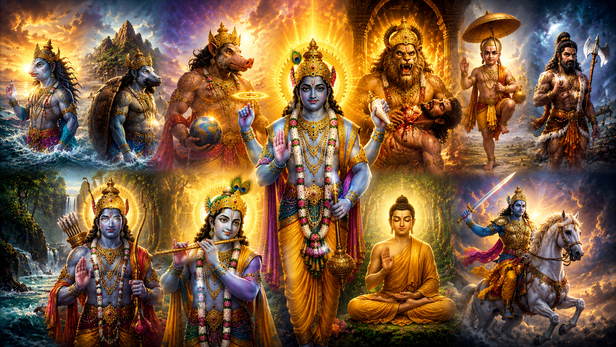
Ask most people about Lord Vishnu's incarnations, and they will immediately name the Dashavatara. But did you know that the Shrimad Bhagavatam describes 24 principal avatars, each appearing for a unique purpose? Every incarnation was not meant to fight demons alone. Some came to spread knowledge, some restored Dharma, while others protected sacred wisdom or guided humanity toward spiritual awakening. The final eight avatars reveal a deeper side of Vishnu's divine mission one that goes far beyond the stories most people have heard.
When Dharma Needed a New Beginning
Treta Yuga witnessed two remarkable incarnations before the appearance of Lord Rama. As Vamana, Bhagwan humbled the mighty King Bali with three divine steps and restored balance to the universe. Later, as Parashurama, He destroyed tyrannical rulers who had abandoned Dharma and misused their power. These two avatars teach that true strength lies in humility, justice, and using power only for righteousness rather than personal pride.
The Perfect King Who Defined Righteous Living
Among all incarnations, Shri Rama is remembered as Maryada Purushottam the perfect example of righteousness. Every decision He made placed Dharma above personal comfort, whether accepting exile, protecting sages, or defeating Ravana. His life reminds humanity that greatness is measured not by power alone but by character, compassion, honesty, and unwavering commitment to truth, even during the most difficult circumstances.
Knowledge Became the Greatest Divine Weapon
Not every avatar came with weapons in hand. As Veda Vyasa, Bhagwan divided the single Veda into four parts and composed the Puranas and Mahabharata so that spiritual knowledge could reach ordinary people. His incarnation reminds us that preserving wisdom is just as important as defeating evil. Knowledge protects Dharma long after battles have ended.
Strength Guided by Compassion
In Dwapara Yuga, Bhagwan appeared as Balarama and Shri Krishna, two avatars with different yet complementary missions. Balarama symbolised physical strength, discipline, and protection of righteousness, while Krishna combined wisdom, diplomacy, devotion, and divine love. Through the Bhagavad Gita, Krishna taught that performing one's duty with faith and detachment is the highest path toward liberation.
Compassion Became the Highest Teaching
As Kali Yuga began, Bhagwan appeared as Buddha Avatar to encourage compassion and non-violence. His teachings challenged unnecessary violence performed in the name of religion and reminded humanity that kindness and wisdom are inseparable from true spirituality. This avatar demonstrated that protecting Dharma sometimes requires changing hearts rather than defeating enemies through force.
Every Avatar Carried a Different Divine Purpose
The final eight avatars show that Bhagwan Vishnu's mission extended far beyond destroying demons. Some avatars protected sacred scriptures, some restored justice, others spread knowledge, and some inspired compassion. Together, they reveal that Dharma survives not only through strength but also through wisdom, humility, devotion, and selfless service. Every age required a different solution, and every incarnation answered that need perfectly.
The 24 Avatars Reveal a Greater Spiritual Journey
The Dashavatara are only part of a much larger spiritual narrative described in the Shrimad Bhagavatam. The complete list of 24 principal avatars presents Bhagwan Vishnu as the eternal protector of creation, appearing whenever knowledge fades, righteousness declines, or humanity loses its way. Each incarnation offers a timeless lesson, reminding us that Dharma is protected through courage, wisdom, compassion, humility, and unwavering devotion. The journey of these avatars is ultimately the journey of humanity toward truth and spiritual awakening.
Unlock insightful tips and inspiration on personal growth, productivity, and well-being. Stay motivated and updated with the latest at My Life XP.
Frequently Asked Questions (FAQs)
1. Does Lord Vishnu have only 10 avatars?
No. While the Dashavatara (10 principal incarnations) are the most widely known, the Shrimad Bhagavatam describes 24 principal avatars of Lord Vishnu. Each incarnation appeared with a unique purpose to protect Dharma, preserve knowledge, and guide humanity.
2. Why are only the Dashavatara more popular?
The Dashavatara became the most well-known because these incarnations played major roles in Hindu scriptures and are widely celebrated through festivals, temples, and devotional traditions. However, other avatars mentioned in the Shrimad Bhagavatam are equally important in conveying spiritual teachings.
3. Which are the final eight avatars in the traditional list of the 24 avatars?
The final eight avatars traditionally include:
- Vamana
- Parashurama
- Shri Rama
- Veda Vyasa
- Balarama
- Shri Krishna
- Buddha
- Kalki (the future avatar who is yet to appear at the end of Kali Yuga)
4. Why did Lord Vishnu take different avatars?
According to Hindu scriptures, Lord Vishnu incarnates whenever Dharma declines and Adharma rises. Each avatar appeared to fulfil a specific purpose, such as protecting devotees, restoring righteousness, preserving sacred knowledge, or guiding humanity toward spiritual growth.
5. Which scripture mentions the 24 avatars of Lord Vishnu?
The Shrimad Bhagavatam (Bhagavata Purana), especially Canto 1, Chapter 3, describes the principal avatars of Lord Vishnu and explains their divine missions