
Why Your Nakshatra Has Its Own Vishnu Sahasranama Shloka
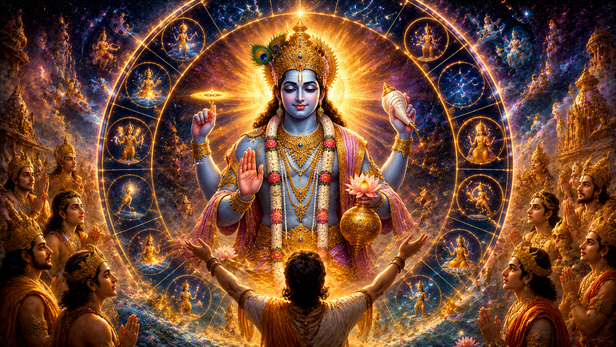
What if the most powerful prayer for you was chosen the moment you were born?For centuries, millions have recited the Vishnu Sahasranama without realizing that its 108 verses may hold a deeply personal connection with their birth. According to an intriguing Vedic tradition, every individual is linked to one specific shloka based on their Nakshatra and Pada. This isn't just another spiritual beliefit is a fascinating way of understanding how astrology and sacred chants come together. Could your birth star already be pointing you toward the exact prayer meant for you? Let's uncover this remarkable connection that very few people know.
The Sacred Math That Most People Never Notice
The connection begins with a simple calculation. Vedic astrology recognizes 27 Nakshatras, and each Nakshatra is divided into four Padas. Together they create 108 divisions, the very number of verses traditionally associated with the Vishnu Sahasranama. Rather than being viewed as a coincidence, many Vedic scholars believe this reflects a carefully designed spiritual system where every verse symbolically corresponds to one specific Nakshatra Pada, creating a personal link between birth and devotion.
Your Birth Star May Already Have a Personal Shloka
Imagine discovering that your birth itself has already chosen a prayer for you. According to this traditional belief, every Nakshatra Pada is linked with one particular Vishnu Sahasranama shloka. For example, someone born in the first Pada of Ashwini Nakshatra is believed to begin with the very first verse. This creates a deeply personal spiritual practice, where chanting is not random but connected to the unique celestial position present at birth.
Why Ancient Sages Connected Astrology With Devotion
In Vedic thought, astrology was never meant only for predicting the future. It also served as a guide for self-improvement and spiritual growth. Sacred chants were considered powerful vibrations capable of calming the mind and strengthening positive qualities. By assigning one Vishnu Sahasranama verse to each Nakshatra Pada, sages created a simple path that combined devotion with astrology, allowing individuals to seek inner balance through daily prayer and remembrance of Lord Vishnu.
Can One Shloka Really Balance a Nakshatra?
Traditional belief suggests that regularly chanting the verse linked to your birth Nakshatra helps harmonize the natural qualities associated with it. While this is a matter of spiritual faith rather than scientific proof, many devotees believe focused chanting encourages emotional stability, mental clarity, and stronger devotion. The practice is less about changing destiny and more about developing discipline, faith, and a peaceful state of mind through consistent remembrance of the Divine.
A Simple Example Makes the Idea Easy to Understand
Suppose two people chant the Vishnu Sahasranama every day. One recites the entire text, while another begins by focusing on the specific verse associated with their birth Nakshatra. According to this tradition, the second person is adding a personal spiritual connection to the practice. For someone born in Ashwini Nakshatra, First Pada, that journey begins with the very first shloka, making devotion feel even more meaningful and closely tied to one's birth.
How You Can Discover Your Own Sacred Verse
The first step is knowing your exact birth details, including date, time, and place. These help identify your Nakshatra and its Pada through a Vedic birth chart. Once you know this information, you can refer to traditional Vishnu Sahasranama mappings followed by your lineage or teacher to find the corresponding verse. Learning its meaning before chanting can make the practice even more thoughtful and spiritually enriching.
The Real Secret Is the Personal Connection
The greatest beauty of this tradition is not the mathematics or astrology it is the feeling that spirituality can become deeply personal. Instead of viewing the Vishnu Sahasranama as only a sacred text, this belief encourages people to see it as a lifelong companion connected to the moment they entered the world. Whether followed as a traditional practice or appreciated as symbolic wisdom, it reminds us that devotion becomes most powerful when it feels personal, meaningful, and consistent.
Unlock insightful tips and inspiration on personal growth, productivity, and well-being. Stay motivated and updated with the latest at My Life XP.
Frequently Asked Questions (FAQs)
1. What is the connection between Nakshatras and Vishnu Sahasranama?
According to a traditional Vedic belief, the 27 Nakshatras are divided into 4 Padas each, making a total of 108 divisions. These are symbolically associated with the 108 verses of Vishnu Sahasranama, with each Nakshatra Pada linked to a specific shloka.
2. How do I know which shloka belongs to my Nakshatra?
You first need to find your Nakshatra and Pada using your birth date, time, and place. After that, you can refer to traditional Vishnu Sahasranama mappings followed in your spiritual lineage or consult a knowledgeable Vedic astrologer.
3. Is this connection mentioned directly in the Vishnu Sahasranama?
No. This is a traditional interpretative belief found in some Vedic and spiritual traditions. The Vishnu Sahasranama itself is a sacred hymn containing the thousand names of Lord Vishnu.
4. Can chanting my specific shloka remove problems in life?
Many devotees believe that chanting the shloka connected to their birth Nakshatra helps create mental peace, spiritual focus, and inner balance. However, it should be practiced as an act of devotion rather than seen as a guaranteed solution to every problem.
5. What if I do not know my birth time?
Without an accurate birth time, identifying the exact Nakshatra Pada can be difficult. In such cases, people often chant the entire Vishnu Sahasranama, which is considered highly auspicious for everyone.