The sea looks uniform from the beach. A stretch of blue-green water, some foam, the occasional wave breaking at an angle. But the surface is a map, and it is being redrawn every few seconds. Rip currents, longshore drift, and feeder currents are all visible before you enter the water, if you know the vocabulary the water is using.
Stand Back Before You Step In
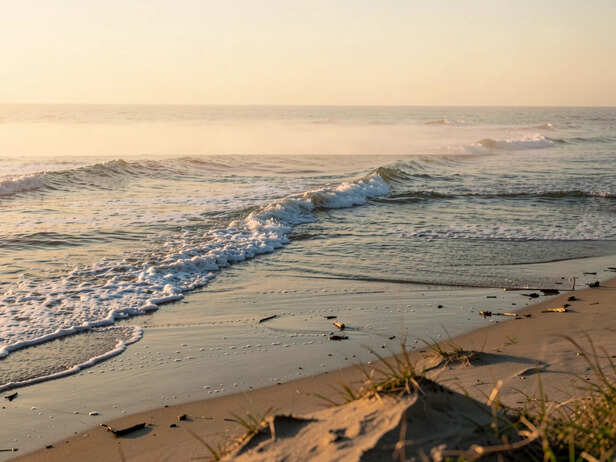
![Golden Hour Beach Shoreline]()
Golden Hour Beach Shoreline
Image credit : MyLifeXP Bureau
Spend two minutes above the waterline before you go anywhere near it. The higher your vantage point, the more the pattern reveals itself. A low dune, a rock shelf, even the top of a beach staircase gives you enough elevation to see the surface as a system rather than as a series of individual waves.
What you are looking for first is the break line, the point where waves stop being smooth and begin to tumble. A consistent break line, running parallel to the shore, usually means the water is behaving predictably. A break line that curves, gaps, or disappears in one section is the first signal that something is pulling water in a direction you have not accounted for.
What a Rip Current Actually Looks Like
A rip is not a wave. It does not crash. It is a narrow, fast-moving river of water heading away from shore, and it looks calmer than the water on either side of it, which is exactly why swimmers wade into it.
The visual signs, in order of reliability:
A gap in the break line. Waves break where shallow water forces them to. Where the water is deeper, because a rip has scoured a channel, waves do not break, or break much smaller. That quiet strip between two sections of white water is often a rip channel.
Discoloured water. The channel a rip carves tends to carry sand, sediment, and foam out to sea. Look for a strip of water that is darker, murkier, or more brown-green than the water beside it. On a clear day this contrast is stark. On an overcast day it is subtler, but still visible.
Foam and debris moving seaward. Watch the surface for thirty seconds. Foam, seaweed, and floating debris caught in a rip will travel steadily away from shore rather than washing back and forth. If something on the surface is moving in one direction without pausing, the water under it is too.
Churned, choppy surface. The edges of a rip channel, where the outgoing current meets the incoming water on either side, produce a distinctive choppy texture, small, confused waves that do not align with the swell direction. This turbulence marks the rip's shoulders.
Reading Longshore Currents
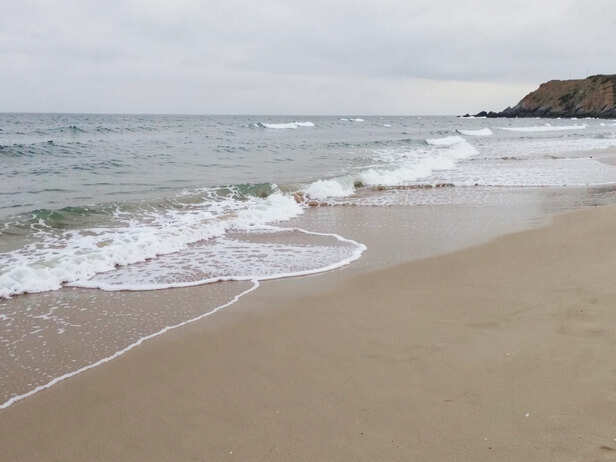
![Sandy Beach, Angled Waves]()
Sandy Beach, Angled Waves
Image credit : MyLifeXP Bureau
A rip runs perpendicular to the shore. A longshore current runs parallel to it, and it is the current most swimmers underestimate because it does not feel like danger, it just feels like the water is a little pushy.
To spot a longshore current, watch where the foam from breaking waves goes after the wave has finished. If it consistently washes in one direction along the beach rather than draining straight back, there is a longshore current running that way. Swimmers who enter the water without noticing this find themselves fifty metres down the beach from their towel without understanding how they got there.
Longshore currents are strongest at beaches with a pronounced angle between the swell direction and the shoreline. If the waves are arriving from the left and breaking at an angle rather than straight-on, the water they push along the shore has to go somewhere. It goes sideways, and it takes you with it if you are not swimming against it.
Flags, Locals, and the Shape of the Beach
Lifeguard flags are the fastest read available. Red-and-yellow flags mark the patrolled swimming zone. A black-and-white chequered flag marks the area reserved for surfboards and other craft. A single red flag means conditions are dangerous for all swimmers. Two red flags mean the water is closed. These are not suggestions.
Where there are no flags, the beach's physical shape tells you something. Rips form most reliably at breaks in sandbars, beside rocky headlands, at the ends of beaches where the shoreline curves, and at the mouths of channels cut by rainwater draining from the land. If the beach has a headland at one end and a flat open section in the middle, the current is most likely running from the open section toward the headland.
Local knowledge compresses years of observation into one conversation. A fisherman, a surf instructor, a regular morning swimmer, any of them can tell you in thirty seconds where the water moves at this beach and at this tide. That information is not in any guide.
If You Are Already in a Rip
The instinct is to swim directly back to shore. That instinct works against you, because a rip is narrower than it is fast. Swimming against it exhausts most people before they make any ground.
The standard advice from water safety organisations is to swim parallel to the shore, across the current, not against it, until you are out of the rip channel, then angle back in. If you cannot swim out of it, float and signal. A rip will not pull you underwater. It will carry you past the break zone into calmer water, where you can rest and then swim back at an angle.
Staying calm is not a platitude here. A rip's speed, typically one to two metres per second, feels alarming, but it is not faster than a person can think. Panic burns the energy that floating preserves.
The ability to read the water before you enter it is what makes the rip scenario rare rather than routine. Two minutes of looking from the shore, knowing what a gap in the break line means, watching which way the foam moves, these observations are available to anyone standing on a beach. The sea does not hide what it is doing. It just requires you to look before you step in.
Unlock insightful tips and inspiration on personal growth, productivity, and well-being. Stay motivated and updated with the latest at
My Life XP.