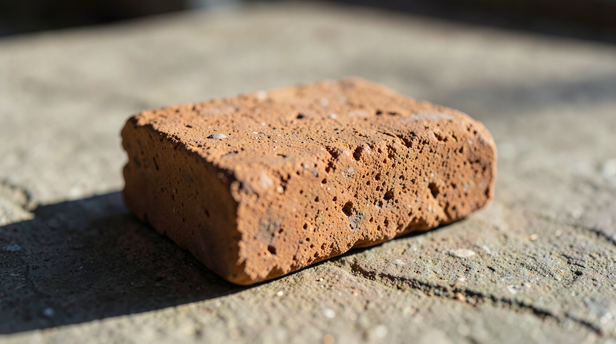
The first thing most visitors notice at Nalanda is the scale. The second thing, if they slow down, is the texture. Every wall, every staircase riser, every arched doorway that still holds its curve, all of it is brick. Not stone. Brick, fired in kilns, laid in courses, mortared with a lime paste that has held for over a thousand years in a climate that should have dissolved it. A single brick pulled from this site, were you allowed to pull one, would tell you more about how Nalanda worked than most of the interpretive boards nearby.
Why Brick and Not Stone
The Bihar plain that Nalanda sits on has almost no surface stone. The nearest quarry of any quality is far enough that transporting dressed stone in the volumes this campus required would have been a logistical project of a different order entirely. Brick was the answer the landscape offered, and the builders took it seriously. The bricks at Nalanda are not uniform, they vary in size across different periods of construction, which is one of the ways archaeologists date the phases of the site. The earliest courses tend to be larger and slightly coarser. Later additions show a more standardised form, suggesting something like a production system rather than ad hoc firing.
![Ancient Fired Brick Texture]()
Ancient Fired Brick Texture
Image credit : AI
What the Kilns Required
Firing brick at this scale needed fuel, and fuel meant wood, and wood meant organised access to forest. Estimates of how many bricks the full campus contained run into the tens of millions. Each firing cycle consumed enormous quantities of timber. The landscape around a working Nalanda would have looked quite different from the flat agricultural plain you see today, there would have been smoke, stacked fuel, the heat shimmer of active kilns somewhere nearby. The brick was not a humble material here. It was an industrial undertaking dressed in a monastic setting.
The Lime That Held It Together
![Ancient Bihar Stupa Dawn]()
Ancient Bihar Stupa Dawn
Image credit : MyLifeXP Bureau
Brick alone does not explain the survival. The mortar does. Nalanda's builders used a lime-based paste that, in the right conditions, continues to harden over centuries rather than weakening. This is a property of hydraulic lime: it sets through a chemical reaction with water rather than simply drying, and it keeps gaining strength long after the wall is built. Where that mortar has been protected from direct rain by a collapsed upper course or a later fill of earth, it is still intact. Where it has been exposed, the brick has separated. The condition of any given wall at Nalanda is largely a story about what happened to its mortar.
Reading the Stupa Cores
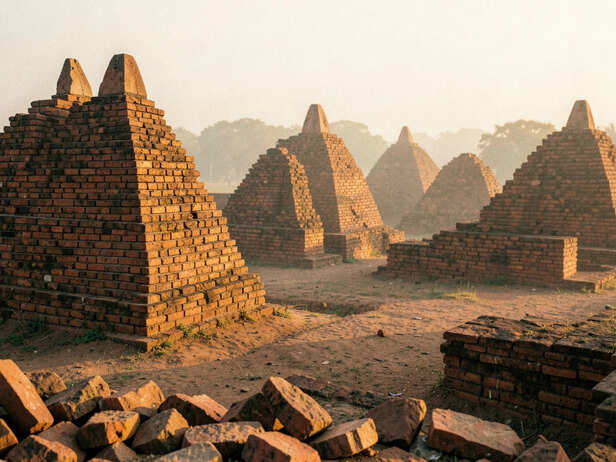
The most instructive structures on the site are the votive stupas, the smaller ones that cluster around the main temple mound. Their outer faces have mostly eroded or been robbed for later construction, but their cores are exposed, and the cores show the building logic clearly. Courses of brick are laid in alternating patterns: one course running lengthwise, the next running across. This is not decorative. It is structural, a way of tying the wall together so that it behaves as a single mass rather than two parallel faces with rubble between them. The builders understood compression and load distribution in practice, even without the vocabulary we now use for it.
What Robbing the Site Tells You
Nalanda was not only built with brick. It was also unmade with it. After the campus fell into disuse, local builders quarried it for centuries. Brick from Nalanda walls went into village houses, into wells, into field boundaries. This is not vandalism in any simple sense, it is how durable material moves through time when there is no institution left to protect it. The robbing also preserved the site in a strange way: the parts that were stripped of their outer courses had their cores exposed to air rather than to water ingress, and the cores sometimes survived better than the faced surfaces that were left standing. What you walk through today is partly what was too deep or too awkward to remove.
The One Brick Worth Looking At
There is a particular spot near the main excavated monastery blocks where a section of original flooring is still in place at ground level. The bricks are set on edge rather than flat, which increases the wearing surface and distributes foot traffic differently. They are worn smooth in the centre of what would have been a corridor, and the wear pattern is visible. Someone walked there, many people walked there, over a long enough period that the brick recorded it. That worn surface is the closest thing the site offers to a direct encounter with the people who used it, not the scholars whose names survived in Chinese travel accounts, but the ordinary movement of feet through an ordinary day in a place that happened to be extraordinary.
Unlock insightful tips and inspiration on personal growth, productivity, and well-being. Stay motivated and updated with the latest at
My Life XP.