The logic behind a long pre-wash oil soak is straightforward: more time means more penetration, more nourishment, more of whatever the oil is supposed to do. It is a reasonable assumption, and it is only partly right.
Oil does absorb into the hair shaft, but only up to a point. After that point, the extra oil sitting on the surface starts behaving differently from fresh oil, and that difference is exactly what makes wash day harder than it needs to be.
What Oil Actually Does in the First Hour
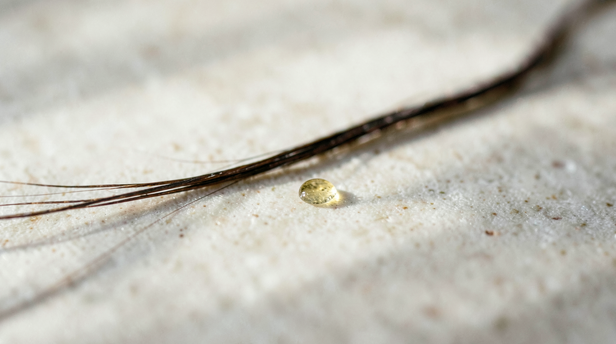
![Golden Oil on Hair Strand]()
Golden Oil on Hair Strand
Image credit : MyLifeXP Bureau
Oils that penetrate the hair shaft, coconut oil being the most studied, work by temporarily filling the spaces inside the cortex, the inner layer of the strand. This reduces the amount of water the hair absorbs during washing, which is what limits the swelling and friction that cause breakage when wet hair is handled. The benefit is real, and it happens relatively quickly. Most of the penetration that a penetrating oil can achieve happens in the first thirty to sixty minutes on clean, dry hair. After that, the cortex is as saturated as it is going to get, and the remaining oil is sitting on the cuticle and the surface of the strand.
Oils that do not penetrate, argan, castor, jojoba, coat the surface from the start. They add slip and shine by smoothing the cuticle, and that job is done as soon as the oil is spread evenly. Time does not improve the result.
What Changes When Oil Sits for Several Hours
Surface oil that sits undisturbed for a long time does two things. First, it oxidises slowly. Exposure to air causes the unsaturated fatty acids in most plant oils to begin breaking down, producing compounds that can smell slightly rancid and that are harder to emulsify than fresh oil. This is not dramatic after a few hours, but it is measurable, and it is why hair that has soaked overnight sometimes smells faintly off even after washing.
Second, the oil migrates. It moves along the strand by capillary action, travels down toward the scalp, and spreads into the follicle opening. Scalp skin produces its own sebum, and the combination of sebum and applied oil creates a thicker, stickier layer than either alone. This is the layer that shampoo has to break through, and it is why one round often does not do it.
Why Shampoo Struggles With a Heavy Oil Load
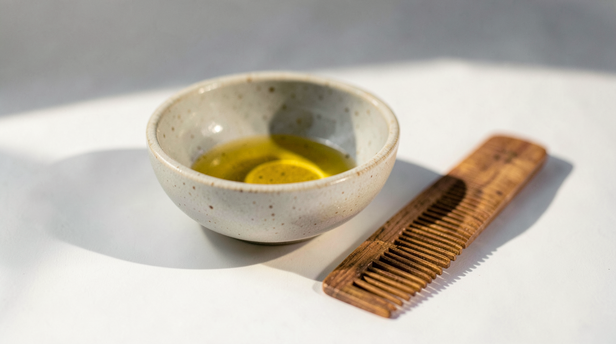
![Golden Oil Ritual]()
Golden Oil Ritual
Image credit : MyLifeXP Bureau
Shampoo works through surfactants, molecules with one end that attracts oil and one end that attracts water. When you lather, the surfactant molecules surround the oil droplets, lift them off the hair, and carry them away in the rinse water. This process is called emulsification, and it works efficiently when the oil layer is thin and evenly spread.
A thick, oxidised, scalp-mixed oil layer resists emulsification for two reasons. The layer is too deep for surfactants to penetrate in a single pass, so the first lather lifts the surface oil but leaves the lower layer largely intact. The second lather reaches further but still may not clear the follicle area. This is why the double-shampoo recommendation exists, and why it sometimes takes three passes if the soak was long and the oil was heavy.
Each extra lather also strips more of the hair's own moisture barrier than a single wash would. The scalp's natural sebum, which is different from applied oil and genuinely protective, gets removed along with everything else. The result is a scalp that produces more sebum in the days after a heavy wash to compensate, which can make hair feel greasy faster than usual.
The Practical Difference a Shorter Soak Makes
A thirty-to-forty-five minute soak on dry hair before washing gives a penetrating oil like coconut enough time to do what it does well. A non-penetrating oil like argan or almond can be applied even closer to the wash, ten to fifteen minutes is enough to coat the cuticle and add slip without building up a thick surface layer.
Applying oil to damp hair rather than dry hair changes the equation further. Damp hair has already absorbed some water, which limits how much oil can enter the cortex, but it also means the surface oil sits in a thinner layer and emulsifies more easily. This is a useful approach if the goal is shine and detangling rather than deep conditioning.
Warming the oil slightly before applying it, not hot, just above room temperature, reduces its viscosity, which helps it spread more evenly in a thinner layer and makes the eventual wash easier.
What to Do If the Soak Was Already Long
If the oil has been on for several hours, the most effective approach before shampooing is to apply a small amount of conditioner or a diluted shampoo directly to dry, oiled hair and work it through before adding water. Conditioner contains emulsifying agents that begin breaking down the oil layer before the water dilutes the surfactants. Adding water first locks the surfactants into foam before they have done their emulsifying work, which is why a dry pre-lather is more efficient.
Once water is added, shampoo twice. The first lather will not feel like much, it will not foam well because the surfactants are occupied with oil, and that is the sign it is working. The second lather will foam normally, which is the sign the bulk of the oil is gone.
A light conditioner on the mid-lengths and ends after washing replaces the protective coating without reintroducing the scalp-heaviness the whole process was trying to avoid.
The oil itself is not the problem. The duration is. A shorter soak does the same conditioning work with less to undo on wash day, and that is the whole calculation.
Unlock insightful tips and inspiration on personal growth, productivity, and well-being. Stay motivated and updated with the latest at
My Life XP.