The skin does not know it is a festival. It responds to what arrives in the bloodstream, and during Diwali, what arrives is a concentrated dose of sugar, refined carbohydrates, and in many cases, dairy. The breakout that appears two days after the celebrations is not a coincidence. It is a sequence of events that begins in the gut and ends on the face.
What Sugar Does Once It Enters the Bloodstream
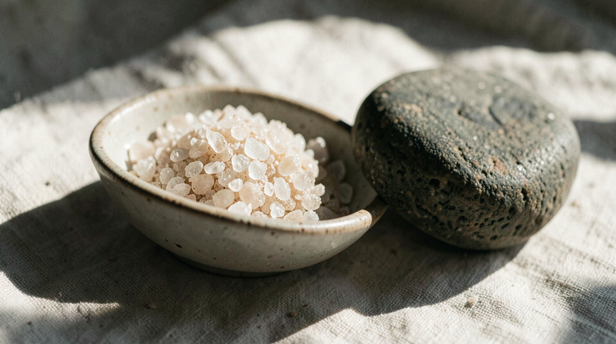
Every mithai, ladoo, barfi, gulab jamun, jalebi, delivers glucose quickly. The body responds by releasing insulin to move that glucose out of the blood. When this happens in a large spike rather than a gradual rise, insulin carries a companion: a group of hormones called insulin-like growth factors, or IGFs. These tell the sebaceous glands to produce more oil. More oil, more clogged pores, more breakouts. This is not a sensitivity or an allergy. It is standard sebaceous gland behaviour in response to a hormonal signal. The skin of someone who rarely breaks out will respond less visibly, but the mechanism is the same.
![Sugar Crystals and River Stone]()
Sugar Crystals and River Stone
Image credit : AI
The Glycation Effect on Skin Texture
Sustained high sugar intake, across several days of festive eating, not a single piece, contributes to a process called glycation. Glucose molecules bind to collagen fibres in the dermis, making them stiffer and less elastic. The result is not dramatic over a few days, but it is real: skin that looks slightly less plump and less reflective than usual. Glycation is cumulative and slow, which is why a week of festive eating does not age a face visibly, but years of high sugar intake do. The festive week is worth understanding as a smaller version of the same process.
Why Dairy-Heavy Sweets Affect Some Skin More Than Others
Khoya, paneer, condensed milk, and cream are the base of a large proportion of traditional mithai. Dairy contains whey and casein proteins that, in some people, trigger a mild inflammatory response in the skin. This is not the same as a dairy intolerance. It is a low-grade immune response that shows up as redness, congestion around the jawline and cheeks, or small bumps that are not quite pimples. Not everyone experiences this. The people who notice that dairy consistently affects their skin are not imagining it; the mechanism is real and documented in dermatology literature, even if the individual response varies considerably.
![Pure Water and Oats]()
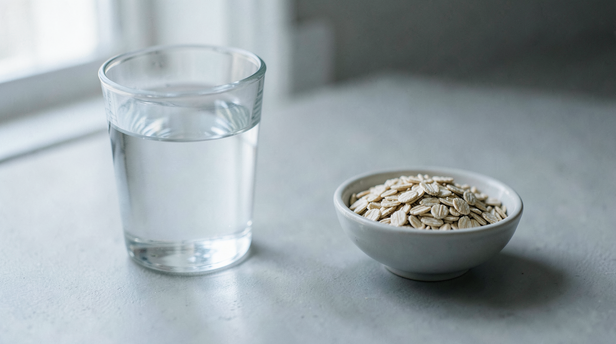
Pure Water and Oats
Image credit : AI
Puffiness, Salt, and the Mithai You Did Not Expect
Savoury festival snacks, namkeen, chakli, mathri, carry sodium in quantities that add up quickly across an evening. Sodium draws water into tissue. The puffiness around the eyes and jawline that appears the morning after a late Diwali night is partly sleep deprivation, but partly fluid retention from a high-sodium intake. The body corrects this on its own within a day or two of returning to normal eating and drinking enough water. It is worth knowing because it looks like a skin problem and is actually a hydration and sodium problem.
What the Skin Barrier Is Doing During All of This
The skin barrier, the outermost layer that keeps water in and irritants out, is sensitive to internal inflammation. When the body is processing a high load of sugar and refined carbohydrates, systemic inflammation rises slightly. This does not cause a visible rash, but it can make the barrier temporarily more reactive. Skincare products that were tolerable before the festive week may feel slightly more irritating during it. This is not a product problem. It is the skin's threshold dropping temporarily. The practical response is to simplify the routine during and immediately after the festive period: a gentle cleanser, a plain moisturiser, and nothing with active ingredients that require a stable barrier to tolerate well.
What Actually Helps, and What Does Not
The skin does not need a cleanse or a detox after Diwali. It needs the inputs to return to normal. Drinking enough water speeds the clearance of sodium and supports the barrier. Eating fibre-rich food in the days following restores gut microbiome balance, which has a real and increasingly understood connection to skin inflammation. Sleep, which tends to suffer during a week of late nights and noise, is when the skin repairs itself; the debt shows up as dullness and congestion. Topically, a non-comedogenic moisturiser helps the barrier while it resets. A harsh exfoliant or a strong acid used immediately after a week of inflammatory eating is likely to irritate rather than clear. The skin is already slightly reactive. The move is gentleness, not aggression.
The breakout or dullness that follows a festive week is the skin reporting on what the body processed, not a malfunction and not a permanent change. Understanding the sequence, sugar spike, hormone signal, sebum, inflammation, makes the response predictable rather than alarming. The skin returns to its baseline when the inputs do. What helps that return is unremarkable: water, sleep, plain food, and a routine that asks nothing difficult of a barrier that is already working hard.
Unlock insightful tips and inspiration on personal growth, productivity, and well-being. Stay motivated and updated with the latest at
My Life XP.