A dull knife is more dangerous than a sharp one. It slips off what it should cut and forces the hand to press harder, which is when accidents happen. The whetstone has been the answer to this for centuries, and it still is, not because it is traditional, but because it is the only tool that removes metal in a controlled, predictable way and lets you set the exact angle you want.
What the Numbers on a Whetstone Actually Mean
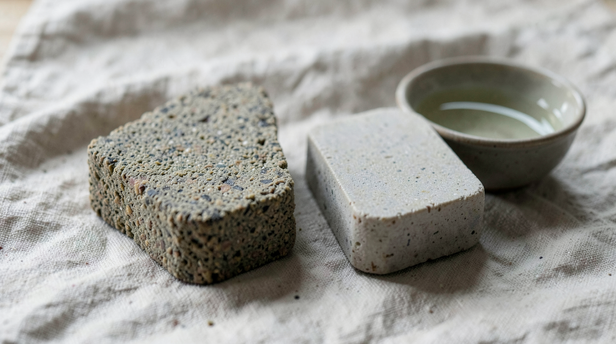
![Sharpening Stones Ready]()
Sharpening Stones Ready
Image credit : MyLifeXP Bureau
Grit is the measure of how coarse the abrasive particles are. A low number means large particles and an aggressive cut. A high number means fine particles and a polishing action. For a kitchen knife that has gone dull from regular use, you almost never need anything below 400 grit. A stone in the 400 to 800 range removes the damaged edge and sets a new bevel. A stone in the 1000 to 2000 range refines it. Anything above 3000 polishes the edge and is optional for a home cook.
Most Indian kitchen knives, the broad vegetable chopper, the thinner utility blade, respond well to a two-stone sequence: one medium stone around 600 grit, one fine stone around 1500. If you have only one stone, a 1000-grit combination stone with a coarse side and a fine side covers both steps.
Soaking the Stone and Setting Up
Water stones need to be wet before use. Submerge the stone in water for five to ten minutes until bubbles stop rising from it. During sharpening, add a few drops of water every minute or so. The water creates a slurry with the metal particles you are removing, and that slurry does part of the cutting work. Do not wipe it away. Oil stones use honing oil instead of water; the two are not interchangeable, so use whichever the stone was made for.
Set the stone on a damp cloth or a rubber mat so it does not slide. The stone should sit at the edge of a stable surface, low enough that your elbow can stay close to your body. Sharpening with a raised elbow and a tense shoulder makes it almost impossible to hold a consistent angle through the stroke.
The Angle Is the Whole Skill
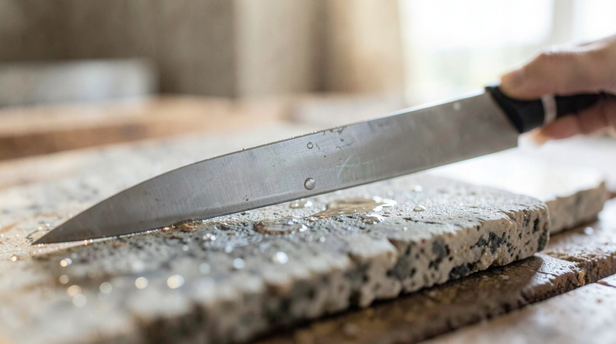
![Knife Meets Whetstone]()
Knife Meets Whetstone
Image credit : MyLifeXP Bureau
The bevel angle, the angle between the blade and the stone, determines what kind of edge you get. A shallow angle, around 15 degrees, produces a very fine, thin edge that cuts cleanly but chips more easily. A steeper angle, around 20 to 25 degrees, produces a more durable edge that holds up to the lateral pressure of chopping and rocking.
Most Western kitchen knives are ground at 20 to 22 degrees from the factory. Most Japanese knives sit at 15 to 17 degrees. A rough guide for setting the angle without a protractor: lay the blade flat on the stone, that is zero degrees. Lift the spine until a matchbook would fit under it, that is roughly 15 degrees. Lift it until a two-rupee coin stacked twice would fit under it, that is roughly 20 degrees. Hold that gap and do not let it change through the stroke.
This is the part that takes practice. The angle does not have to be perfect to the degree, but it has to be consistent. An edge sharpened at 18 degrees on one stroke and 24 degrees on the next is worse than an edge sharpened consistently at 22 degrees throughout, because you are grinding two different bevels and neither is clean.
The Stroke That Builds an Even Edge
Place the heel of the blade at the near end of the stone, edge facing away from you, at your chosen angle. Push the blade forward and away, drawing it across the stone so that by the time the stroke ends, the tip of the blade has crossed the far end of the stone. The motion is a single arc, heel to tip, in one smooth push. Apply moderate, even pressure on the push stroke. Lift slightly on the return.
Do the same number of strokes on each side. Ten strokes on one side, ten on the other. Keep count. Uneven sharpening produces an edge that cuts well in one direction and folds on the other.
After ten strokes per side on the coarser grit, run your thumb very lightly across the edge, not along it, on the side you were not sharpening. You should feel a faint roughness, almost like a wire. That is the burr: a thin curl of metal that has been pushed over the edge by the grinding action. When you feel it consistently along the whole length of the blade, the coarse work is done. Switch to the finer grit and repeat, with lighter pressure, until the burr is gone.
The Strop and the Paper Test
After the stone, the edge still has microscopic roughness from the abrasive. A strop, a strip of leather, or even the back of a leather belt, aligns those final irregularities. Draw the blade spine-first across the strop, edge trailing, five or six times per side. This is the opposite direction from sharpening: you are not removing metal, you are straightening what is already there.
The paper test is the simplest check. Hold a sheet of printer paper by the top edge and draw the knife down through it. A sharp knife cuts cleanly with no tearing and no deflection. A knife that tears the paper or skips sideways needs more work on the stone. A knife that cuts cleanly at the heel but not at the tip was sharpened with strokes that did not carry all the way through, the tip never crossed the stone.
Rinse the blade after sharpening to remove any metal slurry, dry it immediately, and store it away from other metal. A blade that just had its edge set deserves not to be thrown into a drawer where it will hit other knives.
The whetstone asks for ten minutes of attention and a consistent angle. What it gives back is a knife that does the work the hand was trying to force. Most kitchen knives in regular use benefit from this every two to three months, with a quick strop on a leather strip in between. The steel honing rod that came with the knife block does not sharpen, it only realigns an edge that is still intact. When the edge is truly gone, only the stone brings it back.
Unlock insightful tips and inspiration on personal growth, productivity, and well-being. Stay motivated and updated with the latest at
My Life XP.