Every Onam table is laid for someone who is not in the room. The banana leaves, the exact ten dishes, the pookalam drawn at the threshold, in the oldest popular telling of the festival, all of it is prepared for a king named Mahabali, who is believed to travel up from the underworld once a year to visit the people he once ruled.
The King at the Centre of the Story
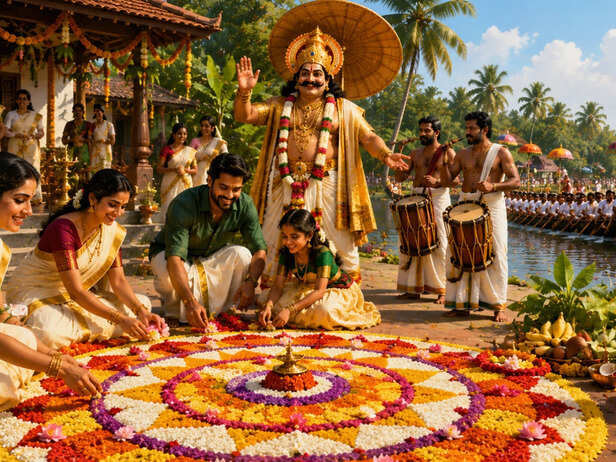
![Onam Have 4 Days]()
Onam Have 4 Days
Image credit : CHATGPT(AI)
In this telling, Mahabali was an asura king who ruled Kerala during what popular tradition describes as a golden age. His reign, as the story goes, was marked by equality, abundance, and the absence of sorrow. No one lied, no one went hungry, no one was turned away. The land flourished under him and the people loved him without reservation.
The tradition holds that this prosperity drew the attention of the gods, who grew uneasy at a demon king outshining the heavens. They appealed to Vishnu, who took the form of Vamana, a small brahmin boy, and approached Mahabali during a great yajna. Vamana asked for three paces of land. The king, known for his generosity, agreed without hesitation.
Three Steps and What They Covered
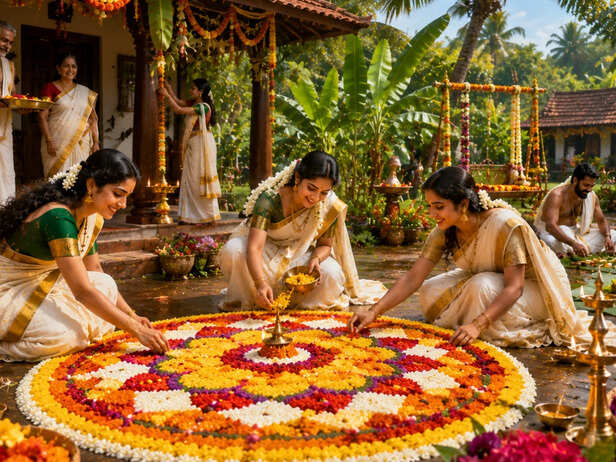
![First Onam Uthradam preparations in Kerala]()
First Onam Uthradam preparations in Kerala
Image credit : CHATGPT(AI)
Vamana then grew to cosmic size. In two steps he covered the earth and the sky. He paused, and asked Mahabali where he should place the third step. The king, understanding what was happening and unwilling to break his word, offered his own head. Vamana placed his foot there and pressed Mahabali down into the underworld, Patala, in the Sanskrit cosmological tradition.
What separates this telling from a simple defeat is what happened next. Mahabali, even in that moment, asked for one thing: that he be allowed to return once a year to see his people. The request was granted. Popular tradition in Kerala holds that Onam marks that annual return, the ten days of Atham to Thiruvonam in the Malayalam calendar are the days of his visit.
Why the People Still Set the Table
The emotional logic of the festival rests entirely on this: the people of Kerala are not celebrating an event that happened. They are receiving a guest. The pookalam is not decoration; in this reading, it is a welcome drawn on the ground so the king recognises his home when he arrives. The Onasadya, the elaborate feast, is not served to the family first, it is set as an offering before it is eaten as a meal.
This is why Onam sits differently from other harvest festivals. The harvest is present, the timing falls with the end of the monsoon and the beginning of the new crop, but the story that holds the festival together is not about grain. It is about loyalty that outlasts power, and about a king who chose to keep his word over keeping his kingdom.
Regional Variation and What the Tradition Holds
It is worth naming this as one regional telling, because the story of Vamana and Mahabali exists in several Puranic versions and carries different weight in different parts of the country. In Kerala's popular devotional tradition, Mahabali is an unambiguously beloved figure, the villain of the Sanskrit cosmological account becomes the hero of the folk memory. Some regional tellings describe him as still watching over the land even from Patala, allowed a kind of sovereignty that the three steps could not fully take away.
The Vamana avatar appears in the Bhagavata Purana and the Vishnu Purana, among other texts. The specific association with Onam and the annual return is strongest in Kerala's oral and devotional tradition rather than in any single canonical text, which is why it reads as a living story, one that different families and different regions of Kerala carry in slightly different forms.
What the Homecoming Means to the People Keeping It
The festival asks its keepers to imagine that a just ruler, removed from power by forces larger than him, still cares enough to come back. The people, in turn, show him that the land he loved is still worth returning to. The flowers at the door, the meal on the leaf, the games played in the courtyard, in this telling, they are all evidence. The king is watching, and what he sees should match what he remembers.
That is the festival's emotional core: not triumph, not ritual obligation, but the quiet act of keeping a promise on both sides. He comes back. They are ready.
The story of Mahabali does not end in the underworld. In Kerala's telling, it ends at a threshold, once a year, where a king stands and looks at a pookalam someone drew for him and knows he is still loved. The feast is not for the harvest. It is for the guest.
Unlock insightful tips and inspiration on personal growth, productivity, and well-being. Stay motivated and updated with the latest at
My Life XP.