It is a side of Karwa Chauth that many people celebrating the festival today may never have heard.The Pandavas’ lives were filled with uncertainty exile, conflict and powerful enemies determined to defeat them.
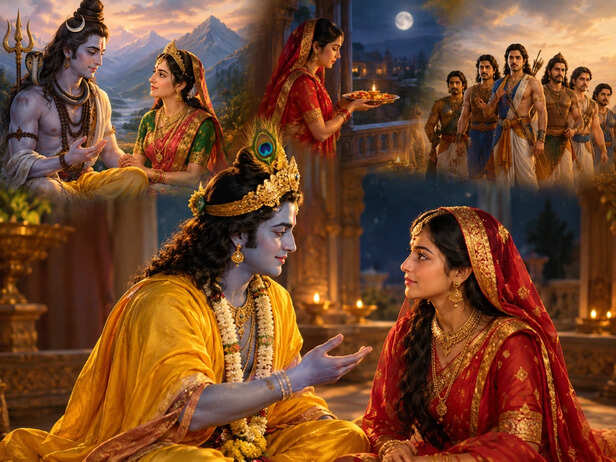
According to a popular legend associated with Karwa Chauth, there came a time when Draupadi became deeply concerned about the difficulties facing her husbands.Unable to simply watch events unfold, she sought the guidance of someone she trusted completely: Lord Krishna.Draupadi asked Krishna what she could do for the well-being and protection of the Pandavas.Krishna’s answer is where the story becomes particularly intriguing.Rather than simply giving Draupadi a ritual to perform, tradition says Krishna told her about another divine couple—Shiva and Parvati.
Krishna Tells Draupadi About Parvati
![Krishna]()
Krishna
Image credit : ChatGPT
According to versions of the legend passed down through tradition, Goddess Parvati had once asked Lord Shiva about a vrata that could bring well-being and protection to married life.Shiva explained the significance of observing a sacred fast with devotion and sincerity.
Krishna is believed to have narrated this tradition to Draupadi and advised her to undertake a vrata with faith for the welfare of the Pandavas.Draupadi followed his guidance.Later tradition connects her observance with the Pandavas overcoming the difficulties before them.This creates an intriguing chain within the legend:
Parvati asks Shiva.Krishna recounts the tradition.Draupadi observes the vrata.The Pandavas face their challenges.And centuries later, elements of this story became associated with the traditions surrounding Karwa Chauth.
But Was It Actually Called “Karwa Chauth” in the Mahabharata?
This is where legend and history need to be separated.The familiar Karwa Chauth celebrated today—with
sargi, karwa, puja gatherings, the channi and waiting for the moon to rise—should not simply be described as a festival directly documented in the Mahabharata in its present form.
Instead, the Draupadi-Krishna episode survives as one of several traditional narratives associated with the religious ideas behind the observance.
That distinction actually makes the story more interesting.Karwa Chauth did not acquire meaning from just one tale. Over generations, different communities connected stories of devotion, courage, marital bonds and protection with the festival.Draupadi’s story became one part of that larger cultural memory.
Why Draupadi Makes This Story Different
Draupadi is not remembered merely as someone waiting helplessly for the Pandavas to return.She is one of the Mahabharata’s strongest personalities—intelligent, outspoken and capable of confronting extraordinarily difficult circumstances.That changes the way her association with the vrata can be understood.
Her fast is not simply a romantic gesture.Within the legend, it becomes an
act of determination during uncertainty—a way of expressing hope and commitment when circumstances are beyond her control.This also explains why the older stories associated with Karwa Chauth often feel very different from its modern popular image.
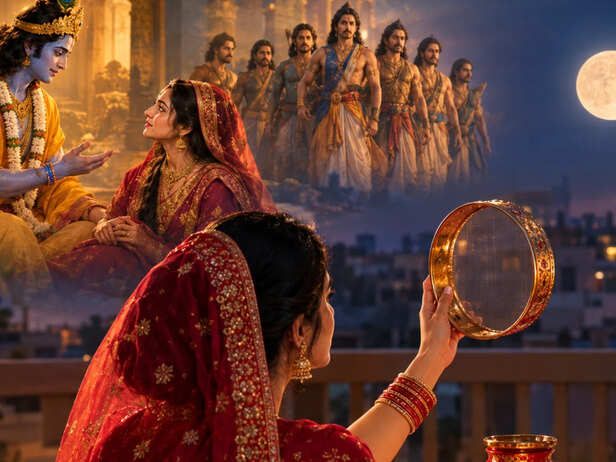
Today, films and television frequently portray Karwa Chauth through romance: a beautifully dressed couple, moonlight, a sieve and the husband offering his wife water.The traditional stories are considerably more dramatic.
They speak of separation, danger, faith, sacrifice and women confronting situations in which the lives of the people they love appear uncertain.
The Hidden Connection Between the Ancient Story and Today's Festival
![Karwa Chauth Under Moonlit Legends]()
Karwa Chauth Under Moonlit Legends
Image credit : ChatGPT
The world around Karwa Chauth has changed enormously.The earthen
karwa may now sit beside designer puja thalis. Families separated by thousands of kilometres may watch the moon together over video calls. In some relationships, husbands and wives even choose to fast together.
Yet beneath these changing customs survives an old emotional idea.When you cannot control what tomorrow will bring, you can still express how deeply you care about the person with whom you want to face it.That is what makes the Mahabharata connection fascinating.It shifts the story beyond the familiar image of a wife waiting for the moon.It becomes a story about Draupadi facing uncertainty, seeking Krishna’s guidance and choosing faith when she could not know what awaited the Pandavas.
More Than a Fast Under the Moon
Perhaps the most fascinating thing about Karwa Chauth is that its meaning cannot be contained in a single ritual—or even a single legend.Behind today's moonrise photographs, mehndi and festive celebrations lies a much older world of stories.
Among them is the tradition of Draupadi turning to Krishna during a difficult moment and being guided towards a vrata associated with devotion and protection.Whether one approaches the story through faith, mythology or cultural tradition, its emotional core remains remarkably recognisable.
The moon may be the most visible symbol of Karwa Chauth. But according to this lesser-known legend, the real story begins much earlier—with a worried Draupadi, a conversation with Krishna, and a simple question: what do you do when someone you love is facing a battle you cannot fight for them?
Unlock insightful tips and inspiration on personal growth, productivity, and well-being. Stay motivated and updated with the latest at
My Life XP.