The shrine is easy to miss if you are moving quickly. A small stone, sometimes painted red, sometimes garlanded with marigolds going brown at the edges, sitting at the point where the last field meets the first stretch of open land. No temple tower, no courtyard, no bell. Just the deity at the margin, facing outward.
The Threshold as the Most Dangerous Place
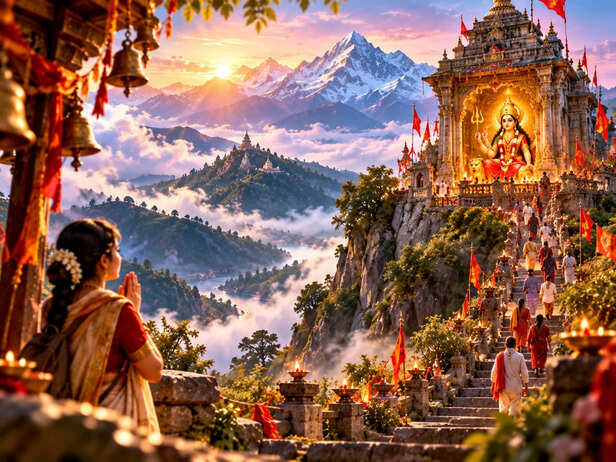
![Himalayan Goddess Temple at Sunrise]()
Himalayan Goddess Temple at Sunrise
In the cosmology that shapes most Indian village traditions, danger does not come from within the settlement. It arrives. Disease moves in from the road. A drought begins at the sky's edge. A stranger enters through the path that also leads out. The boundary is where the known world ends and the uncontrolled world begins, which is precisely why it needs a guardian rather than a guest.
The deity placed at the edge is not being marginalised. In popular tradition across much of peninsular and central India, the boundary deity, called by different names in different regions, Gramadevatā in Sanskrit usage, but known locally as Ellamma, Mariyamman, Khandoba, Kshetrapāla and dozens of others, is understood to be the first line of protection. The village deity inside the settlement, often housed in a proper temple, handles prosperity and continuity. The field deity handles what comes from outside.
Facing Outward, Always
One detail appears with enough consistency across traditions to be worth naming: the boundary deity faces away from the village. The gaze goes toward the forest, the road, the open sky, toward whatever might arrive. This is not a symbolic accident. In vastu shastra and in the older folk traditions that predate its formal codification, a guardian faces the direction of potential threat. A deity facing inward is a deity looking at what it already has. A deity facing outward is one doing the actual work.
The same logic appears in how doorways are treated in many Indian homes. The threshold itself, the step, the lintel, the doorframe, is marked with turmeric, with kolam, with the image of a footprint entering. The threshold is sacred because it is the point of transition, and transition is where protection is most needed.
Why the Fields and Not the Well or the Road
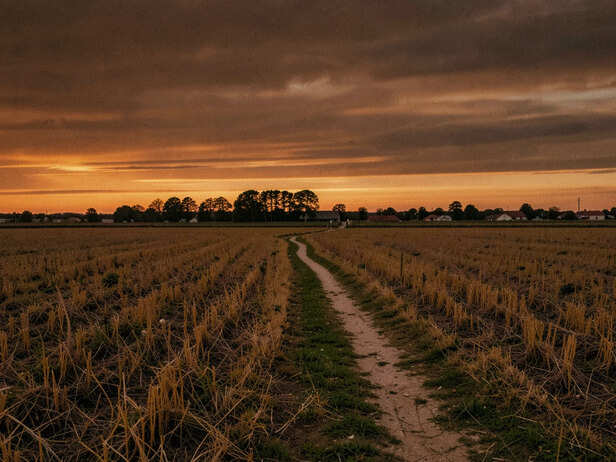
![Rural Dusk Landscape]()
Rural Dusk Landscape
Image credit : MyLifeXP Bureau
The fields occupy a particular place in village cosmology that the well or the road does not. The well is inside the settlement's logic. The road belongs to no one. The field is the village's claim on the land beyond its houses, its most extended and most vulnerable possession. The crop can fail. The rain can refuse. Something from the forest can cross into the planted rows. The deity at the field's edge is placed at the exact point where the village's investment in the land is most exposed.
In one regional telling common across parts of Maharashtra and Karnataka, the boundary deity is described as someone who gave their life at the edge of the village, a figure who died defending or protecting the settlement's margin. The shrine marks the spot. The deity did not choose the edge; the edge is where the story ended, and so the edge is where the worship begins. Across other traditions, the deity is older than the village itself, already present in the land before the first house was built, and the settlement grew inward from the point where the deity already stood.
The Annual Walk to the Boundary
In many village traditions, the relationship between the settlement and its boundary deity is renewed through a ritual that involves physically walking the perimeter. The procession moves from the interior temple outward, traces the village's edge, and returns. The walk is not tourism. It is a re-establishment of the boundary, a statement that the village knows where it ends and that the guardian at the edge is still in place.
These processions are often tied to the agricultural calendar: before planting, after harvest, or at the point when the rains are expected. The timing is not coincidental. The moments when the fields are most open to risk, bare earth before the seed goes in, ripe grain before it is cut, are when the boundary needs the most deliberate acknowledgment.
What the Placement Carries Forward
The shrine at the edge of the field is one of the oldest surviving forms of sacred geography in the subcontinent. Urban growth has swallowed many of these shrines. A boundary that was once the edge of a village is now a median strip or a construction site. The deity remains, often relocated a few metres, sometimes rebuilt in concrete where the original stone was worn smooth, but still placed as close to the edge as the edge will allow.
What the placement carries is a particular understanding of how safety works. It is not concentrated at the centre, in the most important building, behind the most important walls. It is distributed to the margins, where the risk actually is. The village deity inside the temple holds what has already been gathered. The deity at the field's edge holds the line.
Unlock insightful tips and inspiration on personal growth, productivity, and well-being. Stay motivated and updated with the latest at
My Life XP.