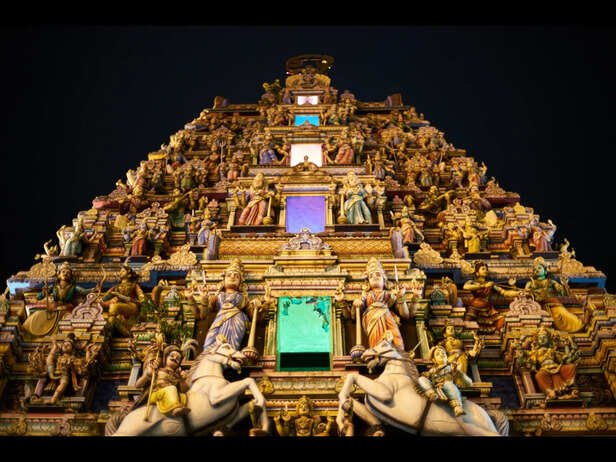
Stand at the gopuram of an old Chola or Pallava temple before seven in the morning and the light does something deliberate. It travels straight through the main entrance, down the axial corridor, and reaches the sanctum. The architects who laid the foundation stone knew exactly where the sun would be. They planned for it.
The Tradition That Governs Temple Layout
![Walk up to almost any ancient temple in southern India and the main entrance will greet the rising sun.]()
Walk up to almost any ancient temple in southern India and the main entrance will greet the rising sun.
Image credit : Freepik
The design of a Hindu temple is not left to a builder's preference. It follows a body of knowledge called Vastu Shastra and, more specifically for temple architecture, the Agamas, a set of Sanskrit texts that specify how a sacred structure must be oriented, proportioned, and consecrated. Different Agamic traditions govern different regional schools: the Shaiva temples of Tamil Nadu follow primarily the Shaiva Agamas, which include texts such as the Kamikagama and the Suprabhedagama. These texts treat the temple as a living body, with the sanctum as its heart and the entrance as its face. The face, in this system, must look toward the source of light.
Why East Holds the Highest Rank Among Directions
In the directional cosmology that underlies both Vastu Shastra and the Agamic temple texts, each of the eight directions carries a presiding deity and a quality. East, called Purva, belongs to Indra and is associated with the rising sun, with prana, and with the beginning of things. The sun's movement from east to west maps onto the arc of a day, a life, and a ritual. A worshipper who enters from the east walks in the same direction as the sun. By the time they reach the sanctum, they have moved from light into the concentrated darkness where the deity stands. That movement is deliberate: the journey from the open world into the sacred interior mirrors the journey from ordinary awareness toward something more still.
What Morning Light Does Inside a Temple
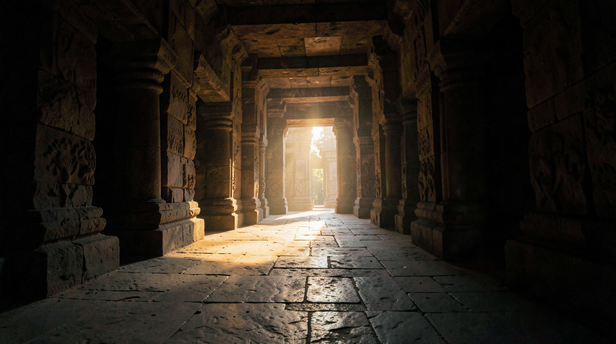
![Temple Corridor's Golden Light]()
Temple Corridor's Golden Light
Image credit : MyLifeXP Bureau
The east-facing door is not only symbolic. In the oldest temples, built before artificial lighting of any kind, the orientation was also functional. On the equinoxes, the two days of the year when day and night are equal, the rising sun enters an east-facing sanctum directly. Several temples across Tamil Nadu and Karnataka are documented to allow sunlight to fall on the deity's feet or face on specific mornings. The Brihadeeswara temple at Thanjavur, consecrated in the early eleventh century, is oriented so that its shadow falls away from the structure at noon rather than onto it, a feat of solar calculation built into the foundation. The east door is the mechanism that makes these alignments possible.
When Temples Face Another Direction, and Why
Not every temple in southern India faces east, and the exceptions are instructive. Temples dedicated to certain fierce or protective deities, Kali, Bhairava, and some forms of Durga, are sometimes oriented south, because south is the direction of Yama, the lord of death, and of Pitru, the ancestors. A south-facing temple signals a different kind of sacred relationship: one that faces what is feared rather than what is welcomed. Some temples face west because they were built on the western bank of a river or tank and the water, considered sacred, lies to the east of the structure. The deity then faces the water. A few temples face north because the site's geography or the patron's intent required it, and the Agamic texts do allow for these orientations under specific conditions. The east-facing norm is the default, not an absolute rule. What is consistent is that the direction is always chosen, never accidental.
The Threshold as a Ritual Boundary
The main door of a southern temple, the dvara, carries its own layer of meaning beyond orientation. It is guarded by dvarapalas, the flanking figures whose role is to mark the passage between the ordinary and the sacred. The threshold itself, the sill the worshipper steps over, is treated as a moment of transition. In many traditions, one does not step on the threshold; one steps over it. The east-facing entrance makes this crossing literal: you move from the direction of the rising sun into the interior, leaving the world of movement behind. The architecture teaches the ritual without a word being spoken.
A Design Principle That Has Outlasted Its Explanations
Many of the craftsmen who build and restore temples today follow the east-facing convention as inherited practice, without necessarily tracing it back to the Agamic texts. The knowledge has been carried through lineages of sthapatis, hereditary temple architects, for whom the orientation is as fundamental as the proportions of the shikhara or the placement of the pradakshina path. What began as a reasoned system encoded in texts became, over centuries, an embodied knowledge. The east door faces east because it has always faced east, and because the tradition that shaped it understood, in its own terms, exactly why it should.
The sun's path across the sky was the first clock, the first calendar, and the first compass that temple builders had. The east-facing door is the point where that understanding became stone, a calculation made once, set in granite, and still holding its angle a thousand years later.
Unlock insightful tips and inspiration on personal growth, productivity, and well-being. Stay motivated and updated with the latest at
My Life XP.