The image is unmistakable: dark skin, wild hair, a garland of skulls, and a tongue pushed out past the lips, vivid red against the dark of her face. Most people who grow up around images of Kali absorb the picture before they absorb any explanation for it. The tongue becomes part of the whole, inseparable from the sword and the severed head and the foot planted on Shiva's chest. But the tongue is doing specific work in each tradition that depicts it, and the explanations are not all the same.
The Story Most People Know First
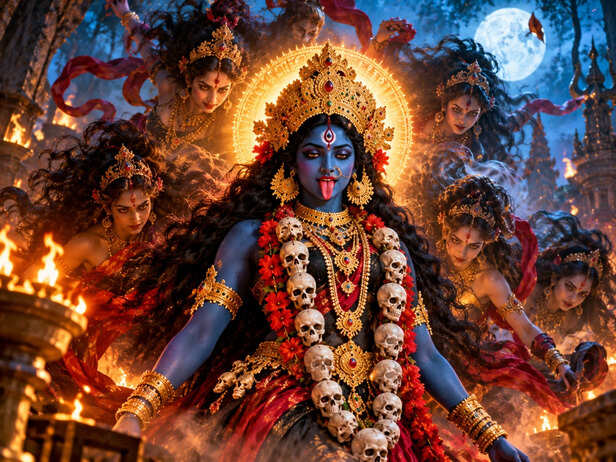
![Kali Goddess Amidst Moonlit Yoginis]()
Kali Goddess Amidst Moonlit Yoginis
Image credit : CHATGPT(AI)
The most widely told explanation comes from the Devi Mahatmya and from the Puranic traditions that followed it. Kali, summoned from the brow of Durga to destroy the demon armies of Raktabija, enters a battle fury so total that she cannot stop. Every drop of Raktabija's blood that touches the ground spawns a new demon, so she drinks the blood as it falls and consumes the demons whole. The battle is won, but the goddess continues, her dance of destruction threatening the world itself. Shiva, understanding that only he can reach her, lies down in her path. When her foot lands on his chest, she realises what she has done. The tongue comes out in that moment, the gesture of a person who has overstepped, the instinctive response to shock and self-correction that is still recognised across much of South Asia today. In this reading the tongue is not rage. It is the goddess catching herself.
What the Tantric Traditions Read Differently
In the Shakta Tantric traditions, particularly those that developed in Bengal and Assam, the explanation moves away from shame entirely. Here, Kali's tongue is understood as the active principle of the universe reaching outward. The tongue, in Tantric symbolism, is associated with speech, with the creative sound that underlies existence, and with the consuming fire of transformation. When Kali extends her tongue, she is not embarrassed. She is tasting the world, drawing it into herself, or releasing the primordial sound that creation rides on. The goddess in this frame is not a figure caught mid-mistake. She is the universe in the act of knowing itself. Several texts in the Tantric tradition describe her tongue as the colour of blood because blood is the substance of life, and life is what she both takes and gives.
The Older Symbolic Layer
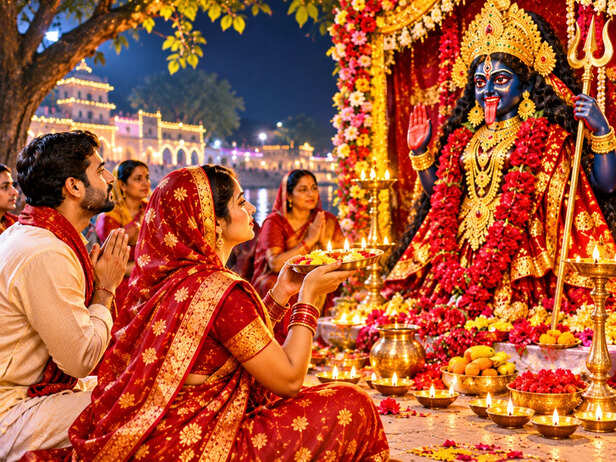
![Devotional Kali Puja by the Ghats]()
Devotional Kali Puja by the Ghats
Image credit : CHATGPT(AI)
Art historians who study the goddess traditions of eastern India point to an iconographic layer older than the Puranic stories. In some of the earliest visual representations of fierce goddesses across the subcontinent, the protruding tongue appears as a marker of power and terror, not of emotion at all. A deity who shows the tongue is displaying the capacity to consume, enemies, disease, time itself. The same gesture appears in protective figures carved above doorways and in masks used in ritual contexts across parts of Odisha, Bengal, and Assam. In this reading the tongue precedes the stories told about it. The stories arrived later and gave the image a narrative, but the image was already doing something before the narrative existed.
The Foot on Shiva and What It Changes
The posture cannot be read without the foot. Kali standing on Shiva's prone body is an image that carries its own range of interpretations. In one reading it is a moment of the goddess's dominance over even the highest of the gods, a statement about the primacy of Shakti. In another it is a union of opposites: Shiva as pure consciousness, still and unmoving, and Kali as pure energy, dynamic and consuming. Neither is complete without the other. The foot is not conquest. It is contact. The tongue, in this frame, belongs to the moment of that contact, the instant when the two principles meet and the goddess is recalled to herself, or, in the Tantric reading, the instant when the two principles recognise each other and the universe holds its breath.
How the Image Is Read in Practice
Across the households and temples where Kali is worshipped, the explanations often sit side by side without contradiction. A devotee in Kolkata may know the story of Shiva underfoot and understand the tongue as the goddess's moment of self-awareness, while also holding the sense that the image is fundamentally one of power rather than embarrassment. Popular devotion is not always interested in resolving the tension between readings. The image works precisely because it holds more than one thing. The goddess who is tender and terrible, who destroys and protects, who is caught mid-step and yet utterly sovereign, the tongue is the point where all of that becomes visible at once.
What the posture adds up to is not a single story but a record of how different communities have understood the goddess over centuries. The Puranic tradition gave the image a moment of recognition. The Tantric tradition gave it a cosmological meaning. The older protective tradition gave it a face of power that needed no explanation. Each layer is still present in the image, which is why the image has lasted, it is dense enough to carry all of them without resolving into any one.
Unlock insightful tips and inspiration on personal growth, productivity, and well-being. Stay motivated and updated with the latest at
My Life XP.