The Ramayana is full of forests and full of meetings. Ram walks through kingdoms, crosses rivers, argues with sages, and fights demons across years of exile. Most of those encounters are remembered for what happens next. The meeting with Shabari is remembered for what happens in it, nothing more than an old woman offering fruit, and a god eating it without hesitation.
Who Shabari Was, Before Ram Arrived
![Valmiki Ramayana]()
Valmiki Ramayana
Image credit : Gemini_(AI)
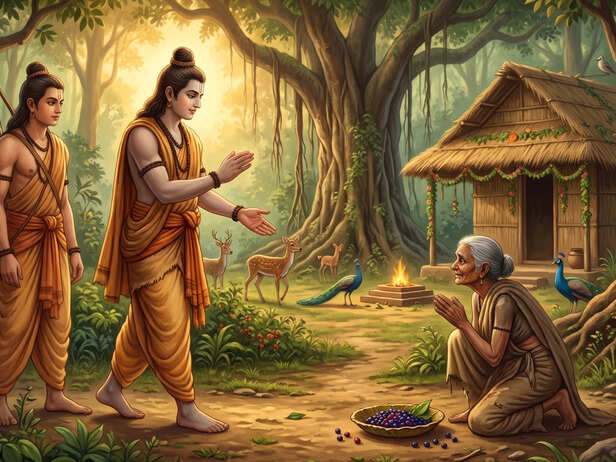
The Valmiki Ramayana places Shabari in the ashram of the sage Matanga, in the forest of Dandaka. She is described as a woman of low birth, a servant to the ashram, who stayed on after Matanga and his disciples died, not because she had nowhere to go, but because her teacher had told her to wait. Ram would come, Matanga had said. She had been waiting long enough that she was very old by the time he did.
This is the detail the tradition dwells on: the waiting. She gathered berries each day, tasted each one to find the sweetest, and set them aside. She did this not knowing when Ram would arrive, or whether he would. Devotion in this telling is not a feeling that arrives with its object. It is a practice that continues in the object's absence.
The Tasting, What the Tradition Says It Means
![Ram does not merely accept the berries;]()
Ram does not merely accept the berries;
Image credit : Gemini_(AI)
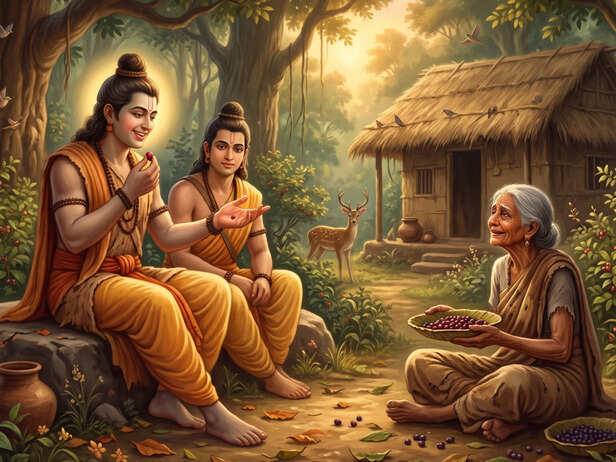
The act of tasting each berry before offering it is what makes the scene uncomfortable to some and luminous to others. In one reading, she is violating the rules of ritual purity, offering food already touched by her lips, food that by any conventional standard of the time was no longer fit to give a guest, let alone a king. Tulsidas in the Ramcharitmanas names this directly. Ram does not merely accept the berries; he says they are the finest offering he has received in the forest.
The tradition's interpretation is consistent across its versions: Ram is not overlooking the impurity. He is demonstrating that the category does not apply here. What Shabari offers is not contaminated fruit. It is certainty, she has made sure, personally, that nothing bitter reaches him. The gesture is maternal in the oldest sense. The offering has already been loved before it is given.
In Vedic devotional thought, this is sometimes called the inversion of the ritual: the form breaks so the feeling can be seen. Where a correct offering can be made without the heart being in it, Shabari's offering cannot be made any other way.
The Scene Across Regional Tellings
The Ramayana does not belong to one text. It travels in oral traditions, in regional languages, in theatrical forms, and in versions that differ from one another in ways that are not errors but choices. Shabari's scene is one of the most stable across them, the berries appear in nearly every telling, but what surrounds it shifts.
In some southern traditions, Shabari is a figure of great spiritual attainment in her own right, not simply a devotee waiting for grace. In the Kamba Ramayana, composed in Tamil, the encounter carries a different emotional weight: Shabari has already, through her long practice, seen Ram in everything around her. His arrival is confirmation, not revelation. In several tribal and folk tellings of central and eastern India, Shabari belongs to an adivasi community, and the scene is read as Ram crossing the boundary of caste without ceremony, simply by eating.
The Ramcharitmanas, which is the version most North Indian listeners know, gives Shabari a speech before she offers the fruit. She lists her lowness, her birth, her sex, her ignorance of scripture, and Ram answers each point not with reassurance but with what he says he values. He names nine forms of devotion. Shabari's is the simplest: she thought of him, she waited, she prepared. That was enough.
Why This Scene Travels Further Than the Battle Scenes
The Ramayana has battles that last days, weapons with names, and demons whose deaths are described in elaborate detail. Those scenes are celebrated. They are not the ones people reach for when they want to explain what the Ramayana is about.
Shabari's scene travels because it requires nothing from the listener to understand. There is no theological background needed, no knowledge of lineage or weapon lore. An old woman waits for someone she loves. He comes. She gives him the best of what she has. He accepts it entirely. The scene is complete in itself, and it does not depend on the listener knowing what comes before or after.
There is also the matter of who she is. The Ramayana is full of powerful men and divine women. Shabari is neither. She is old, low-born, and by the story's own account, she knows very little scripture. The tradition uses her specifically to make a point it cannot make through a sage or a queen: that the form of devotion matters less than its direction.
What the Scene Is Actually Asking of the Reader
The berries are a test only in the sense that every sincere offering is a test, not of the receiver, but of the giver. Shabari does not know whether Ram will come that day, or whether he will eat what she brings, or whether her gesture will be understood. She prepares anyway. The preparation is the devotion; the arrival is its completion.
In popular devotional thought, this is the scene most often cited when someone asks what bhakti looks like when it has no audience. Not the grand gesture, not the public vow, not the correct ritual at the correct hour. A woman alone in a forest, tasting berries, waiting.
The scene has stayed in the tradition for the same reason it stays in memory: it describes something the listener has felt without having a name for it. The love that prepares before it knows whether the preparation will be received. The offering made not because it will be seen, but because not making it is unthinkable.
Ram eating Shabari's berries is the Ramayana at its quietest. That is why, across centuries and languages and versions, it keeps being told.
Unlock insightful tips and inspiration on personal growth, productivity, and well-being. Stay motivated and updated with the latest at
My Life XP.