Chandra Dev, the Hindu god of the Moon, is believed to have had 27 wives, each representing a different nakshatra. But ancient traditions also mention a mysterious 28th nakshatra called Abhijit. Why did it disappear from the commonly used list of 27? The answer connects the Moon's movement, the 27 nakshatras, the 12 zodiac signs and the mathematical structure of Vedic astrology. There is also a fascinating reason why your exact birth time and birthplace matter when astrologers prepare your kundli.
Why the Moon Has 27 Wives
![Chandra Dev and His 27 Nakshatra Wives]()
Chandra Dev and His 27 Nakshatra Wives
Image credit : Gemini(AI)
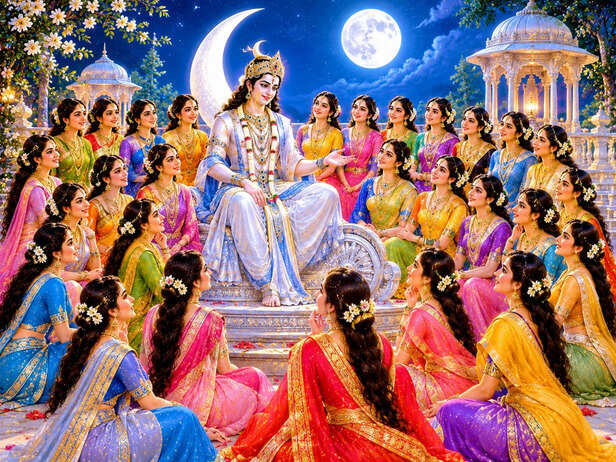
In Hindu mythology, Chandra Dev married the 27 daughters of Prajapati Daksha. These wives are associated with the 27 nakshatras, or lunar mansions, in Vedic astrology. Each nakshatra represents a section of the sky along the Moon's apparent path. According to the popular story, Chandra Dev spent more time with Rohini than his other wives, which made Daksha's daughters unhappy. This mythological story gives a human form to an ancient system of observing the Moon's movement across the night sky.
The Moon's 27.3-Day Journey
![Abhijit, the Forgotten 28th Nakshatra]()
Abhijit, the Forgotten 28th Nakshatra
Image credit : chatgpt(ai)
The Moon takes approximately 27.3 days to complete one revolution around Earth relative to the distant stars. This period is called a sidereal month. As the Moon moves along its apparent path, it appears near different groups of stars on successive nights. Ancient Indian astronomers observed these positions and developed the nakshatra system to track the Moon. The 27 nakshatras became a way to divide its journey into identifiable sections, connecting observations of the sky with calendars, rituals and astrology.
What Happened to Abhijit?
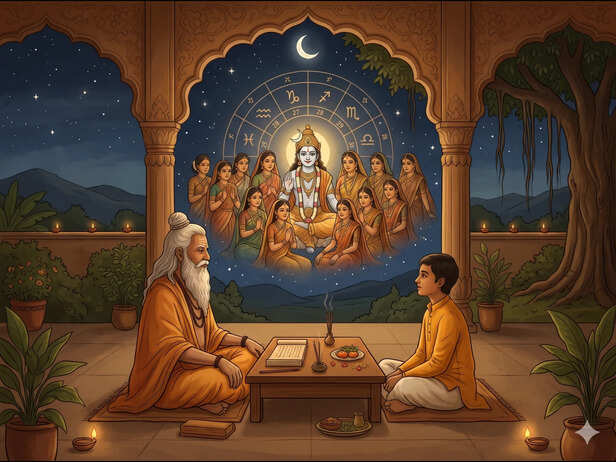
The mystery of the 28th nakshatra has a historical explanation. Some ancient Indian texts list 28 nakshatras, including Abhijit, while other texts follow a 27-nakshatra system. Abhijit is traditionally placed between Uttara Ashadha and Shravana. Later astronomical systems adopted 27 equal divisions of the zodiac, leaving Abhijit outside the standard sequence. So, it is not accurate to say that sages simply banished it because 28 could not be divided by 12. Both 27- and 28-nakshatra traditions have existed in Indian astronomy.
Why 27 Nakshatras Became 108 Padas
In the standard Vedic system, each of the 27 nakshatras is divided into four parts called padas. This gives a total of 108 padas. The 360-degree zodiac is divided into 12 rashis, each measuring 30 degrees. Every nakshatra covers 13 degrees and 20 minutes, while each pada covers 3 degrees and 20 minutes. This creates a neat mathematical arrangement: every rashi contains nine padas. These divisions help astrologers describe planetary positions more precisely within the zodiac.
The Moon Has Two Astrological Addresses
In Vedic astrology, the Moon's rashi and nakshatra describe two different aspects of its position. The rashi identifies the 30-degree zodiac sign in which the Moon is placed, while the nakshatra identifies its smaller 13-degree-and-20-minute division. The pada gives an even more specific position within that nakshatra. For example, knowing that the Moon is in Taurus gives its rashi, while knowing that it is in Rohini gives its nakshatra. Together, these details provide a more precise description of the Moon's position in a birth chart.
Why Your Exact Birth Time Matters
Here comes the most interesting part. If planetary positions are calculated for a particular moment, why does an astrologer need your exact birth time? Because the sky's apparent position changes continuously as Earth rotates. In Vedic astrology, the ascendant, or Lagna, is the zodiac sign rising on the eastern horizon at the time of birth. It changes roughly every two hours, although the actual duration varies. Even a small difference in birth time can affect the calculated ascendant and house positions.
Why Your Birthplace Completes the Kundli
Your birthplace matters because the eastern horizon is not the same everywhere on Earth. Someone born in Delhi and someone born in Mumbai at the same instant will have different local horizons and may have different ascendants. Astrologers use the date, exact time and geographical coordinates to calculate the ascendant, planetary positions and astrological houses. The planetary positions are based on the same celestial moment, but the local arrangement of the birth chart can differ. Astrology offers traditional interpretations of these calculations, though its predictions are not scientifically established.
The real mystery behind Chandra Dev's 27 wives is not simply a story of marriage. It is also a window into how ancient Indian astronomers observed and divided the sky. The 27 nakshatras, 108 padas and 12 rashis form an interconnected system of celestial measurements. And the next time someone asks for your exact birth time and birthplace to prepare a kundli, you will know why those details matter.
Unlock insightful tips and inspiration on personal growth, productivity, and well-being. Stay motivated and updated with the latest at
My Life XP.