Why Did Sahadeva Stay Silent During the Pandavas’ Exile?
Noopur Kumari | Sept 18, 2026, 15:00 IST
What made Sahadeva remain unusually quiet when the Pandavas lost their kingdom and entered exile? Was his silence hiding pain, anger, or knowledge of what was coming? The youngest Pandava rarely revealed what he carried within. But behind his calm nature was a deeper story of wisdom, restraint, family, destiny and one unforgettable act of revenge.

Sahadeva’s Silence
Image credit : ChatGPT(ai)
Imagine watching your family lose its kingdom, seeing Draupadi forced into exile, and knowing that something terrible has changed forever. Most people would shout, argue or demand answers. But Sahadeva was different. Among the five Pandavas, he is remembered as the quietest, yet tradition often portrays him as exceptionally wise and knowledgeable about time, destiny and astrology. During the Pandavas’ departure from Hastinapura, Kunti was particularly concerned about Sahadeva and asked Draupadi to look after him.
But why was Sahadeva so silent? Was his silence simply his nature, or was he carrying something that the others could not see?
![Pandavas leaving Hastinapura for exile]()
The loss of the dice game changed the Pandavas’ lives completely. They had to leave their kingdom and enter a long period of exile with Draupadi. The departure was filled with grief, anger and uncertainty. Sahadeva did not respond with the loud fury associated with Bhima or the visible determination of Arjuna. Instead, descriptions of his departure emphasize his quiet response to the humiliation. He even smeared mud over his face so that people would not recognize him. His silence was not necessarily weakness. It reflected a man choosing restraint when everything around him had fallen apart.
![Young Sahadeva walking silently through the forest]()
Sahadeva's comparatively silent role has often been connected with his reputation as a knower of events and destiny. Some traditional accounts say he possessed extraordinary knowledge of the future but could not freely reveal everything he knew. This helps explain why later retellings portray him as someone who watched, understood and waited rather than constantly speaking. However, this detail varies across versions and retellings of the Mahabharata. The original epic does not simply present Sahadeva as a man who literally stopped speaking for weeks. What remains consistent is his reputation for wisdom, restraint and a quieter presence than his brothers.
One small detail from the exile makes Sahadeva’s story especially emotional. As the Pandavas prepared to leave, Kunti spoke to Draupadi and specifically asked her to look after Sahadeva. The youngest Pandava held a special place in her heart. This moment shows that Sahadeva's quiet nature was noticed by those closest to him. He was not simply another warrior leaving the palace. He was the son Kunti worried about most as the family entered an uncertain future. The scene adds another layer to his character: beneath the calm exterior was someone deeply loved by his family.
It is easy to mistake silence for helplessness, especially when surrounded by louder personalities. But Sahadeva repeatedly showed that he could speak firmly when action demanded it. During the forest exile, when Draupadi was carried away by the Rakshasa Jatasura, Sahadeva openly challenged him and declared his identity as a son of Pandu. He was ready to fight rather than simply watch. This is why his character is more complicated than the image of a permanently silent prince. He could remain quiet when words were unnecessary, yet become decisive when duty required action.
Sahadeva was not without anger. During the exile, the Pandavas carried memories of the humiliation they had suffered in Hastinapura. Traditional accounts especially connect Sahadeva with a vow against Shakuni, whose role in the dice game had helped bring about their downfall. Instead of constantly announcing his anger, Sahadeva allowed his actions to speak later. On the final day of the Kurukshetra war, he killed Shakuni. His story therefore carries a striking contrast: years of restraint eventually led to one decisive act.
This is what makes Sahadeva relatable even today. Not everyone responds to pain by shouting or demanding attention. Some people become quieter. They observe, think and wait until they understand what they need to do. Sahadeva's story is often remembered through this lens. His silence should not automatically be treated as proof that he knew every future event, because different Mahabharata traditions tell his story differently. But his reputation as a wise and restrained Pandava is firmly established in later tradition. His character reminds us that emotional strength does not always make noise.
Sahadeva did not need to become the loudest Pandava to become memorable. His strength came from observation, knowledge, patience and the ability to act when the moment arrived. The exile tested every member of the family, but Sahadeva carried his pain differently. Perhaps that is why his story continues to intrigue people. His silence was not simply about having nothing to say. It became part of the way his character is remembered: quiet, thoughtful and capable of decisive action when the time came. Sometimes, the strongest person in the room is not the one speaking the most, but the one who knows when to speak and when to act.
Unlock insightful tips and inspiration on personal growth, productivity, and well-being. Stay motivated and updated with the latest at My Life XP
But why was Sahadeva so silent? Was his silence simply his nature, or was he carrying something that the others could not see?
The Day Everything Changed
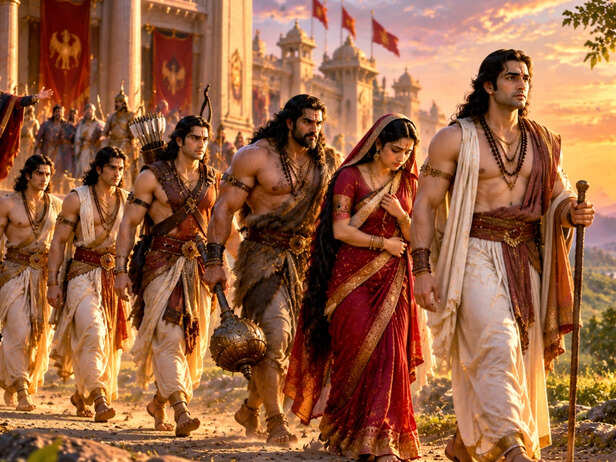
Pandavas leaving Hastinapura for exile
Image credit : ChatGPT (ai)
The loss of the dice game changed the Pandavas’ lives completely. They had to leave their kingdom and enter a long period of exile with Draupadi. The departure was filled with grief, anger and uncertainty. Sahadeva did not respond with the loud fury associated with Bhima or the visible determination of Arjuna. Instead, descriptions of his departure emphasize his quiet response to the humiliation. He even smeared mud over his face so that people would not recognize him. His silence was not necessarily weakness. It reflected a man choosing restraint when everything around him had fallen apart.
Why Was Sahadeva So Quiet?

Young Sahadeva walking silently through the forest
Image credit : ChatGPT (ai)
Sahadeva's comparatively silent role has often been connected with his reputation as a knower of events and destiny. Some traditional accounts say he possessed extraordinary knowledge of the future but could not freely reveal everything he knew. This helps explain why later retellings portray him as someone who watched, understood and waited rather than constantly speaking. However, this detail varies across versions and retellings of the Mahabharata. The original epic does not simply present Sahadeva as a man who literally stopped speaking for weeks. What remains consistent is his reputation for wisdom, restraint and a quieter presence than his brothers.
Draupadi Was Asked to Protect Him
His Silence Was Not Cowardice
He Carried His Anger Differently
Silence Can Hide Deep Emotion
The Power Behind His Silence
Unlock insightful tips and inspiration on personal growth, productivity, and well-being. Stay motivated and updated with the latest at My Life XP