Before Ravana became the mighty king of Lanka, the kingdom belonged to Kubera, the lord of wealth. But a sight in the sky would inspire Ravana’s grandfather, Sumali, to make a decision that shaped the future of his family. When Sumali saw Kubera travelling in the magnificent Pushpaka Vimana, he began imagining a similar rise for his own clan. His plan involved his daughter, Kaikesi, and a powerful sage named Vishrava. However, the sage’s response carried a warning that would make this story even more intriguing.
Lanka Once Belonged to Kubera
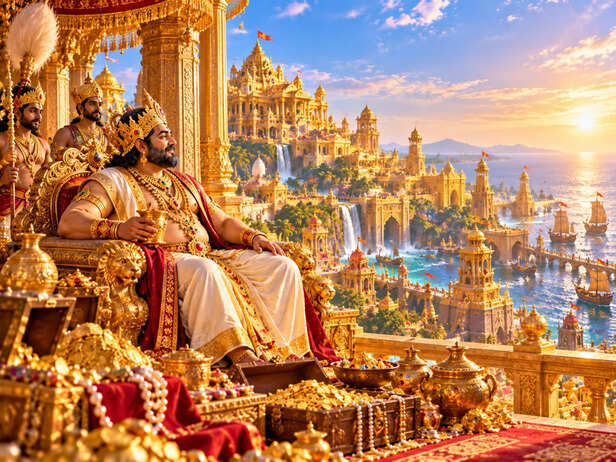
![Kubera and the Golden Glory of Lanka]()
Kubera and the Golden Glory of Lanka
Image credit : chatgpt(ai)
Before Ravana became associated with Lanka, Kubera was its ruler. Known for his immense wealth and splendour, he travelled in the Pushpaka Vimana, a magnificent celestial vehicle. His life represented the kind of power and prosperity that Sumali wanted for his own family. According to the Ramayana’s Uttara Kanda, this sight became the starting point of a plan that would eventually lead to Ravana’s birth.
Sumali Sees an Opportunity
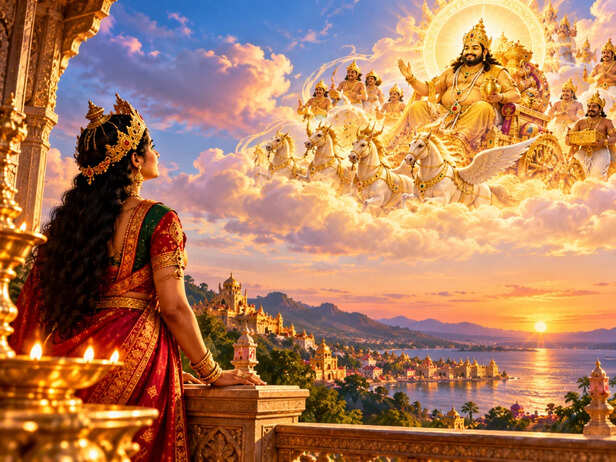
![Celestial Blessing Over the Golden City]()
Celestial Blessing Over the Golden City
Image credit : chatgpt(ai)
Sumali, a rakshasa who had been living in the netherworld, emerged with his daughter Kaikesi and travelled across the earth. One day, he saw Kubera passing through the sky in his Pushpaka Vimana on his way to visit his father, Sage Vishrava. Kubera’s radiance and prosperity caught Sumali’s attention. He began wondering how his own family could achieve similar greatness. Rather than treating the encounter as a passing sight, Sumali saw it as an opportunity to plan his clan’s future.
Why Sumali Chose Sage Vishrava
Sumali knew that Kubera was the son of Sage Vishrava, who belonged to a respected lineage. He therefore advised Kaikesi to approach Vishrava and choose him as her husband. Sumali hoped that their children would inherit exceptional qualities and raise the standing of their family. His decision was driven by ambition and the desire to restore his clan’s influence. Yet he could not know exactly what kind of children would be born from this union.
Kaikesi Approaches the Sage
Following her father’s advice, Kaikesi went to Vishrava’s hermitage. The sage was performing an Agnihotra ritual when she arrived. She stood respectfully before him with her head bowed. When Vishrava asked why she had come, Kaikesi explained that she was acting on her father’s instructions. According to the traditional account, the sage understood that she had come seeking children through their union. But his response was not what she had expected.
The Sage’s Ominous Warning
Vishrava told Kaikesi that she had approached him at an inauspicious time. As described in the traditional story, he warned that the children born from their union would have fierce natures and engage in cruel deeds. His words frightened Kaikesi, who had hoped for worthy and virtuous children. The warning introduced an unexpected turn into Sumali’s carefully planned future. The marriage intended to bring greatness to the family was now accompanied by a troubling prediction.
Kaikesi Makes a Humble Request
Distressed by the sage’s prediction, Kaikesi pleaded with Vishrava to ensure that she did not give birth only to wicked children. Her request showed that she cared about the nature and conduct of her future family, not merely its power. Vishrava then offered her some reassurance: her youngest son would follow a righteous path and uphold the virtues associated with his lineage. This promise foreshadowed the arrival of a child whose character would differ from that of his elder siblings.
A Decision That Led to Ravana’s Birth
Sumali’s encounter with Kubera had begun with a desire to restore his family’s greatness. His plan brought Kaikesi to Sage Vishrava, and the sage’s warning introduced a deeper twist into the story. In the traditional account, Kaikesi later gave birth to children whose natures and destinies differed. Her eldest son would become known as Ravana, while her youngest son, Vibhishana, would be remembered for his devotion to righteousness. The next part of the story explores Ravana’s extraordinary birth and how he came to be known as Dashagriva.
Unlock insightful tips and inspiration on personal growth, productivity, and well-being. Stay motivated and updated with the latest at
My Life XP