What would you do if a sage’s curse told you that you had only seven days to live? King Parikshit, the grandson of Arjuna, faced this terrifying situation after making one impulsive mistake in the forest. But his story begins with another powerful moment from the Mahabharata, when Yudhishthira faced his own final test and discovered why letting go of hatred could matter more than victory itself. Together, these stories reveal how anger, pride and fear can shape a person’s destiny.
Yudhishthira Faces the Kauravas Again
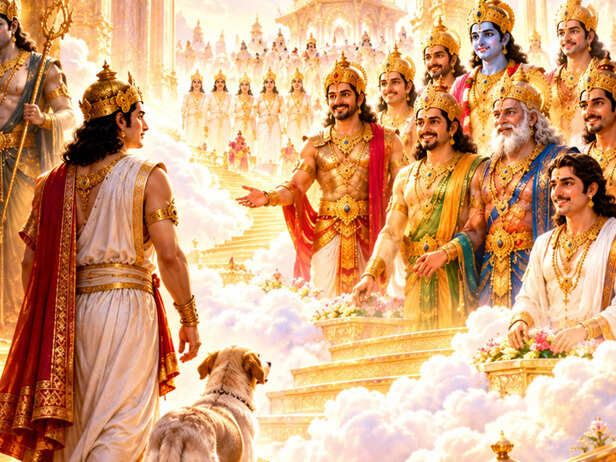
![Yudhishthira at the Heavenly Crossroads]()
Yudhishthira at the Heavenly Crossroads
Image credit : CHATGPT(AI)
After the devastating Kurukshetra war, Yudhishthira’s journey did not end with his reign as king. In the traditional Mahabharata narrative, his final journey brought him to an extraordinary encounter with the Kauravas. Seeing those who had once been his enemies stirred painful emotions within him. The war had ended, but its wounds had not disappeared completely. His experience raised a difficult question: can someone truly move beyond conflict if hatred continues to survive within the heart?
The Moment He Let Go of Hatred
![Yudhishthira Chooses Forgiveness]()
Yudhishthira Chooses Forgiveness
Image credit : CHATGPT(AI)
Yudhishthira had every reason to remember the suffering caused by the Kauravas. Their rivalry had contributed to the destruction of an entire generation. Yet his final journey offered a different kind of test. Rather than allowing old resentment to control him, he had to confront the emotions he still carried. The deeper lesson of this episode is that even when a conflict has ended, hatred can continue to hurt the person holding on to it. Letting go does not erase the past, but it can free the heart from its burden.
Parikshit Inherits the Kingdom
After the Pandavas withdrew from worldly life, Parikshit became the king of Hastinapura. As the son of Abhimanyu and grandson of Arjuna, he belonged to a family remembered for its courage and extraordinary role in the Mahabharata. Yet being born into a legendary family did not mean he was free from mistakes. His story shows how even a powerful ruler could lose control of his emotions and face consequences that no amount of royal authority could easily prevent.
A Sage’s Silence Triggers His Anger
One day, while hunting in the forest, Parikshit became exhausted and desperately thirsty. He came across a sage named Shamika, who was deeply absorbed in meditation. Parikshit asked him for water, but the sage did not respond. Feeling ignored, the king allowed frustration to overcome his judgment. Instead of respecting the sage’s silence, he picked up a dead snake with his bow and placed it around the sage’s neck. This impulsive act would soon bring consequences far beyond what Parikshit had expected.
The Curse That Gave Him Seven Days
When Shringi, the sage’s son, learned what Parikshit had done, he became furious and pronounced a curse: the king would die from a snakebite within seven days. The serpent named Takshaka would eventually fulfil that prophecy. When the news reached Parikshit, he understood the seriousness of his situation. The king who had once ruled with authority now faced a deadline he could not simply command away. His story became a powerful reminder of how one moment of anger can set an unexpected chain of events in motion.
Why Parikshit Built a Tower
Determined to survive, Parikshit arranged to stay in a specially protected structure, with precautions taken to prevent a snake from reaching him. His isolation soon became a subject of discussion. How could a descendant of the fearless Arjuna retreat behind protective walls because of a curse? Yet fear can affect even the bravest people when death feels close. Parikshit’s response reveals the tension between human courage and the instinct to survive when faced with an uncertain future.
The Fruit Basket and the Final Twist
As the seventh day arrived, Parikshit remained under protection, hoping to escape the curse. In the traditional account, Takshaka eventually found a way to reach him by disguising himself as a tiny insect hidden in a fruit. The serpent then revealed his true form and bit the king, fulfilling the prophecy. Parikshit’s death became a turning point in the story of the Mahabharata, leading to the events surrounding his son Janamejaya and the famous narration of the epic. His fate shows how fear and precautions cannot always control what lies beyond human power.
The Lessons Behind These Two Stories
Yudhishthira and Parikshit faced very different tests, yet their stories share a powerful message. Yudhishthira had to confront the hatred left behind by war, while Parikshit had to face the consequences of a moment of anger. One story highlights the freedom that comes from releasing resentment; the other warns against acting impulsively when emotions take control. Both episodes remind us that true strength is not only about winning battles or ruling kingdoms. It is also about mastering our reactions, respecting others and recognising the lasting impact of our choices.
Unlock insightful tips and inspiration on personal growth, productivity, and well-being. Stay motivated and updated with the latest at My Life XP