Imagine an endless ocean with no visible shore. In the middle of these vast waters, Lord Vishnu rests peacefully on a giant serpent, while the universe continues to exist around him. This striking image appears in Hindu temples, paintings, and religious stories, but have you ever wondered why Vishnu is shown in this unusual position?
The Mystery Behind Lord Vishnu’s Cosmic Rest
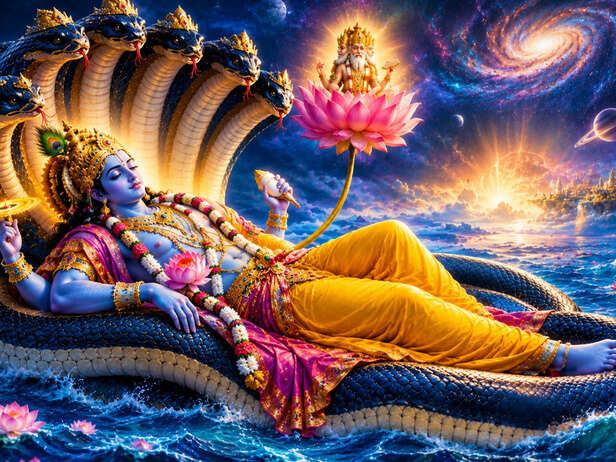
![Lord Vishnu sleeping on Shesh Naag]()
Lord Vishnu sleeping on Shesh Naag
Image credit : ChatGPT
Known as
Anantashayana, this form depicts Lord Vishnu reclining on Ananta Shesha, the divine serpent, in the cosmic ocean. Vishnu is one of the principal deities in Hinduism and is widely worshipped as the preserver and protector of the universe.His posture may look like ordinary sleep, but Hindu traditions give it a much deeper meaning. It is associated with cosmic order, the endless nature of time, and the cycle through which the universe is created, preserved, and renewed.
Why Does Lord Vishnu Rest on a Giant Serpent?
The serpent beneath Lord Vishnu is known by names such as Shesha, Ananta, and Ananta Shesha. In Hindu mythology, Shesha is a powerful divine serpent often described as having many heads.The name
Ananta means “endless” or “infinite.” This connects the serpent with the idea of eternity. Vishnu resting upon Ananta Shesha can therefore be understood as an image of the divine existing beyond the limits of ordinary time.Shesha is not simply a creature serving as Vishnu’s bed. In traditional accounts, he is a divine being associated with stability and the cosmic order. His many heads are often depicted forming a protective canopy above Vishnu.
The image also conveys an important idea: even amid the vast and mysterious forces of the universe, Vishnu remains calm and steady.
What Does the Cosmic Ocean Represent?
The ocean surrounding Vishnu is commonly known as the
Kshira Sagara, or Ocean of Milk, in many Hindu traditions. It is portrayed as a vast, primordial expanse connected with cosmic existence.The waters can be interpreted as representing the unmanifest state of creation, a condition in which the universe has not yet taken its familiar form. Vishnu’s presence within this ocean suggests that the potential for creation exists even when the universe is not visibly active.
In some Hindu cosmological accounts, the universe passes through cycles of creation, preservation, and dissolution. The image of Vishnu resting in the cosmic ocean is especially associated with the interval between periods of creation.This is not a description of sleep in the ordinary human sense. It is a sacred image expressing a cosmic process that is far beyond everyday experience.
Is Lord Vishnu Really Sleeping?
The question becomes even more interesting when we consider what Vishnu’s sleep means in Hindu mythology.His cosmic rest is often connected with
Yoganidra, a divine state of yogic sleep. Unlike ordinary sleep, Yoganidra is associated with deep stillness and divine power. Vishnu is not portrayed as powerless or unaware. Rather, his peaceful posture reflects a state beyond ordinary activity.
Different Hindu texts and traditions describe these ideas in different ways. In some accounts, the universe rests in a dissolved or unmanifest state before a new cycle begins. In other depictions, Brahma, the deity associated with creation, emerges from a lotus growing from Vishnu’s navel.This image connects Vishnu’s stillness with the possibility of renewed creation. The universe may appear quiet, but the potential for another cycle remains.
Why Does a Lotus Grow from Lord Vishnu’s Navel?
One of the most recognisable details in this depiction is the lotus rising from Vishnu’s navel. Lord Brahma is often shown seated on this lotus.According to a widely known Hindu creation account, Brahma emerges from the lotus and undertakes the work of creating the universe. Vishnu represents preservation, while Brahma is associated with creation.
The lotus carries its own symbolism. It is widely associated with purity, spiritual unfolding, and the emergence of beauty from surrounding waters. Its appearance from Vishnu’s navel visually connects the preserving power of Vishnu with the beginning of creation.Together, the serpent, ocean, resting Vishnu, and lotus form a symbolic picture of the relationship between cosmic stillness and the birth of the universe.
What Do Vishnu’s Posture and Appearance Symbolise?
Every major element in this image has inspired religious and philosophical interpretations.
The serpent: Ananta Shesha is associated with infinity and the enduring nature of existence.
The cosmic ocean: It represents the vastness of cosmic reality and, in some interpretations, the unmanifest state before creation.
Vishnu’s peaceful posture: His calmness conveys stability and the preservation of cosmic order.
The lotus: It represents the emergence of creation and is often associated with purity and spiritual growth.
The multiple serpent heads: These create a protective canopy over Vishnu and emphasise the serpent’s extraordinary divine form.
These meanings are interpretations rooted in Hindu religious traditions, rather than a single explanation shared identically by every school of thought.
What This Ancient Image Can Teach Us Today
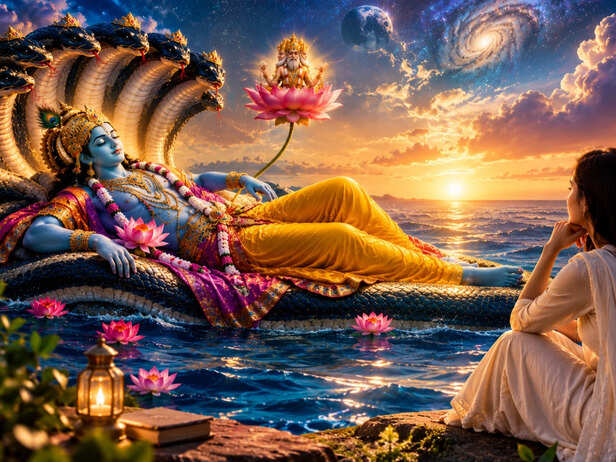
![Significance of Ananta Shesha]()
Significance of Ananta Shesha
Image credit : ChatGPT
The image of Lord Vishnu resting on Ananta Shesha offers a striking contrast between the movement of the cosmic ocean and the stillness of the deity. It invites devotees to reflect on patience, balance, and the idea that not every meaningful process requires visible action.In everyday life, quiet moments are often mistaken for wasted time. Yet rest can create space for reflection, recovery, and a clearer understanding of what needs to happen next. This is a modern personal interpretation of the image, rather than a direct religious instruction.For devotees, Vishnu’s cosmic rest also serves as a reminder of his role in maintaining order through the vast cycles of existence.
A Cosmic Scene With a Deeper Meaning
Lord Vishnu’s resting form is much more than a beautiful scene from Hindu art. The endless serpent, the cosmic ocean, and the lotus emerging from his navel combine to tell a story about infinity, preservation, and creation.His apparent sleep is not simply inactivity. In Hindu cosmology, it points towards a state of divine stillness in which the potential for renewed creation continues to exist.
The next time you see Lord Vishnu reclining on Ananta Shesha, look beyond the image of a sleeping deity. It represents a universe in which stillness and creation, time and eternity, remain deeply connected.
Unlock insightful tips and inspiration on personal growth, productivity, and well-being. Stay motivated and updated with the latest at
My Life XP.