Why Does Number 14 Follow Lord Ram Everywhere?
Noopur Kumari | Aug 26, 2026, 16:00 IST
The number 14 appears in several important Ramayana references, but not every popular claim about the number is equally supported by the original Valmiki text. Some connections are directly found in the epic. Others come from later traditions, interpretations or popular storytelling.
The most interesting question, therefore, is not simply "Why 14?" It is: Did the number 14 have a deliberate symbolic role in Rama's story, or are we connecting separate events after the fact?
The most interesting question, therefore, is not simply "Why 14?" It is: Did the number 14 have a deliberate symbolic role in Rama's story, or are we connecting separate events after the fact?

14 Follow Lord Ram Everywhere
Image credit : ChatGPT(ai)
Fourteen years. Fourteen weapons. Fourteen demons. Fourteen thousand warriors. Fourteen worlds. At first, these numbers may look like unrelated details scattered throughout the Ramayana. But once you start noticing the number 14, something curious happens. It seems to appear again and again around the life of Lord Rama. His exile lasted fourteen years. The story connects him with divine weapons, battles involving fourteen warriors, the fourteen worlds mentioned in the epic tradition and even the fourteenth sarga of the Valmiki Ramayana's Bala Kanda, where the story moves toward the Putrakameshti sacrifice. So is there actually a hidden meaning behind the number? Or are we simply noticing patterns because the number appears in several famous episodes? That is where this story becomes fascinating.
![Lord Rama begins his fourteen-year exile]()
The strongest connection between Rama and the number 14 is undoubtedly his fourteen-year exile. Rama leaves Ayodhya after Kaikeyi invokes her two boons from King Dasharatha. Instead of challenging the decision, Rama accepts the exile to honour his father's promise. Sita and Lakshmana accompany him. Those fourteen years transform the story completely. Rama leaves Ayodhya as a prince and eventually faces encounters with sages, demons, allies and enemies that lead toward the war in Lanka. The number is therefore not just a duration.
Fourteen years become the bridge between Rama's royal life and his greatest test.
![Vishwamitra teaches Rama divine weapons]()
Another popular connection comes from Rama's journey with Sage Vishwamitra. During this period, Vishwamitra teaches Rama knowledge associated with powerful celestial weapons. However, the frequently repeated claim that Rama received exactly fourteen divine weapons should be treated carefully. The Valmiki Ramayana describes numerous astras and their associated powers, but popular summaries often group or count them differently. This distinction matters. The story does not become less fascinating when we separate scripture from later interpretation.In fact, it becomes more interesting because we can see how generations of storytellers have continued to find patterns in Rama's extraordinary journey.
The number appears again during Rama's life in the forest. After Shurpanakha encounters Rama and Lakshmana, events eventually lead to conflict with Khara and the Rakshasas of Janasthana. In the Valmiki Ramayana, Khara sends a group of fourteen Rakshasas against Rama.
Rama defeats them. The confrontation then escalates dramatically. Khara eventually leads a much larger force against Rama, resulting in one of the epic's major forest battles. The progression is striking: 14 warriors first. Then a much larger army. The episode shows how a seemingly limited confrontation develops into a major test of Rama's strength and skill.
The next number is even more dramatic. Khara's army is described as consisting of fourteen thousand Rakshasas. Rama faces the enormous force alone. The battle becomes a defining demonstration of his warrior abilities. This is one of the clearest places where the number 14 appears in a major numerical detail connected with Rama. But should we assume that the number was chosen because 14 was secretly "Rama's number"?
Not necessarily. Epic numbers can carry literary, cultural and symbolic significance, but a repeated number does not automatically prove a hidden code. The fascinating part is simply that 14 appears at several major turning points in Rama's story.
Another popular connection comes from Hindu cosmology. Traditional Hindu texts describe fourteen lokas or worlds, commonly understood as seven higher realms and seven lower realms. This concept is much broader than Rama's personal story. It belongs to Hindu cosmological thought. Yet when storytellers describe Rama as a figure whose influence extends across the worlds, the number 14 can naturally become part of the larger symbolic picture. This is also where we should be careful. The existence of fourteen worlds does not by itself prove that 14 was deliberately assigned as Rama's personal number.
It is better understood as a broader religious idea that later storytelling can connect with Rama's cosmic significance.
Here comes one of the most intriguing details. The fourteenth sarga of the Bala Kanda is connected with the events surrounding Dasharatha's desire for sons and the preparations for the great sacrifice. The Putrakameshti Yajna becomes central to the birth story of Rama, Bharata, Lakshmana and Shatrughna. This makes the number 14 an interesting literary coincidence within the structure of the epic.
But again, there is a difference between "this occurs in the fourteenth sarga" and "the author deliberately designed the entire story around the number 14." The first can be checked against the text.
The second requires interpretation.
This is where the mystery needs a balanced answer. Yes, 14 appears repeatedly in important Ramayana traditions. The fourteen-year exile is central. Fourteen Rakshasas are defeated in an early confrontation. Khara's larger force is described as fourteen thousand. Hindu cosmology speaks of fourteen worlds. And the fourteenth sarga of the Bala Kanda contains an important part of the narrative leading toward the royal sacrifice. But there is no established scriptural statement saying that 14 was Rama's special number. The pattern is fascinating. Its deeper meaning, however, remains a matter of interpretation.
Unlock insightful tips and inspiration on personal growth, productivity, and well-being. Stay motivated and updated with the latest at My Life XP.
The Fourteen-Year Exile
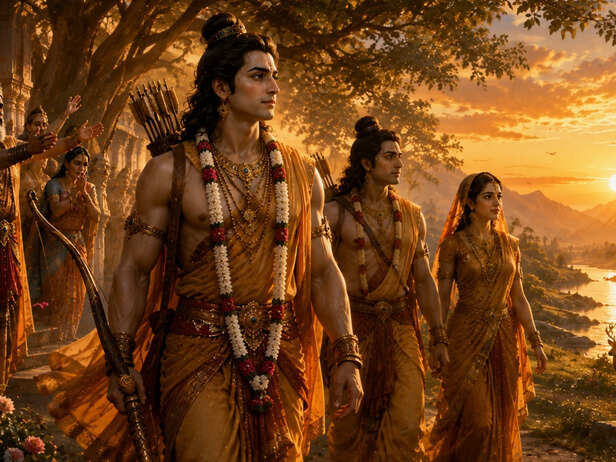
Lord Rama begins his fourteen-year exile
Image credit : ChatGPT(ai)
The strongest connection between Rama and the number 14 is undoubtedly his fourteen-year exile. Rama leaves Ayodhya after Kaikeyi invokes her two boons from King Dasharatha. Instead of challenging the decision, Rama accepts the exile to honour his father's promise. Sita and Lakshmana accompany him. Those fourteen years transform the story completely. Rama leaves Ayodhya as a prince and eventually faces encounters with sages, demons, allies and enemies that lead toward the war in Lanka. The number is therefore not just a duration.
Fourteen years become the bridge between Rama's royal life and his greatest test.
Fourteen and Rama’s Divine Weapons
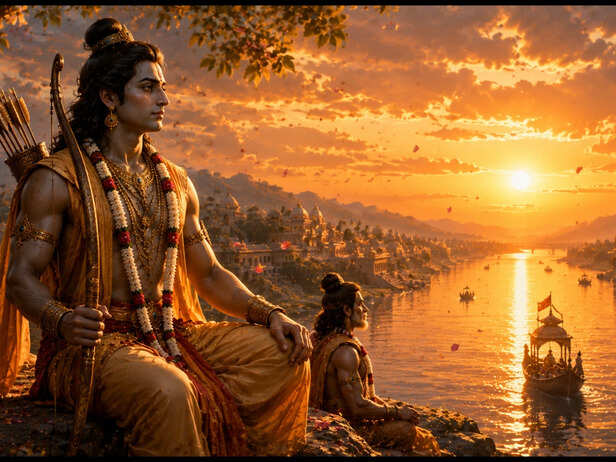
Vishwamitra teaches Rama divine weapons
Image credit : ChatGPT(ai)
Another popular connection comes from Rama's journey with Sage Vishwamitra. During this period, Vishwamitra teaches Rama knowledge associated with powerful celestial weapons. However, the frequently repeated claim that Rama received exactly fourteen divine weapons should be treated carefully. The Valmiki Ramayana describes numerous astras and their associated powers, but popular summaries often group or count them differently. This distinction matters. The story does not become less fascinating when we separate scripture from later interpretation.In fact, it becomes more interesting because we can see how generations of storytellers have continued to find patterns in Rama's extraordinary journey.
Fourteen Demons Appear in Battle
Rama defeats them. The confrontation then escalates dramatically. Khara eventually leads a much larger force against Rama, resulting in one of the epic's major forest battles. The progression is striking: 14 warriors first. Then a much larger army. The episode shows how a seemingly limited confrontation develops into a major test of Rama's strength and skill.
The Fourteen Thousand Warriors
Not necessarily. Epic numbers can carry literary, cultural and symbolic significance, but a repeated number does not automatically prove a hidden code. The fascinating part is simply that 14 appears at several major turning points in Rama's story.
The Fourteen Worlds
It is better understood as a broader religious idea that later storytelling can connect with Rama's cosmic significance.
The Fourteenth Sarga Holds a Surprise
But again, there is a difference between "this occurs in the fourteenth sarga" and "the author deliberately designed the entire story around the number 14." The first can be checked against the text.
The second requires interpretation.
So, Is 14 Really Rama’s Number?
Unlock insightful tips and inspiration on personal growth, productivity, and well-being. Stay motivated and updated with the latest at My Life XP.