Why Was Krishna Born as the 8th Child? The Hidden Meaning
Noopur Kumari | Aug 31, 2026, 16:00 IST
Krishna’s birth story blends tradition with spiritual symbolism. Devaki’s six children were killed by Kamsa, Balarama was transferred to Rohini’s womb through Yogamaya, and Krishna appeared as the eighth child. Later interpretations connect the six children with the six inner enemies: desire, anger, greed, delusion, pride and jealousy. Ashtami and other traditions add deeper symbolism to Krishna’s birth.

Krishna’s birth story contains several layers of religious tradition and spiritual symbolism. T
Image credit : ChatGPT (ai)
Why did Lord Krishna enter the world as Devaki and Vasudeva’s eighth child? The number may look like a simple detail from the birth story, but Hindu traditions and later spiritual interpretations attach deeper symbolism to it. Before Krishna’s arrival, Devaki’s first six children were killed by Kamsa, while the seventh, Balarama, was mystically transferred to Rohini’s womb. Then came Krishna on Ashtami. Beyond the dramatic story lies a powerful spiritual idea: sometimes transformation begins only after fear, attachment and inner obstacles are confronted. But there is another mystery too. Why is the number eight repeatedly associated with Krishna?
![Krishna’s Divine Birth in Mathura]()
The story begins with Devaki and Vasudeva, whose children became victims of Kamsa’s fear. According to the Bhagavata Purana, Kamsa killed Devaki’s first six sons. Balarama was then transferred from Devaki’s womb to Rohini’s womb through divine intervention, while Krishna became the eighth child. His birth took place at midnight on the eighth lunar day, or Ashtami, of the dark fortnight. This makes the number eight an important part of Krishna’s birth narrative. For devotees, the sequence is not simply a count of births. It forms the dramatic setting for the arrival of the Divine when darkness appears to have reached its peak.
![Symbolic Representation of the Six Inner Enemies]()
One spiritual interpretation gives the first six births a symbolic meaning. They are associated with the six inner enemies, known as shadripu: kama or uncontrolled desire, krodha or anger, lobha or greed, moha or attachment, mada or pride, and matsarya or jealousy. It is important to distinguish this from the literal narrative of the Bhagavata Purana. The connection is a spiritual interpretation rather than a straightforward statement in the birth account. Read symbolically, however, it creates a striking message: before Krishna arrives, the obstacles within the human mind must gradually be confronted. The story then becomes a journey from inner darkness towards divine awareness.
The seventh child introduces another remarkable turn in the story. Traditional accounts describe Balarama being transferred from Devaki’s womb to Rohini’s womb through the power of Yogamaya. This allowed Kamsa to believe that Devaki had lost her pregnancy. Balarama therefore appears before Krishna, but through a completely different circumstance. Symbolically, devotees sometimes see this sequence as preparation for Krishna’s arrival. Balarama is closely associated with strength and divine support, while Krishna represents the fullness of divine play and wisdom. Together, their appearance creates a powerful transition in the birth narrative, moving the story towards its central moment.
The number eight has a fascinating presence in Krishna-related traditions. Krishna is born on Ashtami, the eighth lunar day. He is traditionally described as having eight principal wives, known as the Ashtabharya. In Vaishnava tradition, Lakshmi, the divine consort of Vishnu, is also worshipped in eight forms as Ashtalakshmi. These connections do not mean every appearance of the number eight has one fixed meaning. Rather, devotees and spiritual teachers have found symbolic associations in its repeated appearance. For many, eight represents a point of transition, balance and movement, making Krishna’s birth on Ashtami especially meaningful.
Krishna is traditionally celebrated as being born on Krishna Paksha Ashtami, the eighth lunar day of the waning fortnight. The lunar cycle gives this date an interesting symbolic character because it occurs around the middle of the fortnight. The moon is moving towards darkness, yet Krishna appears precisely during this period. For devotees, this creates a beautiful spiritual contrast: divine light enters when the surroundings are dark. Some modern spiritual interpretations describe Ashtami as a point of transition or transformation. Whether viewed through faith, symbolism or the lunar calendar, Krishna’s birth timing adds another layer to the story.
The birth of Krishna does not begin in comfort. Devaki and Vasudeva are imprisoned, Kamsa rules through fear, and their children face terrible danger. Yet this darkness becomes the setting for Krishna’s arrival. This does not mean suffering is always necessary or that pain should be romanticised. Instead, the story can offer a more hopeful message: difficult periods can become moments when courage, faith and inner change emerge. The symbolic journey from the first six children to Krishna’s eighth birth can therefore be read as movement through obstacles towards transformation. The darkness does not get the final word.
Perhaps the most powerful way to understand Krishna’s eighth birth is not to focus only on the number itself, but on what the entire story represents. Fear comes first. Loss follows. Balarama arrives through divine intervention. Then Krishna appears on Ashtami, bringing a new direction to the story. The spiritual lesson can be applied to everyday life without claiming that every difficulty has a predetermined cosmic purpose. When anger, greed, attachment, pride and jealousy are recognised and worked through, there can be space for greater clarity and compassion. Krishna’s birth then becomes a powerful metaphor for inner transformation after darkness.
Unlock insightful tips and inspiration on personal growth, productivity, and well-being. Stay motivated and updated with the latest at My Life XP.
Why Krishna Was the Eighth Child
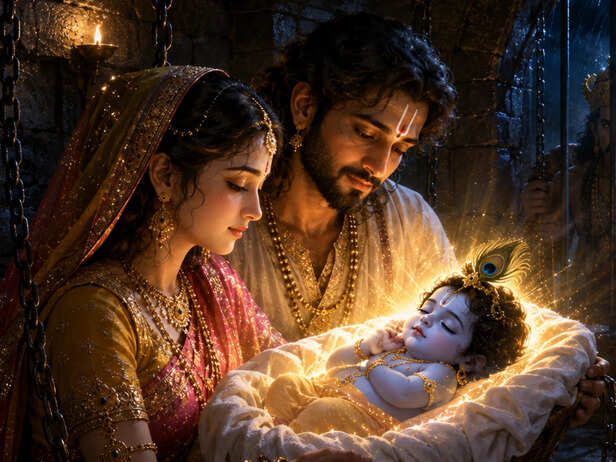
Krishna’s Divine Birth in Mathura
Image credit : chatgpt(ai)
The story begins with Devaki and Vasudeva, whose children became victims of Kamsa’s fear. According to the Bhagavata Purana, Kamsa killed Devaki’s first six sons. Balarama was then transferred from Devaki’s womb to Rohini’s womb through divine intervention, while Krishna became the eighth child. His birth took place at midnight on the eighth lunar day, or Ashtami, of the dark fortnight. This makes the number eight an important part of Krishna’s birth narrative. For devotees, the sequence is not simply a count of births. It forms the dramatic setting for the arrival of the Divine when darkness appears to have reached its peak.
The Six Children and Inner Enemies
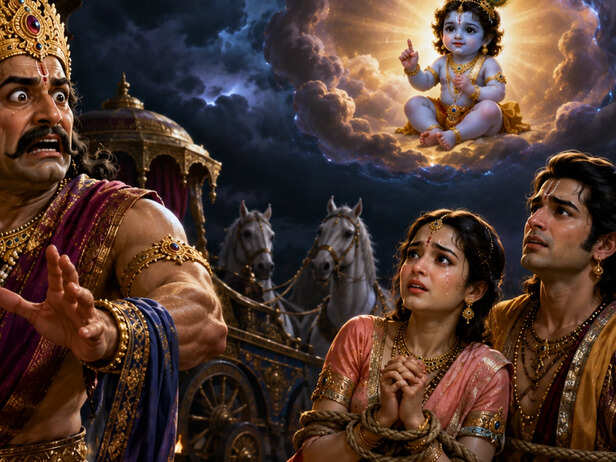
Symbolic Representation of the Six Inner Enemies
Image credit : chatgpt(ai)
One spiritual interpretation gives the first six births a symbolic meaning. They are associated with the six inner enemies, known as shadripu: kama or uncontrolled desire, krodha or anger, lobha or greed, moha or attachment, mada or pride, and matsarya or jealousy. It is important to distinguish this from the literal narrative of the Bhagavata Purana. The connection is a spiritual interpretation rather than a straightforward statement in the birth account. Read symbolically, however, it creates a striking message: before Krishna arrives, the obstacles within the human mind must gradually be confronted. The story then becomes a journey from inner darkness towards divine awareness.
Balarama Comes Before Krishna
Why the Number Eight Matters
Ashtami Is a Turning Point
Why Suffering Comes Before Transformation
The Hidden Message of Krishna’s Birth
Unlock insightful tips and inspiration on personal growth, productivity, and well-being. Stay motivated and updated with the latest at My Life XP.