How the 4 Yugas Were Really Created (Hidden Story)
Noopur Kumari | Mon, 27 Apr 2026
What if the Yugas are not just about time but about how humans choose to live? Ancient wisdom suggests that Dharma once stood strong, but slowly began to weaken with every age. Its “four legs” weren’t physical they symbolized truth, purity, knowledge, and compassion. As these faded, each Yuga changed. That’s why Kali Yuga feels more chaotic and uncertain today. But here’s the deeper mystery if Dharma keeps declining, what happens when its last support disappears? Does everything end or does a new beginning quietly take birth again?

4 Yugas
Image credit : ChatGPT(ai)
What if time itself is not just passing but slowly losing its strength? We often hear about the four Yugas Satya, Treta, Dwapar, and Kali but rarely pause to question what they truly represent. Ancient wisdom suggests this is not just a story of time, but of Dharma the balance that holds life together. With each passing Yuga, something essential fades: truth weakens, purity declines, and compassion struggles. What we are witnessing is not just the movement of time, but a gradual shift in human values and that changes everything.
![Creation of Dharma]()
According to ancient beliefs, when Brahma was creating the universe, Dharma emerged from his heart in the form of a sacred force. It was not just a rule but a living principle of balance. Dharma was shown standing on four legs, each representing a core virtue—truth, knowledge, purity, and compassion. These were not optional values; they formed the foundation of existence. As long as these four remained strong, harmony existed in the world.
![Four Pillars of Dharma]()
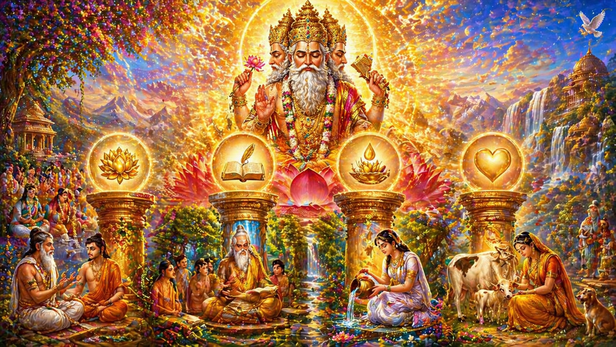
Each leg of Dharma represents a key virtue Satya (truth), Gyaan (knowledge), Shuddhata (purity), and Daya (compassion). These are not just ideas but guiding principles for life. In the beginning, all four were strong, creating a perfect balance. But as time moved forward, human actions began to weaken these values. The decline of these virtues is what defines the change of Yugas. It is not time that changes first it is behavior.
![Satya Yuga Harmony]()
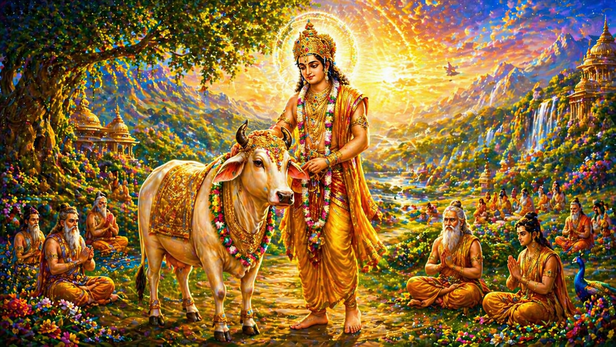
In Satya Yuga, Dharma stood firmly on all four legs. Truth, discipline, purity, and compassion were fully practiced. Life was simple, balanced, and peaceful. There was no confusion or conflict because people lived in alignment with these values. This era represents the highest state of human consciousness. It is often seen as the ideal world, where harmony existed naturally without force.
As time moved into Treta Yuga, one leg of Dharma weakened. Discipline and spiritual focus began to reduce. In Dwapar Yuga, another leg disappeared, and purity declined. This created imbalance in society. Conflicts increased, and people became more divided. The shift was gradual, not sudden. Each Yuga reflected a step away from the original harmony, showing how small changes in values can lead to larger consequences over time.
In Kali Yuga, Dharma stands on just one leg compassion. Truth, purity, and discipline have weakened significantly. This is why the world often feels chaotic, fast, and disconnected. People struggle with clarity and balance. But even in this age, the presence of one virtue means hope still exists. It reminds us that even a small amount of goodness can hold the world together.
When the final leg of Dharma disappears, it is said that Pralaya the great dissolution will occur. This marks the end of the cycle. But it is not destruction alone; it is also renewal. After this, a new Satya Yuga begins, restoring balance again. This cycle shows that time is not linear but circular. Decline is followed by rebirth, and imbalance is eventually corrected.
Unlock insightful tips and inspiration on personal growth, productivity, and well-being. Stay motivated and updated with the latest at My Life XP.
1. What are the four Yugas?
The four Yugas are Satya Yuga, Treta Yuga, Dwapar Yuga, and Kali Yuga. They represent different phases of time, each reflecting a gradual decline in human values and Dharma.
2. What do the “four legs of Dharma” mean?
The four legs symbolize truth, knowledge, purity, and compassion. In each Yuga, one leg weakens, showing how these values slowly decline over time.
3. Why does Dharma decrease in every Yuga?
It is believed that human actions and choices cause the decline. As people move away from discipline and truth, Dharma naturally weakens.
4. Why is Kali Yuga considered the worst age?
In Kali Yuga, only one leg of Dharma remains. This leads to confusion, conflict, and a lack of balance in life.
5. What happens after Kali Yuga ends?
After Kali Yuga, a cosmic reset called Pralaya is said to occur, followed by the beginning of a new Satya Yuga.
6. Can Dharma be strengthened again?
Yes, even in Kali Yuga, individuals can practice truth, compassion, and discipline to restore balance in their own lives
The Birth of Dharma
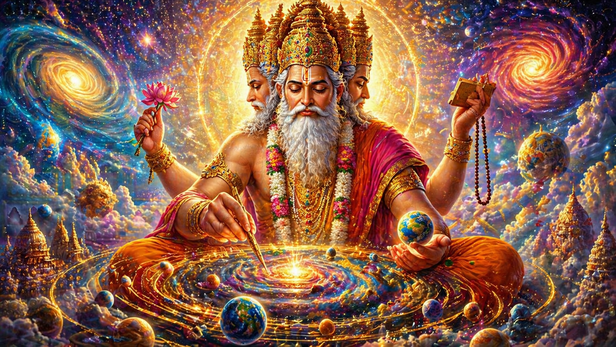
Creation of Dharma
Image credit : ChatGPT(ai)
According to ancient beliefs, when Brahma was creating the universe, Dharma emerged from his heart in the form of a sacred force. It was not just a rule but a living principle of balance. Dharma was shown standing on four legs, each representing a core virtue—truth, knowledge, purity, and compassion. These were not optional values; they formed the foundation of existence. As long as these four remained strong, harmony existed in the world.
The Four Legs of Dharma
Four Pillars of Dharma
Image credit : ChatGPT
Each leg of Dharma represents a key virtue Satya (truth), Gyaan (knowledge), Shuddhata (purity), and Daya (compassion). These are not just ideas but guiding principles for life. In the beginning, all four were strong, creating a perfect balance. But as time moved forward, human actions began to weaken these values. The decline of these virtues is what defines the change of Yugas. It is not time that changes first it is behavior.
Satya Yuga: The Age of Perfection
Satya Yuga Harmony
Image credit : ChatGPT(ai)
In Satya Yuga, Dharma stood firmly on all four legs. Truth, discipline, purity, and compassion were fully practiced. Life was simple, balanced, and peaceful. There was no confusion or conflict because people lived in alignment with these values. This era represents the highest state of human consciousness. It is often seen as the ideal world, where harmony existed naturally without force.
Treta to Dwapar: The Gradual Decline
Kali Yuga: The Final Stage
What Happens When the Last Leg Falls?
Unlock insightful tips and inspiration on personal growth, productivity, and well-being. Stay motivated and updated with the latest at My Life XP.
Frequently Asked Questions (FAQs)
The four Yugas are Satya Yuga, Treta Yuga, Dwapar Yuga, and Kali Yuga. They represent different phases of time, each reflecting a gradual decline in human values and Dharma.
2. What do the “four legs of Dharma” mean?
The four legs symbolize truth, knowledge, purity, and compassion. In each Yuga, one leg weakens, showing how these values slowly decline over time.
3. Why does Dharma decrease in every Yuga?
It is believed that human actions and choices cause the decline. As people move away from discipline and truth, Dharma naturally weakens.
4. Why is Kali Yuga considered the worst age?
In Kali Yuga, only one leg of Dharma remains. This leads to confusion, conflict, and a lack of balance in life.
5. What happens after Kali Yuga ends?
After Kali Yuga, a cosmic reset called Pralaya is said to occur, followed by the beginning of a new Satya Yuga.
6. Can Dharma be strengthened again?
Yes, even in Kali Yuga, individuals can practice truth, compassion, and discipline to restore balance in their own lives