What Hanuman Chalisa Did Inside Akbar’s Prison Will Shock You
Noopur Kumari | Fri, 10 Apr 2026
A humble saint refuses to prove his faith with a miracle, angering a powerful king whose pride cannot accept defiance. What follows is not a battle of strength, but of belief. Thrown into chains, the saint turns inward, where devotion only grows stronger. Days pass and something unseen begins to build. Then suddenly, a mysterious force shakes the entire empire, leaving the king helpless. No weapon can stop it. No logic can explain it. And in that moment of chaos, the king realizes a truth he ignored faith is not to be tested it is to be respected.

History of Hanuman Chalisa
Image credit : CHATGPT(AI)
What if one of the most powerful prayers ever written was born not in peace but in chains? What if unshaken devotion could challenge a mighty emperor and win? This is not just a tale from the past. It is a moment where faith stood firm against power, where silence spoke louder than authority. In the darkest place, a light was created that still guides millions today. A story of courage when everything is taken away, of surrender without fear, and of a miracle that didn’t just happen once but continues to inspire belief, strength, and unwavering trust even now.
![Saint in the Mughal Court]()
When Tulsidas was summoned by Akbar to Fatehpur Sikri, it seemed like an honor. But the atmosphere quickly shifted. The emperor demanded a miracle proof of divine power. Tulsidas didn’t bend. He calmly said he was only a devotee of Lord Rama, not a magician. That one sentence changed everything. In a court driven by power and pride, humility felt like rebellion. And rebellion had consequences.
![Prison Cell of Silence]()
Angered by what he saw as defiance, Akbar ordered Tulsidas to be imprisoned. Heavy chains. A dark cell. Silence. But what the emperor didn’t understand was this faith does not weaken in darkness, it strengthens. Inside that prison, Tulsidas didn’t despair. He turned inward. He began chanting, remembering Hanuman with deep focus. The body was trapped, but the mind was free. And in that stillness, something powerful began to take shape something the world would never forget.
In that very prison, Tulsidas composed the sacred Hanuman Chalisa. Not as poetry, but as surrender. Line by line, verse by verse, he poured unwavering faith into words. For 40 days, he recited it with complete devotion. No distractions. No doubts. Just belief. This wasn’t just writing it was creation through faith. And when belief reaches that depth, it doesn’t stay invisible. It begins to move the world in ways logic cannot explain.
Then came the moment no one expected. Suddenly, thousands of monkeys flooded Fatehpur Sikri. Not ordinary chaos this was unstoppable. Palaces shaken. Soldiers overwhelmed. The entire empire thrown into confusion. No weapon worked. No order could control it. It felt like nature itself had turned against power. Legends say these were not just animals they were a divine response. A silent message: faith cannot be chained, and devotion cannot be challenged.
It was Birbal who understood what was happening. He told Akbar this chaos was the result of insulting a true devotee. For the first time, the emperor felt fear not of war, but of something beyond control. Akbar rushed to the prison, apologized, and released Tulsidas. And just like that the monkeys disappeared. Silence returned. But something had changed forever the realization that true power lies not in authority, but in devotion.
Unlock insightful tips and inspiration on personal growth, productivity, and well-being. Stay motivated and updated with the latest at My Life XP.
1. Was the Hanuman Chalisa really written in prison?
Many traditional stories say that Tulsidas composed the Hanuman Chalisa during imprisonment. While historical proof is limited, this belief is deeply rooted in devotional tradition.
2. Did Emperor Akbar really imprison Tulsidas?
Some popular legends connect Akbar with this story. However, historians consider it more of a spiritual narrative than a confirmed historical event.
3. Why is Hanuman Chalisa considered powerful?
The Hanuman Chalisa is believed to invoke the blessings of Hanuman, symbolizing strength, protection, courage, and removal of fear and obstacles.
4. What is the significance of chanting it for 40 days?
Devotees believe that chanting the Hanuman Chalisa consistently for 40 days strengthens focus, faith, and inner peace, often called a “mandala” period in spiritual practice.
5. Is the story of monkeys attacking the empire real?
This part is widely seen as symbolic or legendary, representing divine intervention and the power of unwavering devotion rather than a literal historical
The Day Faith Entered the Royal Court
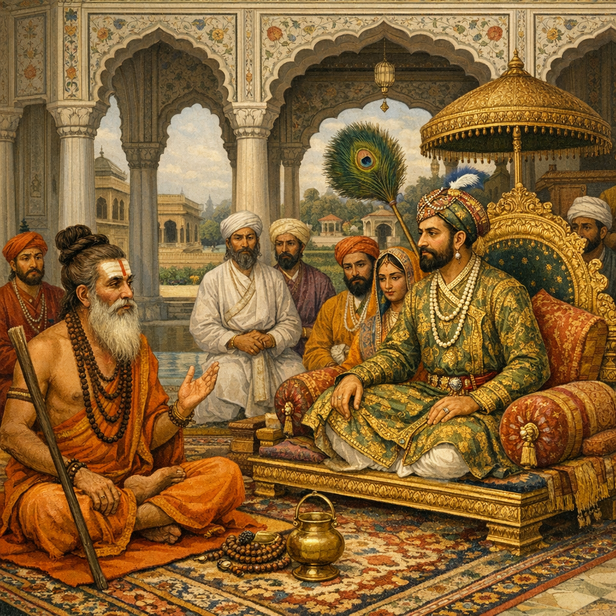
Saint in the Mughal Court
Image credit : chatgpt(AI)
When Tulsidas was summoned by Akbar to Fatehpur Sikri, it seemed like an honor. But the atmosphere quickly shifted. The emperor demanded a miracle proof of divine power. Tulsidas didn’t bend. He calmly said he was only a devotee of Lord Rama, not a magician. That one sentence changed everything. In a court driven by power and pride, humility felt like rebellion. And rebellion had consequences.
Chains Could Not Break Devotion
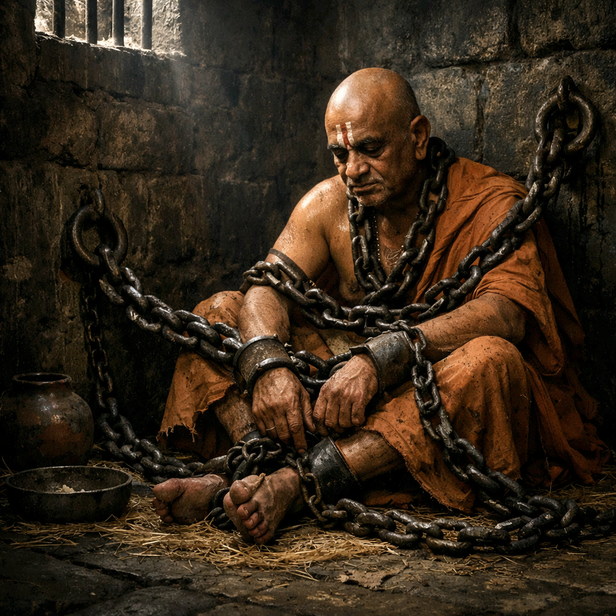
Prison Cell of Silence
Image credit : CHATGPT(aI)
Angered by what he saw as defiance, Akbar ordered Tulsidas to be imprisoned. Heavy chains. A dark cell. Silence. But what the emperor didn’t understand was this faith does not weaken in darkness, it strengthens. Inside that prison, Tulsidas didn’t despair. He turned inward. He began chanting, remembering Hanuman with deep focus. The body was trapped, but the mind was free. And in that stillness, something powerful began to take shape something the world would never forget.
A Prayer Born in Darkness
In that very prison, Tulsidas composed the sacred Hanuman Chalisa. Not as poetry, but as surrender. Line by line, verse by verse, he poured unwavering faith into words. For 40 days, he recited it with complete devotion. No distractions. No doubts. Just belief. This wasn’t just writing it was creation through faith. And when belief reaches that depth, it doesn’t stay invisible. It begins to move the world in ways logic cannot explain.
The Day the Empire Trembled
When Power Bowed to Faith
Unlock insightful tips and inspiration on personal growth, productivity, and well-being. Stay motivated and updated with the latest at My Life XP.
Frequently Asked Questions (FAQs)
Many traditional stories say that Tulsidas composed the Hanuman Chalisa during imprisonment. While historical proof is limited, this belief is deeply rooted in devotional tradition.
2. Did Emperor Akbar really imprison Tulsidas?
Some popular legends connect Akbar with this story. However, historians consider it more of a spiritual narrative than a confirmed historical event.
3. Why is Hanuman Chalisa considered powerful?
The Hanuman Chalisa is believed to invoke the blessings of Hanuman, symbolizing strength, protection, courage, and removal of fear and obstacles.
4. What is the significance of chanting it for 40 days?
Devotees believe that chanting the Hanuman Chalisa consistently for 40 days strengthens focus, faith, and inner peace, often called a “mandala” period in spiritual practice.
5. Is the story of monkeys attacking the empire real?
This part is widely seen as symbolic or legendary, representing divine intervention and the power of unwavering devotion rather than a literal historical