Why Every Purana Has a Different Version of Creation
Noopur Kumari | May 30, 2026, 11:00 IST
Many people believe the Puranas contradict one another because they present different creation stories. However, these differences were intentional, not accidental. The sages were not confused. They used different narratives to explain the same cosmic truth from different perspectives. To understand why Shiva, Vishnu, and Adi Shakti can all be described as the source of creation, we must first understand the purpose of the Puranas themselves.

Who came first Shiva, Vishnu, or Adi Shakti? This question has sparked debates for centuries. One Purana says Shiva existed before everything. Another declares Vishnu as the source of creation. A third describes Adi Shakti as the supreme force from whom even Brahma, Vishnu, and Mahesh emerged. So who is telling the truth? The answer may surprise you. What appears to be a contradiction is actually one of the deepest spiritual insights hidden within Hindu scriptures. The confusion begins only when we read the Puranas literally and ignore the larger picture they are trying to reveal.
![Shiva, Vishnu, and Adi Shakti in Cosmic Form]()
Many readers encounter a puzzle when studying Hindu scriptures. The Shiva Purana places Mahadev at the center of creation. The Vishnu Purana describes Vishnu as the origin of the universe. The Devi Bhagavata Purana presents Adi Shakti as the supreme source. At first glance, these stories seem impossible to reconcile. People often assume that one scripture must be correct and the others must be wrong. But Hindu philosophy rarely operates in such a simple way. The apparent contradiction is actually an invitation to look deeper and understand the symbolic language through which ancient sages explained cosmic truths.
The Vedas contain profound spiritual knowledge, but their language and concepts can be difficult for ordinary people to grasp. According to tradition, Maharishi Vedavyasa recognized that future generations would struggle to preserve and understand this vast wisdom. To make spiritual knowledge accessible, he compiled teachings, histories, and philosophical ideas into stories. These became the foundation of the Puranas. Their purpose was not merely to record events but to teach eternal truths through relatable narratives. The stories were designed for people with different levels of understanding, allowing complex ideas to reach every corner of society.
Imagine several people standing around a mountain. Each person describes what they see, yet no description is completely identical. The Puranas work in a similar way. A Shaiva text emphasizes Shiva, a Vaishnava text highlights Vishnu, and a Shakta text glorifies Adi Shakti. Each perspective focuses on one aspect of the same divine reality. Rather than competing with one another, these narratives help devotees connect with the Supreme through different paths. The sages understood that spiritual seekers have different temperaments, so they presented the same truth through multiple lenses and devotional traditions.
One of the most important concepts in Hindu thought is that the divine can manifest in different forms while remaining fundamentally one. Brahma represents creation, Vishnu preservation, and Shiva transformation. In many traditions, these three are seen as expressions of a single cosmic consciousness. Similarly, Adi Shakti is viewed as the energy through which that consciousness operates. Different scriptures emphasize different aspects depending on their spiritual focus. Once this principle is understood, the contradiction begins to disappear. The stories are not arguing over supremacy they are revealing the many dimensions of the same infinite reality.
The biggest mistake is reading every Puranic story as a literal historical report. The sages often used symbolism, metaphor, and devotion to communicate truths that cannot easily be expressed through ordinary language. When readers focus only on surface details, they miss the philosophical message hidden beneath the story. The goal of the Puranas was never to create division between devotees of Shiva, Vishnu, or Devi. Their purpose was to guide seekers toward spiritual understanding. Once we recognize this, the differences between the scriptures become a source of wisdom rather than confusion.
Unlock insightful tips and inspiration on personal growth, productivity, and well-being. Stay motivated and updated with the latest at My Life XP.
1. Why do different Puranas describe different creators of the universe?
Different Puranas focus on different deities and spiritual traditions. The Shiva Purana glorifies Shiva, the Vishnu Purana emphasizes Vishnu, and the Devi Bhagavata Purana highlights Adi Shakti. These perspectives are meant to inspire devotion and explain the same cosmic truth through different lenses.
2. Does this mean the Puranas contradict each other?
Not necessarily. Most Hindu scholars view these differences as complementary rather than contradictory. Each Purana presents a unique perspective to help devotees understand the divine according to their spiritual path.
3. Who came first according to Hindu scriptures—Shiva, Vishnu, or Adi Shakti?
The answer depends on the scripture being referenced. Some texts place Shiva first, others Vishnu, and others Adi Shakti. Philosophically, many traditions teach that all three are manifestations of the same supreme reality.
4. Why were the Puranas written if the Vedas already existed?
The Vedas contain profound spiritual knowledge that can be difficult to understand. The Puranas were composed to make that wisdom accessible through stories, legends, and examples that ordinary people could easily relate to.
5. Who compiled the Puranas?
According to tradition, the Puranas were compiled by the sage Vedavyasa. He organized ancient knowledge into narratives so future generations could preserve and understand spiritual teachings more easily.
The Question That Confuses Almost Everyone
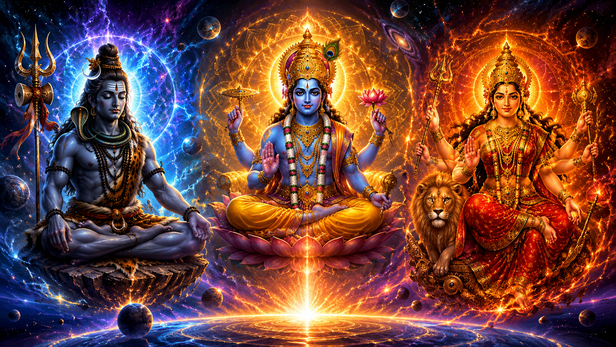
Shiva, Vishnu, and Adi Shakti in Cosmic Form
Many readers encounter a puzzle when studying Hindu scriptures. The Shiva Purana places Mahadev at the center of creation. The Vishnu Purana describes Vishnu as the origin of the universe. The Devi Bhagavata Purana presents Adi Shakti as the supreme source. At first glance, these stories seem impossible to reconcile. People often assume that one scripture must be correct and the others must be wrong. But Hindu philosophy rarely operates in such a simple way. The apparent contradiction is actually an invitation to look deeper and understand the symbolic language through which ancient sages explained cosmic truths.
Why the Puranas Were Created
The Vedas contain profound spiritual knowledge, but their language and concepts can be difficult for ordinary people to grasp. According to tradition, Maharishi Vedavyasa recognized that future generations would struggle to preserve and understand this vast wisdom. To make spiritual knowledge accessible, he compiled teachings, histories, and philosophical ideas into stories. These became the foundation of the Puranas. Their purpose was not merely to record events but to teach eternal truths through relatable narratives. The stories were designed for people with different levels of understanding, allowing complex ideas to reach every corner of society.
Different Stories, One Deeper Truth
The Secret Hidden Behind the Trinity
The Mistake Modern Readers Often Make
Unlock insightful tips and inspiration on personal growth, productivity, and well-being. Stay motivated and updated with the latest at My Life XP.
Frequently Asked Questions (FAQs)
Different Puranas focus on different deities and spiritual traditions. The Shiva Purana glorifies Shiva, the Vishnu Purana emphasizes Vishnu, and the Devi Bhagavata Purana highlights Adi Shakti. These perspectives are meant to inspire devotion and explain the same cosmic truth through different lenses.
2. Does this mean the Puranas contradict each other?
Not necessarily. Most Hindu scholars view these differences as complementary rather than contradictory. Each Purana presents a unique perspective to help devotees understand the divine according to their spiritual path.
3. Who came first according to Hindu scriptures—Shiva, Vishnu, or Adi Shakti?
The answer depends on the scripture being referenced. Some texts place Shiva first, others Vishnu, and others Adi Shakti. Philosophically, many traditions teach that all three are manifestations of the same supreme reality.
4. Why were the Puranas written if the Vedas already existed?
The Vedas contain profound spiritual knowledge that can be difficult to understand. The Puranas were composed to make that wisdom accessible through stories, legends, and examples that ordinary people could easily relate to.
5. Who compiled the Puranas?
According to tradition, the Puranas were compiled by the sage Vedavyasa. He organized ancient knowledge into narratives so future generations could preserve and understand spiritual teachings more easily.