Madurai does not sprawl the way most Indian cities do. It was designed from the inside out, with the Meenakshi Amman Temple as the fixed centre and the city arranged around it in a series of concentric streets called the Chithirai, Avani Moola, Masi, and Chittirai streets, each ring named, each ring with its own character. The logic is old enough that it predates the British grid, and it is still legible if you know to look for it. Walk outward from the gopuram and the city unfolds like a diagram of itself.
The Temple Precinct: Where the Walk Begins
The eastern gopuram is the practical starting point. Face it, then turn around. Everything you can see from that position, the flower sellers laying out jasmine by the rope-length, the oil lamp shops, the narrow corridor of stalls selling turmeric and kumkum in small paper packets, exists in direct service of what is behind you. This innermost ring is not a marketplace that happens to sit near a temple. It is the temple's outer body, the part of the ritual that takes place in open air. Walk the full perimeter of the temple walls before moving outward. The four gopurams face the four cardinal directions, and the streets that radiate from each face have different trades on them. The north face has more silver; the south has more flowers; the east has the most foot traffic because the main entrance draws it. Take note of what each face holds before you leave it behind.
The First Ring: Chithirai Street and Its Trades
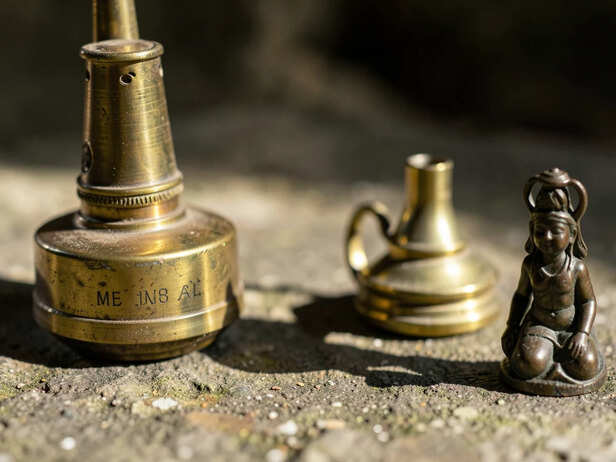
![Brass Lamps and Bronze Figurine]()
Brass Lamps and Bronze Figurine
Image credit : MyLifeXP Bureau
Chithirai Street runs as a rectangle around the temple walls, close enough that you can still hear the nadaswaram players inside when the wind is right. This is where the trade that directly serves the temple concentrates: brass lamps, bronze idols cast in workshops a few streets further out and sold here, silk for offering, incense in bulk. The shops are small and the stock is serious, this is not the souvenir ring, it is the devotional supply ring. The distinction matters when you are deciding what to look at and what to walk past. Slow down at the brass shops. The craftwork on a small lamp is the same craftwork that goes into a large one, and the small ones are made here in the same tradition that has supplied the temple for centuries. Ask where a piece was cast and you will usually get a straight answer and a neighbourhood name.
The Second Ring: Masi Street and the Wider Commerce
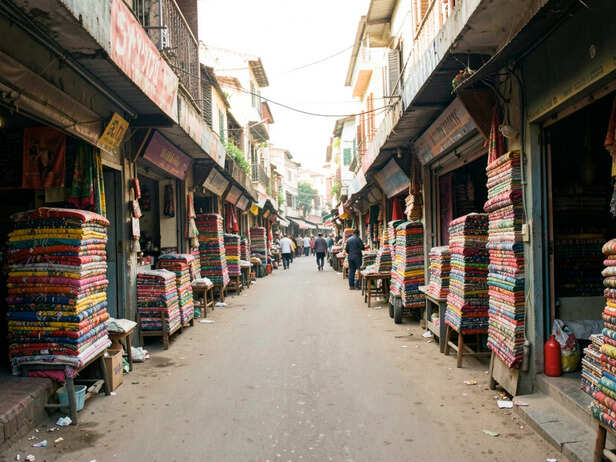
![Vibrant South Indian Bazaar]()
Vibrant South Indian Bazaar
Image credit : MyLifeXP Bureau
Masi Street is wider and louder. The trade here has moved one step away from the sacred and one step toward the everyday: textiles, ready-made garments, gold and silver jewellery in the smaller shops, a few older provision stores that have not yet become something else. The rhythm of the street changes noticeably. On Chithirai Street, people move with purpose toward the temple or away from it. On Masi Street, people move laterally, they are shopping, comparing, stopping to talk. The crowd is denser at the corners where the four sides of the rectangle meet, and those corners are worth pausing at because you can see the geometry of the plan from them: two straight streets meeting at a right angle, both of them curving gently away from you in each direction, both of them carrying the same density of life. This is where the city's original urban logic is most visible.
The Third Ring: Avani Moola Street and the Craftsmen's Quarter
By the time you reach Avani Moola Street, the temple's gopurams are still visible above the roofline but the street's business is its own. This ring traditionally housed the craftsmen whose work fed inward toward the temple, weavers, metalworkers, carpenters who made the wooden frames for festival processions. Some of that is still true. Look for the workshops rather than the shops: the door left open in the middle of the day, the sound of a hammer on metal, the smell of wood shavings. The workshops are not marked and they are not performing for visitors. Walk slowly and look through open doorways. A weaver at a loom in a ground-floor room is not an exhibit; he is working, and the fabric he is making may end up as an offering inside the temple you started from an hour ago.
Walking the Outer Streets: Where the City Becomes Itself
Beyond Avani Moola Street, the concentric logic begins to dissolve into the ordinary city, the vegetable market, the bus stand, the neighbourhoods that grew without a plan. This is not a failure of the walk; it is its conclusion. The value of walking outward from the centre is that you feel the city's density change under your feet. At the gopuram, everything is concentrated, purposeful, loud with devotion. At the outer streets, it is diffuse, domestic, indifferent to the temple in the way that any neighbourhood is indifferent to the landmark it has lived next to for too long. The walk is finished when the city stops feeling organised. That is the edge of the original plan, and it is worth knowing where it is. Turn around at that point and look back toward the gopurams. From the outer streets, on a clear morning, all four of them are visible above the skyline at once, and the city between you and them is the diagram made physical.
The concentric plan of Madurai is not a curiosity for urban historians. It is the reason the city still works as a walking city, the temple at the centre gives every street a direction, and every direction gives a walker a reason to keep moving or to stop. The rings are not equal in what they offer, but they are equal in what they ask: attention paid at walking pace, one street at a time, outward from the point where the city began.
Unlock insightful tips and inspiration on personal growth, productivity, and well-being. Stay motivated and updated with the latest at
My Life XP.