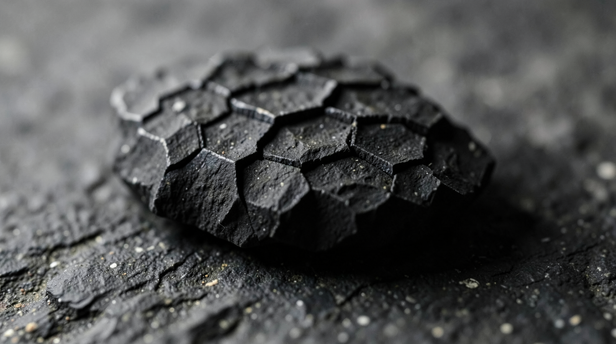
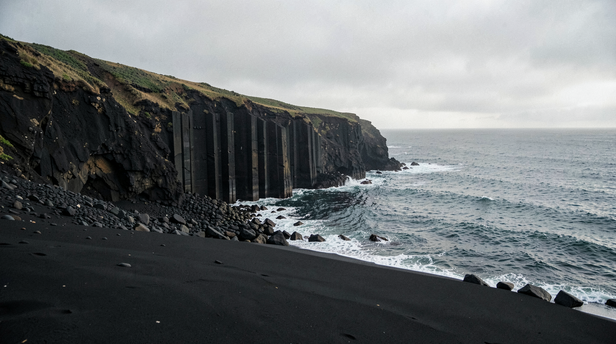
The first thing most people notice at Reynisfjara is the colour, black sand, black cliffs, grey Atlantic. The second thing is the columns. They rise in tight bundles from the cliff face at Reynisdrangar, some tilted, some perfectly upright, each one a near-regular hexagon in cross-section. The instinct is to look for a human hand in it. There isn't one. What made those columns is the same physics that cracks a drying lake bed, only playing out inside cooling rock over thousands of years.
It Starts With a Lava Flow, Not a Volcano
![Basalt Column Hexagons]()
Basalt Column Hexagons
Image credit : MyLifeXP Bureau
The columns at Reynisfjara are basalt, which is the rock that forms when low-viscosity, iron-rich lava cools. Iceland sits on the Mid-Atlantic Ridge, where two tectonic plates pull apart and magma rises continuously to fill the gap. The lava that eventually became Reynisfjara's cliffs did not erupt explosively, it flowed, spread out, and pooled. That pooling is what matters. A thick, flat sheet of lava cools differently from a thin fast-moving flow. It cools slowly, from the outside in, and that slowness is where the geometry comes from.
Why Cooling Lava Contracts Into Columns at All
As basalt cools, it shrinks. Any material that shrinks under cooling will crack if it cannot pull inward uniformly, and a sheet of lava sitting on flat ground cannot pull inward uniformly, it is too wide. So it fractures. The cracks propagate downward from the cooling surface and upward from the ground, meeting somewhere in the middle. What determines the shape of those cracks is the same principle that governs how any contracting surface relieves stress with the least total crack length: a hexagonal grid. A hexagon divides a flat surface into equal areas using less total boundary than squares or triangles do. The lava does not know this. It simply follows the path of least resistance, and that path, when stress is distributed evenly across a cooling sheet, tends toward six sides.
Not Every Column Comes Out Perfectly Hexagonal
![Volcanic Sea Cliffs Emerge]()
Volcanic Sea Cliffs Emerge
Image credit : AI
The columns at Reynisfjara are striking precisely because the conditions there were close to ideal: the lava was compositionally consistent, the cooling was gradual, and the sheet was thick enough to sustain the fracture pattern all the way through. In practice, most basalt columns have between four and seven sides. A true hexagon requires the stress to be distributed evenly in all directions as the rock contracts. Where the lava was thicker on one side, or where it contacted water or uneven ground, the columns skew. The columns at Reynisfjara are not all perfect hexagons either, look at the base of the cliff and the irregular ones are easy to find. The regularity is a tendency, not a rule.
The Role of the Sea in What You See Now
The columns did not emerge from the ground already exposed. They were buried inside the cliff. What revealed them is erosion, specifically, the North Atlantic. The waves at Reynisfjara arrive with almost no land between Iceland and Greenland to slow them down. They strike the cliff face with enough force to exploit the vertical joints between columns, pulling individual columns free and leaving the clean cross-sections visible. The black sand on the beach is largely what those columns become after the sea has ground them down: basalt fragments small enough to be sorted by wave action into the flat, dark expanse the beach is known for. The columns and the sand are the same material at different stages of the same process.
Why This Formation Appears in So Many Places
Reynisfjara is famous partly because the columns are accessible and dramatic, but the same formation exists wherever thick basalt flows cooled slowly: the Giant's Causeway in Northern Ireland, Fingal's Cave on the Scottish island of Staffa, the Columbia River Gorge in the northwestern United States, parts of the Deccan Traps in India. Each of these formed through the same mechanism, pooled lava, slow cooling, contraction, hexagonal fracture, with local variation in column size and regularity depending on how quickly the lava cooled and how compositionally uniform it was. The Giant's Causeway columns are shorter and more regular; Reynisfjara's are taller and more varied. The difference is largely in the thickness of the original lava sheet and the rate at which it lost heat.
The columns at Reynisfjara are not a curiosity or an exception. They are what basalt does when given enough time and a flat surface to cool on. The geometry is not imposed from outside, it emerges from the physics of contraction, the same way a cracked mud flat forms polygons in a dry summer. The ocean then does the work of display, cutting the cliff back year by year and leaving the cross-sections facing the water. What looks like architecture is thermodynamics, and what looks permanent is still in motion.
Unlock insightful tips and inspiration on personal growth, productivity, and well-being. Stay motivated and updated with the latest at
My Life XP.