Stand at the edge of Mehrangarh Fort and look down at the old city below. The rooftops and walls pool into a single wash of blue, not one shade but dozens, from pale sky to deep cobalt, fading and brightening with the angle of the sun. It reads as a single decision made by one hand. It was not.
The Brahmin Quarter Came First
![Jaipur Amber Fort]()
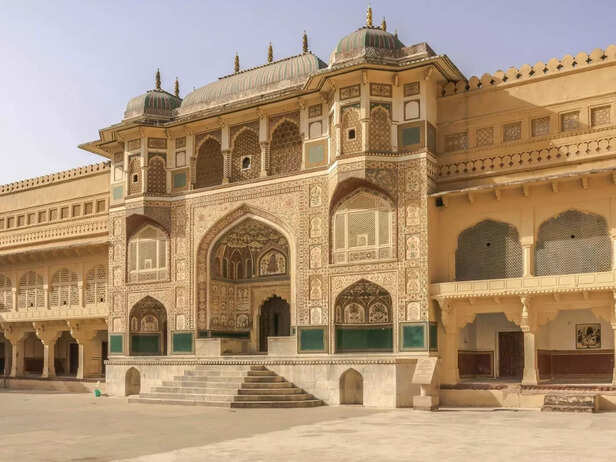
Jaipur Amber Fort
Image credit : Pexels
The oldest explanation, and the one most consistently recorded in local accounts, is that the blue began with the Brahmin community of the old city. Brahmin households painted their walls and doorways blue to mark their homes as distinct from those of other castes, a visual signal of status and identity in a dense neighbourhood where houses shared walls and lanes were narrow enough to touch both sides. The pigment used was indigo mixed with copper sulphate, a combination that happened to be both vivid and practical. In the lanes around the clock tower and the older mohallas close to the fort's base, the concentration of blue is still noticeably heavier than in the neighbourhoods further out.
The Colour Had a Second Job
![The copper sulphate in the original mixture]()
The copper sulphate in the original mixture
Image credit : Freepik
The copper sulphate in the original mixture was not decorative. It repels termites, and in a city where wooden beams, furniture, and structural supports were constant targets, a wash that kept insects away had obvious value. The city sits at the edge of the Thar Desert, where temperatures are extreme and the building stock is old. A lime-and-copper wash also reflects heat and keeps interior walls cooler, not dramatically, but measurably, in the way that matters over a long summer. The colour stayed partly because it looked striking, and partly because it worked. Those two reasons rarely separate cleanly in the history of any building tradition.
How the Rest of the City Followed
The spread of blue beyond Brahmin households happened gradually and without any single moment of decision. Neighbours painted their walls the same colour because the pigment was available, because the mixture was known to be useful, and because the visual coherence of the neighbourhood had become something people wanted to be part of. By the time Jodhpur became a draw for travellers and photographers, the blue had long since crossed caste lines and spread into lanes where no Brahmin household had ever stood. The city had absorbed the colour into its identity in the way cities absorb anything that works: slowly, then completely, then as if it had always been that way.
What the Fort Has to Do With It
Mehrangarh Fort, built on a sandstone ridge above the city, is made from the same warm ochre stone as most of Rajasthan's great forts. The contrast between that stone and the blue city below it is not accidental in the sense of being unnoticed, but it was not planned as a composition either. The fort came first, the city grew around and below it, and the blue developed in the city's lanes independent of anything happening on the ridge. The view from the fort's ramparts, where the blue reads as a single field against the desert edge, is a result of time rather than design. That distinction matters because it is the more interesting story: a colour that emerged from practical and social logic, not from an aesthetic one, and ended up producing one of the most photographed urban landscapes in the country.
The Blue Today
The copper sulphate mixture is still used in parts of the old city, though many households now use regular paint in a blue that approximates the original. The result is a patchwork of shades that, from a distance, reads as uniform and, close up, shows every repair and repainting in the texture of the walls. The lanes near Sardar Market, the step-well at Toorji Ka Jhalra, and the mohallas climbing toward the fort's base are where the oldest layers of paint survive longest, not because they are preserved, but because those walls are painted less often. The blue that looks most vivid in photographs is often the most recently applied. The blue that carries the most history is the faded kind, the colour that has had decades to become part of the stone beneath it.
The city was not designed to be blue. It became blue through a combination of caste marking, insect control, heat management, and the ordinary human tendency to continue what the neighbours have done. That accumulation, practical, social, and finally aesthetic, is what most cities are actually made of, even when they look, from a distance, like a single deliberate stroke.
Unlock insightful tips and inspiration on personal growth, productivity, and well-being. Stay motivated and updated with the latest at My Life XP.