Hair loss that appears in one specific line, one specific temple, or one specific patch along the crown is rarely about what you eat or how stressed you are. It is about where the tension lands, and how often it lands there. The follicle is a living structure embedded in the scalp, and it responds to repeated pulling the same way any tissue responds to repeated strain, by changing.
What the Follicle Is Actually Doing When You Pull
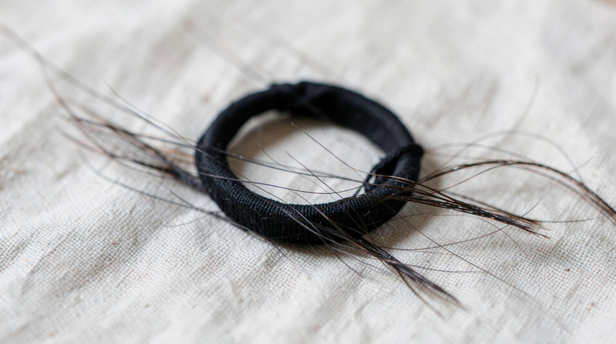
![Hair Tie Macro Detail]()
Hair Tie Macro Detail
Image credit : MyLifeXP Bureau
Skin on the scalp sits over a layer of connective tissue, and each hair follicle anchors into that tissue at a specific angle. When you pull hair back or up, the follicle is tugged toward the direction of the pull. A single pull does nothing. The follicle is elastic enough to return. But when the same pull happens at the same angle, at roughly the same tension, every morning for months, the tissue around the follicle begins to respond to that as a chronic load rather than an occasional one.
The hair growth cycle has three phases. The active growth phase, the transitional phase, and the resting phase that ends in shedding. Chronic tension at a follicle can push it out of the active phase earlier than it would naturally exit. The hair that grows back from a stressed follicle is often finer than the one that shed. Do this long enough, and the follicle miniaturises, producing progressively thinner, shorter hairs until it stops producing a visible one at all. Dermatologists call the condition traction alopecia, and its defining feature is that it follows the exact geometry of the hairstyle causing it.
Why the Same Spot and Not the Whole Hairline
The scalp is not uniformly sensitive to tension. Follicles at the temples and along the frontal hairline sit in thinner skin with less subcutaneous cushioning than the follicles at the back of the head. When you pull hair into a ponytail or bun, the tension is not distributed evenly, it concentrates at the points where the elastic or pin anchors, and at the edges of the hairline where the gathered hair meets scalp that is not moving with it.
A centre parting held in the same place every day creates a different pattern: the follicles along that parting line are exposed to sun, and the scalp along the part can widen over years as the hair on either side is trained to lie flat away from it. A side part fixed in place does the same thing on one side only. A tight braid that always starts at the same temple concentrates tension at that temple. The geometry of the thinning is a map of the hairstyle.
The Elastic and the Clip Are Not the Same Problem
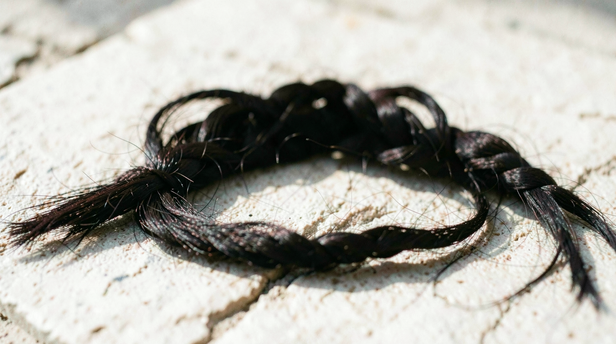
![Dark Hair Laid Flat]()
Dark Hair Laid Flat
Image credit : MyLifeXP Bureau
A hair elastic pulled tight enough to hold a ponytail in place creates a circumferential groove in the hair shaft. Over time, this groove is where breakage happens, which is why the hair around a ponytail holder looks shorter and frayed rather than simply absent. This is not follicle damage; it is shaft damage. The hair is breaking above the scalp, not failing to grow from it. Switching to a softer, seamless elastic reduces shaft breakage but does nothing for the follicle tension below.
A clip or claw that grips at the same point daily is a different problem. The pressure from a clip is localised, it presses the hair flat against the scalp at one spot and holds it there. The follicles under that point experience both compression and tension simultaneously. This is why claw-clip thinning often shows up not at the hairline but mid-shaft on the crown, where the clip sits.
A tight braid or plait is the most mechanically complex of the common styles. The tension runs along the length of the braid, but it is highest at the roots where the braid begins, and it changes angle every time the braid crosses. Box braids and cornrows held for extended periods are among the most well-documented causes of traction alopecia in clinical literature, particularly along the frontal hairline.
When the Thinning Is Still Reversible
The follicle does not give up immediately. In the early stages of traction alopecia, the thinning is reversible if the tension is removed. The follicle is miniaturised but not destroyed. Hair that grows back after the style changes is often finer for a cycle or two, then returns to its original diameter as the follicle recovers.
The sign that the window is still open: the thinning area has some short, fine regrowth visible when you look closely. Fine hairs at the hairline or along the parting mean the follicle is still producing, even if what it produces is not yet the hair you remember. The sign that the window may be closing: the thinning area is smooth, the skin looks slightly shiny, and there is no fine regrowth at all. Smooth, follicle-free scalp at a traction site is worth a dermatologist's appointment rather than a home remedy.
What Actually Reduces the Load
The most effective change is also the least complicated: rotate. A ponytail worn at the nape one day and higher the next distributes the tension load across different follicles rather than concentrating it on the same ones. A parting moved even a centimetre from its usual position gives the follicles along the original line a rest. The principle is the same one that governs any repetitive-load injury, the tissue recovers during the intervals.
Loose styles worn for a full day rest the hairline in a way that a tight style worn for even a few hours does not. Sleeping with hair loose rather than in a braid or a tight bun removes several hours of nightly tension that most people do not count. A silk or satin pillowcase reduces friction during movement in sleep, which matters most for the shorter, more fragile hairs at the hairline.
The tension level of a style matters more than the style itself. A ponytail worn loose enough that you can slide a finger under the elastic at the nape is a different mechanical event than a ponytail pulled tight enough to feel the scalp move. The tight one is not more secure, it is just more damaging.
Traction alopecia is one of the few causes of hair loss where the mechanism is entirely external and the intervention is entirely within reach. The follicle does not know what hairstyle is fashionable or convenient. It knows only how much it is being pulled, in what direction, and how often it gets a break from that pull. Give it a different answer to those questions and, in most cases, it responds.
Unlock insightful tips and inspiration on personal growth, productivity, and well-being. Stay motivated and updated with the latest at
My Life XP.