There is a tree at Bodh Gaya, a Sacred Fig, Ficus religiosa, growing near the Mahabodhi Temple, and the tradition of Theravada Buddhism holds that it descends in a direct, unbroken line from the tree under which Siddhartha Gautama attained enlightenment roughly 2,500 years ago. Not a tree of the same species, not a tree planted in the same soil, but a tree grown from a cutting of the original, whose own lineage was preserved through a branch carried to Sri Lanka in the third century BCE and returned to India centuries later. The claim sounds almost impossible to verify, and in one sense it is. In another sense, the record behind it is more careful than most people expect.
What the Tradition Actually Claims
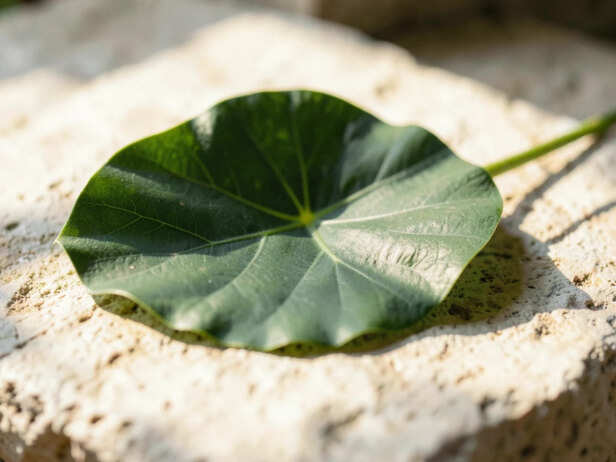
![Sacred Bodhi Leaf Still Life]()
Sacred Bodhi Leaf Still Life
Image credit : MyLifeXP Bureau
In Buddhist understanding, the Bodhi tree is not simply a landmark. It is the Vajrasana, the diamond throne, the spot where the earth itself witnessed the moment of awakening. The tree that stood there was venerated from the earliest centuries of the tradition. What the tradition claims is not that the original tree has never died, it has, more than once, but that before each loss, a part of it was preserved and replanted, and that the line of descent from those cuttings and saplings has been maintained with the kind of care a relic deserves.
The Branch That Went to Sri Lanka
The most documented moment in this lineage is the journey of a branch to Sri Lanka during the reign of Emperor Ashoka, in the third century BCE. Ashoka's daughter, Sanghamitta, is said in Pali texts, including the Mahavamsa, the Sri Lankan chronicle, to have carried a branch of the original Bodhi tree to the island, where it was received by King Devanampiya Tissa and planted at Anuradhapura. That tree, known as the Jaya Sri Maha Bodhi, still stands. It is among the oldest living trees with a documented planting history anywhere in the world. The Mahavamsa is a chronicle with an agenda, it is a record of Theravada Buddhism's establishment in Sri Lanka, but its account of the branch's arrival is specific about the ceremony, the king's reception, and the site of planting in a way that historians treat as a genuine record of an event, even if the miraculous details around it are understood as devotional framing.
What Happened to the Tree at Bodh Gaya
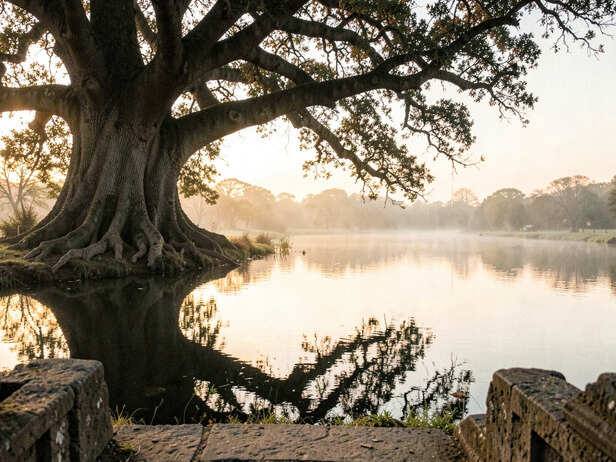
![I witness the ancient Bodhi tree lineage beside]()
I witness the ancient Bodhi tree lineage beside
The original tree at Bodh Gaya did not survive intact. The Pali and Sanskrit sources, along with later accounts by Chinese pilgrims, record at least two episodes in which the tree at Bodh Gaya was damaged or destroyed, once associated with the Shaivite king Shashanka in the seventh century CE, whose hostility to Buddhist sites is documented in the account of the Chinese pilgrim Xuanzang. Each time, the tradition holds that a sapling or cutting from the Sri Lankan tree at Anuradhapura was brought back and planted at Bodh Gaya, restoring the lineage. The tree standing today is understood in this way: not the original, but a descendant of the branch that Sanghamitta carried, returned to the place its ancestor came from. The lineage moved out of India to survive India, and came back.
Why the Lineage Matters More Than the Wood
The insistence on lineage rather than original wood is not a workaround or a consolation. It reflects something central to how Buddhist thought understands continuity. The flame that lights another flame is not the same flame, but the light is unbroken. The tree at Bodh Gaya today carries the same logic: the identity of the Bodhi tree is held to reside in its uninterrupted descent from the place of awakening, not in the survival of the original cells. This is why the tree is treated as the tree, not as a tree. The distinction matters to the tradition and it is worth understanding on its own terms rather than as a claim to be tested against botany.
The Living Tree at Anuradhapura
The Jaya Sri Maha Bodhi at Anuradhapura is the anchor of this whole account. It is a real tree, it is old, it has been continuously tended by monks for over two thousand years, and it has survived invasions, storms, and a terrorist attack in 1985. Its documented history is longer and more continuous than the Bodh Gaya tree's, precisely because Sri Lanka did not experience the same waves of destruction that repeatedly disrupted the Mahabodhi site. In a sense, the Sri Lankan tree is the more stable half of the lineage, the one that held the line while the Indian site went through its losses. Pilgrims who visit both sites are walking the same lineage in two directions.
What the Archaeological Record Adds
The Mahabodhi Temple complex at Bodh Gaya has been excavated and studied, and the site's antiquity as a place of Buddhist veneration is not in question. The Ashoka-era railing fragments found at the site, some of the earliest stone railings in Indian art, confirm that the location was already a major pilgrimage destination within a century or two of the Buddha's lifetime. What archaeology cannot confirm is the biological continuity of any tree across 2,500 years of replanting. What it does confirm is that the site and the tradition of venerating a tree at that specific spot are genuinely ancient, which is a different and meaningful thing.
The story of the Bodhi tree's lineage is, at its core, a story about what a community decides to preserve and how far it will carry that preservation. A branch was taken across the sea. Saplings were brought back across the sea. The record of those journeys was written down and maintained. The tree standing at Bodh Gaya today is the living result of that effort, not unchanged, not the original wood, but the same line, tended across more centuries than most institutions of any kind have managed to survive. That is what the tradition means when it says the tree is traced back to a single lineage, and it is a more careful claim than it first appears.
Unlock insightful tips and inspiration on personal growth, productivity, and well-being. Stay motivated and updated with the latest at
My Life XP.