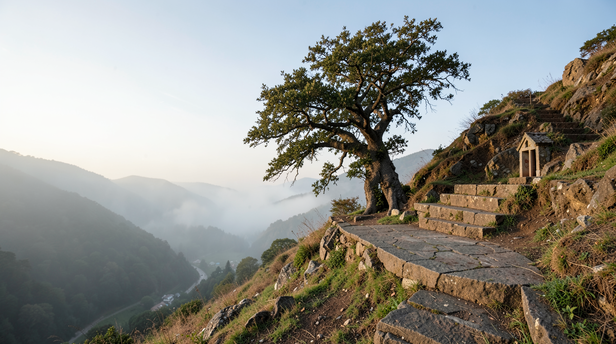
The first few hundred steps feel like exercise. Somewhere past the midpoint, they feel like something else. That shift, from effort to surrender, is not accidental. The architects of India's hill shrines understood it, and they built the climb to produce it.
The path up a sacred hill is called a
sopana marga in some traditions, though the name changes by region and faith. What does not change is the intention behind it: the climb is a form of preparation, not merely a route. By the time a pilgrim reaches the sanctum, the body has been humbled enough that the mind follows.
Why the Shrine Was Placed at the Top
![Sage’s Stern Lesson in the Forest Ashram]()
Sage’s Stern Lesson in the Forest Ashram
Image credit : chatgpt(ai)
In Vedic and Agamic thought, height carries sanctity. The divine is associated with what is above the ordinary plane of life, not because the sky is heaven in a literal sense, but because the act of ascending separates the pilgrim from the daily world below. Every step upward is understood as a step away from ordinary preoccupation and toward a state of readiness for darshan.
Many hill shrines are also associated with the idea that the deity chose the location. Popular tradition holds that the god or goddess appeared on the summit, or that a sage received a vision there, and the temple was built to mark the spot. The steps came afterward, a human accommodation to a divine insistence on height. The pilgrim is not climbing to reach a building. The pilgrim is climbing to reach the place where something already happened.
What the Steps Were Designed to Do to the Body
A staircase of two thousand steps, cut into a hillside at varying heights and widths, is not a comfortable ascent. The irregularity is partly geology and partly design. When each step demands attention, when the foot cannot fall on autopilot, the mind stays with the body. The breath shortens. The pace slows. Conversation drops away. What remains is the sound of feet on stone and the breath that carries the pilgrim upward.
This is the mechanism the tradition is working with. The body's discomfort is not an obstacle to the spiritual experience. It is the spiritual experience's opening condition. In popular devotional thought across several Indian traditions, the effort of the body is understood as a form of offering, what is given before the deity is even seen.
Some shrines formalise this. At certain temples, pilgrims climb barefoot, even when the stone is rough or hot. At others, the tradition calls for climbing on the knees for a portion of the path, or for pausing at each landing to offer a prayer before continuing. These practices are not punishments. They are ways of making the body conscious of what it is doing and why.
The Resting Platforms and What They Are For
![Ancient Hillside Sanctuary]()
Ancient Hillside Sanctuary
Image credit : MyLifeXP Bureau
Most hill shrines with long stairways also have
vishranti sthalas, resting platforms, built at intervals into the climb. These are not concessions to weakness. They are part of the design.
In popular tradition, the rest is also a moment of reflection. The pilgrim looks back at how far the valley is, and forward at how far the summit remains. This double view is understood as a moment of reckoning, a chance to assess not just the physical climb but the intention behind it. Why did this person come? What are they carrying up? What are they willing to leave behind?
The resting platforms often have small shrines of their own, a niche with a lamp, a stone marked with a deity's symbol, a tree that the tradition considers sacred. These are not distractions from the main climb. They are stations in a longer conversation that the full ascent is having with the pilgrim.
How Different Traditions Understand the Same Climb
Hill shrines are not exclusively Hindu, though the majority of India's most famous ones belong to that tradition. Jain tirthas on hills, Shatrunjaya, Girnar, Sonagiri, share the same logic of ascent as preparation. The climb to a Jain tirtha is understood as a movement away from worldly attachment, step by step, and the summit is the place where the tirthankaras attained or demonstrated liberation. The height is not incidental to that story.
In popular Sikh tradition, certain sites associated with the Gurus are also elevated, and the walk to them carries a similar quality of intentional effort. The idea that the body's labour is a form of devotion appears across traditions that otherwise differ sharply in theology.
What the traditions share is the understanding that ease does not prepare a person for encounter with the sacred. The climb does something to the pilgrim that a flat walk to a ground-level temple does not. Whether that something is understood as purification, surrender, or simply the quieting of the ordinary mind, the effect is recognised across faiths and centuries.
The Descent and Why It Is Treated Differently
Popular tradition at many hill shrines holds that the descent is not the same journey in reverse. The pilgrim who has received darshan carries something back down. The steps that were a preparation on the way up are a kind of integration on the way down, time for what happened at the summit to settle before the ordinary world returns.
This is why many traditions discourage rushing the descent, and why some pilgrims pause again at the resting platforms on the way down. The shrine is behind them, but the pilgrimage is not quite finished. The valley, with its noise and its demands, will come soon enough. The steps are the last place where the pilgrim is still, in some sense, in the presence of what drew them up.
The thousands of steps a hill shrine asks of its visitors are not a test of fitness. They are a technology, ancient, deliberate, and still working, for moving a person from one state of being to another. The summit is where the deity waits. The steps are where the pilgrim becomes someone capable of arriving.
Unlock insightful tips and inspiration on personal growth, productivity, and well-being. Stay motivated and updated with the latest at
My Life XP.