There is a moment each evening in every Gurdwara when the hall, however full it has been, quiets to a particular kind of attention. The Guru Granth Sahib, the eternal, living Guru of the Sikhs, is about to be taken from the Takht, the throne on which it rests during the day, and carried to its resting place for the night. What happens in those minutes is not ceremony for ceremony's sake. Each movement carries a meaning the tradition has kept precise across generations.
The Guru Granth Sahib Is Treated as a Living Presence
![Sacred Rest, Golden Glow]()
Sacred Rest, Golden Glow
Image credit : MyLifeXP Bureau
In Sikh theology, the Guru Granth Sahib is not a text that contains the words of the Gurus. It is the Guru itself, the living, sovereign presence of divine wisdom in physical form. This understanding shapes everything about how the scripture is handled. It is never placed on the floor. It is never left unattended while open. A chaur sahib, a whisk traditionally made of fine hair or synthetic fibre, is waved over it continuously while it is open, as it would be over a sovereign. The logic follows through to the end of the day: a living Guru must be given rest, not simply stored.
The Evening Ceremony: Sukhasan
The ritual of putting the Guru Granth Sahib to rest is called Sukhasan, from the Sanskrit root meaning a posture of ease or comfort. It begins after the final prayer of the evening, the Kirtan Sohila, which is recited or sung in the presence of the congregation. Kirtan Sohila is itself a composition of five shabads from the Guru Granth Sahib, three by Guru Nanak, one by Guru Ram Das, one by Guru Arjan, and its words speak of the soul preparing to rest in the presence of the divine. The choice of this hymn for the closing of the day is not incidental: the prayer and the ritual reinforce each other.
How the Scripture Is Wrapped and Lifted
![Serene Dawn Rest]()
Serene Dawn Rest
Image credit : AI
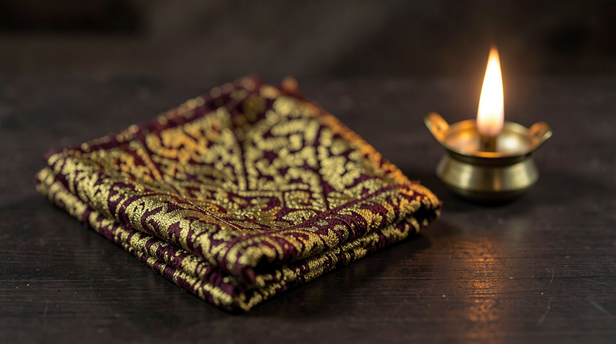
Once Kirtan Sohila is complete and the Ardas, the formal Sikh prayer, has been offered, the Guru Granth Sahib is carefully closed. The rumalas, the cloths that cover and adorn it, are arranged with attention. Rumalas are among the most significant offerings a Sikh family can make to a Gurdwara; they are often gifted on occasions of gratitude or remembrance, and the finest are kept for the scripture's covering. The closed scripture is then lifted by the Granthi, the reader who tends to the Guru Granth Sahib, or by a designated sevadaar, a person in service. It is placed on the head, not carried in the arms. This is the posture of honour: the scripture rests above the carrier, not at the level of the chest or hands. A small canopy, the palki or a cloth held overhead, may accompany the procession in larger Gurdwaras.
The Procession Through the Gurdwara
The congregation, if present, rises. In many Gurdwaras the path is cleared and the sangat stands to either side. The Guru Granth Sahib is carried from the Darbar Sahib, the main hall, to the Sachkhand, the room set aside for the scripture's rest. This room is prepared in advance: a bed, called a manji or palang, is made up with clean coverings. In the largest historic Gurdwaras, this room is a substantial space; in a neighbourhood Gurdwara, it may be modest, but the principle holds. The scripture will sleep in a room of its own. In some traditions, a small lamp is kept burning through the night. In others, a sevadaar keeps a quiet vigil for part of the night hours.
The Morning Ritual: Parkash
What Sukhasan closes, Parkash opens. Each morning, before the congregation gathers, the Guru Granth Sahib is carried back in procession from the Sachkhand to the Darbar Sahib and placed on the Takht. The rumalas are arranged, the chaur sahib resumes its movement, and the first prayer of the day, Asa di Var, a sequence of hymns composed by Guru Nanak, begins. The day's cycle of recitation, called the Akhand Path when the entire scripture is read continuously, or the Sadharan Path when it is read in portions over days, flows from this morning opening. The scripture has rested; the congregation gathers again.
Sukhasan and Parkash together make a single continuous gesture: the recognition that the Guru Granth Sahib is not an object to be managed but a presence to be honoured in the rhythms of a day. The evening procession is not the end of something. It is the hinge between one day of the Guru's presence and the next, kept in exactly the form the tradition has always asked for it.
Are relationship issues affecting your peace of mind? Your name energy may be playing a role. Check your name energy here!Unlock insightful tips and inspiration on personal growth, productivity, and well-being. Stay motivated and updated with the latest at
My Life XP.