The idols of Jagannath are not carved the way a sculptor carves. There is no artist's vision imposed on the wood. The tradition holds that the tree chooses itself, that the craftsmen are guided rather than creative, and that the divine presence moves from one body to the next without interruption. What looks from the outside like a craft process is understood from the inside as a transfer of life.
The Wood That Is Permitted
![Jagannath Ji Can Teach]()
Jagannath Ji Can Teach
Image credit : CHATGPT(AI)
Only neem, Azadirachta indica, is used, and not any neem tree. The Daitapati priests, hereditary servitors of the temple, search for a tree that meets a precise set of conditions described in the Agama texts the temple follows. The tree must have no bird's nest, no anthill at its base, no broken limb, no visible wound in the bark. It must stand near water, ideally near a pond or a river. It must have four branches that suggest the four arms of a deity. And it must show one further sign that varies by which idol it will become, Jagannath's tree is said to carry the mark of a chakra, a conch, or a serpent in the grain or the bark. When a tree is found that satisfies the conditions, it is not immediately felled. The priests perform a puja at its base for several days first, formally requesting permission from the tree to take its body for the purpose.
The Craftsmen and What They Are Permitted to Know
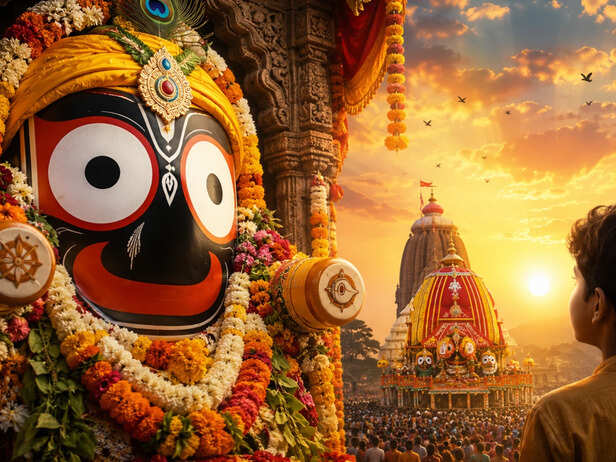
The carvers are called Biswakarma Maharanas, a hereditary community whose right to shape the idols is as old as the temple's recorded history. During Nabakalebara, they work inside a screen of cloth erected around the felled trunks. No one outside the screen may enter. The Maharanas themselves observe restrictions throughout the carving period, they do not eat meat, they do not leave the temple compound at night, and they work in near silence. The tools used are traditional adzes and chisels that are themselves ritually prepared. The forms that emerge are not naturalistic. Jagannath's face is circular, his eyes are wide and unblinking, his arms are stumps without hands. The tradition explains this shape through the story of Vishvakarma, the divine craftsman, who began carving the original idol on the condition that he not be disturbed. The king who commissioned the work could not wait and opened the workshop early. Vishvakarma left the idol unfinished. What remains, the round face, the large eyes, the absent hands, is therefore not an artistic decision but a frozen moment, and every subsequent idol repeats it faithfully.
What Is Transferred: The Brahma Padartha
The most closely guarded part of Nabakalebara is not the carving. It is the moment when the senior Daitapati priest, blindfolded and with his hands wrapped in cloth so that he cannot feel what he touches, reaches into the cavity of the old idol and removes something called the Brahma Padartha, the divine substance. What this substance is, the tradition does not say publicly. Servitors who have witnessed the transfer describe it as something that moves, something that feels alive. It is placed into the corresponding cavity of the new idol, which is then sealed. The old idols are not destroyed. They are buried in the temple compound in a garden called Koili Baikuntha, laid to rest with the rituals used for a human death, because the tradition holds that what is buried there is not wood that once held the divine but a body from which the divine has departed, which is a different thing entirely.
How Often This Happens, and Why It Is Not Predictable
Nabakalebara does not occur on a fixed cycle. It happens in a year when the lunar calendar produces two Ashadha months, an Adhika Masa or leap month in Ashadha. This astronomical condition recurs roughly every twelve to nineteen years, though the interval is irregular. The last Nabakalebara before this writing took place in 2015. The one before that was 1996. The tradition's explanation for tying the renewal to this particular calendrical event is not given in the texts that are publicly available; the servitor communities hold that explanation internally. What is recorded is that the rule has been followed without interruption through documented temple history, which extends back at least to the twelfth century in written form and further in oral tradition.
The Idols Outside Puri
The Nabakalebara rite belongs to the Puri Jagannath temple specifically. Temples dedicated to Jagannath exist across Odisha, in Bengal, in parts of Jharkhand and Assam, and in diaspora communities well beyond India, and many of them have their own carving traditions for their own idols. But the rules of Nabakalebara, the neem selection criteria, the Brahma Padartha transfer, the burial in Koili Baikuntha, are not replicated elsewhere. Other temples may renew their idols when damage requires it or when a community decides to, using local craftsmen and local protocols. The Puri tradition is not a template. It is specific to that temple, those servitor families, and that unbroken lineage of practice.
The idols at Puri are unusual in another way that visitors notice immediately: they are repainted regularly, their colours refreshed by the painters' hereditary community, so that the surface the devotee sees is always new while the form beneath is ancient. The carving is permanent. The colour is renewed. The Brahma Padartha is continuous. Three different kinds of renewal, happening on three different timescales, layered into one object, which is perhaps why the tradition insists the idol is not a representation of the divine but a residence of it.
Unlock insightful tips and inspiration on personal growth, productivity, and well-being. Stay motivated and updated with the latest at
My Life XP.